
Open Source Alternatives LogoOpen Source Alternatives
AlternativesBlogAdvertise
Open Source Alternatives LogoOpen Source Alternatives

Stay Updated

Subscribe to our newsletter for the latest news and updates about Alternatives

Open Source Alternatives LogoOpen Source Alternatives

Handpicked Open Source Alternatives to Paid Softwares

Product
  • Search
  • Categories
  • Tag
  • Sign In
Resources
  • Blog
  • Collection
  • Submit
  • Advertise your tool
Company
  • Privacy Policy
  • Terms of Service
  • Refund Policy
  • Sitemap
Copyright © 2026 All Rights Reserved.
Home/Categories/Marketing & Growth/OpenClix
icon of OpenClix

OpenClix

Open source alternative to Braze, CleverTap and MoEngage

Open-source mobile app retention and engagement automation platform.

38 starsTypeScriptMIT
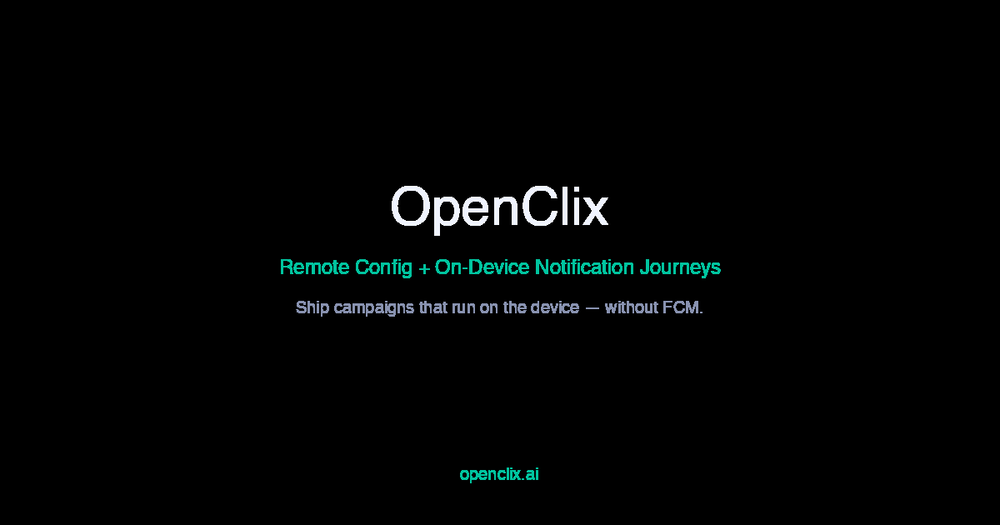
image of OpenClix
Contents
  1. 01What OpenClix does
  2. 02Who OpenClix is for
  3. 03

Repository

Stars
38
Forks
2
License
MIT
Last commit
55 days ago
Last verified
May 21, 2026
Repo
openclix/openclix ↗

Additional details

Active recently
Visit websiteGitHub repo
The problem it solves
  • 04How it solves it
  • 05Strengths and trade-offs
  • 06Tech stack
  • 07FAQ
  • 08Similar open-source tools
  • TL;DR

    OpenClix is an open-source mobile retention and engagement automation tool for product teams that want configurable on-device engagement logic. It helps teams manage user prompts, nudges, and retention flows without rebuilding a proprietary engagement stack.MIT · TypeScript · 38 stars · Active recently

    what it does

    What OpenClix does#

    OpenClix is an open-source, local-first mobile app retention and engagement automation platform designed for developers and product teams. It leverages config-driven on-device logic to facilitate seamless user engagement without the need for complex backend infrastructure.

    Key Features:

    • Agent-Based Operations: Utilize AI agents to manage and modify engagement rules safely and effectively.
    • Local-First Logic: Run engagement campaigns directly on-device, ensuring quick execution and user privacy.
    • Config-Driven: Easily customize engagement strategies using openclix-config.json, allowing for rapid iterations without app redeployment.
    • Integration Ready: Source-first integration with tools like OpenClaw, Claude Code, and Codex for enhanced functionality.

    Use Cases:

    • Indie Developers: Quickly implement onboarding nudges and re-engagement flows.
    • Product Teams: Test retention strategies before investing in full engagement platforms.
    • Agencies: Deploy a consistent engagement framework across multiple client applications.
    • AI-Driven Solutions: Enable AI agents to read and modify engagement rules, enhancing adaptability and responsiveness.
    who it's for

    Who OpenClix is for#

    Mobile retention experiments

    OpenClix fits teams testing prompts, nudges, and engagement rules inside mobile apps.

    Skip if

    You need a mature hosted marketing automation suite with nontechnical campaign builders.

    Privacy-aware app engagement

    Teams can keep more logic in their own app and codebase instead of sending every behavior decision through a vendor.

    Skip if

    Your organization wants fully outsourced campaign operations.

    the problem

    The problem it solves#

    how OpenClix solves it

    How it solves it#

    Config-driven engagement rules

    OpenClix uses configuration to define mobile engagement behavior, helping teams update retention logic without scattering it through app code.

    On-device logic orientation

    Running engagement decisions closer to the app can reduce reliance on a heavyweight remote campaign engine.

    Open-source retention tooling

    Teams can inspect and adapt the engagement layer instead of treating it as a black-box SDK.

    strengths · trade-offs

    Strengths and trade-offs#

    Strengths

    • Developer-friendly retention controlOpenClix is strongest for mobile teams that want retention features managed with code and configuration.
    • Lower vendor lock-inOpen-source engagement logic gives teams more control than a closed campaign automation SDK.

    Trade-offs

    • -Requires product-engineering ownershipTeams need to design safe engagement rules, test app behavior, and avoid creating annoying user experiences.
    tech stack · detected from GitHub

    What it's built on#

    Languages
    DartKotlinSwiftTypeScript
    Frameworks
    Next.jsReact
    frequently asked

    FAQ#

    What is OpenClix?

    OpenClix is an open-source tool for mobile app retention and engagement automation.

    How does OpenClix manage engagement logic?

    OpenClix centers engagement behavior around configuration-driven rules and app-controlled logic.

    Who should use OpenClix?
    also worth a look

    Similar open-source tools#

    Open Wearables

    Open Wearables

    Open source health API for wearable device developers

    1.7KPythonMIT
    Remodex

    Remodex

    Control Codex agents from your iPhone, open source and free

    3KSwiftApache-2.0
    Donut Browser

    Donut Browser

    Anti-detect browser with isolated profiles and zero telemetry

    2.5KRustAGPL-3.0
    Echolon

    Echolon

    Local-first API client for HTTP, REST, and GraphQL

    49TypeScriptMIT
    Hoppscotch

    Hoppscotch

    Open source Postman alternative for REST and GraphQL testing

    79.2KTypeScriptMIT
    Logto

    Logto

    Multi-tenant auth platform with SSO, RBAC, and social login

    12KTypeScriptMPL-2.0
    Language
    TypeScript
    Open issues
    8
    Contributors
    3
    First release
    2026

    Categories

    Marketing & GrowthAPIs & IntegrationDeveloper Tools

    Tags

    Workflow AutomationDeveloper ToolsAI AgentsLocal-firstA/B TestingMonitoringCRM

    Mobile retention work often depends on third-party engagement SDKs that run campaigns, prompts, and experiments from a vendor dashboard. That can add cost, privacy concerns, and another dependency inside the app.

    OpenClix takes a more source-first approach by centering engagement rules around configuration and app-owned logic. Product and engineering teams can shape retention behavior while keeping more of the implementation visible and controllable.

    OpenClix is best for mobile product teams that want more control over retention workflows than closed engagement SDKs provide.