
Auth0 starts free for 7,500 MAUs. Then the Essential plan is $240/year for up to 1,000 MAUs. The Professional plan is $1,500/year. Need enterprise SSO (SAML, LDAP)? That's the Enterprise plan, with "contact us" pricing that typically runs $3,000–10,000+/year.
Okta's pricing is similar or worse. Cognito charges $0.0055/MAU after the free tier; that sounds cheap until you're at 100,000 MAUs and paying $550/month for auth alone.
The pricing structure of authentication-as-a-service reflects the vendor lock-in risk: switching auth providers is genuinely hard, so they can charge what the market will bear as you scale. Auth is also one of the last places you want a dependency on an external SaaS product; if the service has an outage, your users can't log in. If the company changes pricing mid-contract, you're stuck.
Open source authentication tools solve both problems. Deploy once on your infrastructure, and your auth cost does not scale with user count; it scales with compute, which is much more linear. More importantly, you own the user data and the session infrastructure. No third party can audit your users or hold your user database hostage.
I compared 3 open source authentication platforms that are production-ready, actively maintained, and genuinely capable of replacing Auth0 or Okta for most use cases. You can explore the full range of authentication tools in the authentication category of the Open Source Alternatives directory.
TL;DR: ZITADEL is the most complete enterprise-grade identity provider: choose it for B2B SaaS with multi-tenant SSO requirements. Logto has the best developer experience for consumer and CIAM use cases. Better Auth is the right choice for TypeScript teams that want auth embedded in their application, not a separate service. All three are Apache 2.0 or MIT licensed, actively maintained, and replace Auth0 or Cognito at a fraction of the operating cost.
Key Takeaways:
- Best enterprise identity platform: ZITADEL: full OIDC/SAML provider with multi-tenancy, machine-to-machine auth, and robust compliance features
- Best developer-focused auth: Logto: modern CIAM with excellent DX, pre-built UI components, and growing enterprise features
- Best for Next.js/TypeScript apps: Better Auth: framework-first approach, TypeScript-native, drop-in solution for modern web apps
Quick Comparison
| Tool | Best For | Self-Hosted | SSO/SAML | MFA | Multi-Tenant | License |
|---|---|---|---|---|---|---|
| ZITADEL | Enterprise identity | Yes | Yes | Yes | Yes | Apache 2.0 |
| Logto | Developer CIAM | Yes | Yes (paid) | Yes | Yes | MPL 2.0 |
| Better Auth | Web app auth | Embedded | Partial | Yes | Yes | MIT |
The Real Cost of Authentication-as-a-Service
Before getting into the tools, the economics are worth understanding. Auth pricing is structured to trap you:
| Service | Free Tier | 10,000 MAU | 50,000 MAU | 100,000 MAU |
|---|---|---|---|---|
| Auth0 Essential | 7,500 MAU | ~$23/mo | ~$113/mo | ~$228/mo |
| Auth0 Professional | N/A | ~$125/mo | ~$625/mo | ~$1,250/mo |
| Cognito | 50,000 MAU | Free | ~$0/mo | ~$275/mo |
| Okta | 100 MAU | ~$83/mo | ~$417/mo | ~$833/mo |
| ZITADEL (self-hosted) | Unlimited | ~$10/mo VPS | ~$20/mo VPS | ~$40/mo VPS |
| Logto (self-hosted) | Unlimited | ~$10/mo VPS | ~$20/mo VPS | ~$40/mo VPS |
Self-hosted auth costs roughly $10–40/month regardless of user count; the only variable is compute. At 10,000 MAUs that's break-even or better; at 100,000 MAUs the savings are $800–1,200/month compared to Auth0 Professional.
The hidden cost is migration. Every year you spend on Auth0, you accumulate more lock-in: custom rules, login flows, and user data that becomes harder to move. Starting with an open source alternative eliminates the exit penalty.
What to Look For in Open Source Authentication
Authentication is one place where cutting corners is genuinely dangerous. Here's what separates production-ready auth from a prototype:
- Standards compliance: OAuth 2.0, OIDC, and SAML support ensures compatibility with every enterprise identity provider
- MFA support: TOTP, WebAuthn/passkeys, SMS backup
- Multi-tenancy: can you isolate customer organizations with separate user pools and SSO configs?
- Machine-to-machine auth: client credentials flow for service-to-service authentication
- Audit logging: who logged in, when, from where; required for compliance
- SDK quality: how much code do you write to integrate auth into your app?
- Security response: does the project have a responsible disclosure process and a security team?
- Community health: active GitHub, responsive maintainers, regular security releases
1. ZITADEL: Enterprise-Grade Identity Provider
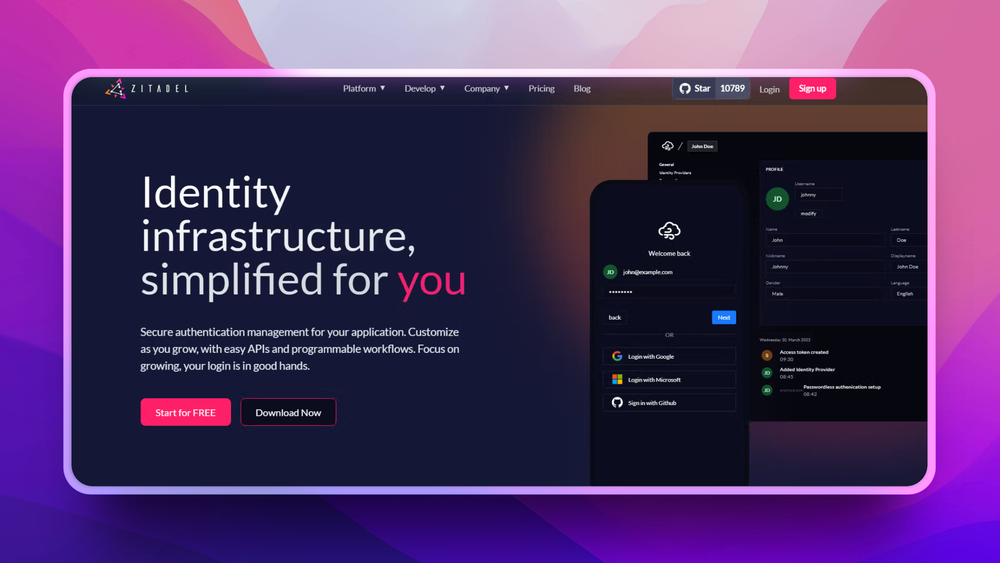
Best for companies that need a full enterprise identity platform: multi-tenant B2B auth, SAML federation, machine-to-machine tokens, and compliance-ready audit trails.
ZITADEL is the most feature-complete open source identity provider on this list. It's designed as a direct replacement for Auth0 or Okta: not just user login, but the full enterprise identity stack: multi-tenant organizations with isolated user pools, SAML and OIDC federation, machine-to-machine auth via client credentials, and granular role-based access control.
The multi-tenancy model is particularly strong for B2B SaaS products. Each customer organization gets its own isolated identity space, can configure their own SSO (SAML or OIDC), and can set their own MFA policies without affecting other tenants. This is not a bolted-on feature; it's the primary architecture.
ZITADEL has been in production since 2020 and is used by engineering teams at companies across Europe and North America for critical identity infrastructure. The cloud offering has SOC 2 certification, and the self-hosted version logs every auth event in a tamper-evident audit log.
Key Features
- Multi-tenant organizations: isolated user pools with per-org SSO and MFA policies
- OIDC and SAML 2.0: both identity provider and service provider roles
- Machine-to-machine auth: service accounts with client credentials flow
- Passwordless: WebAuthn/FIDO2, passkeys, and magic links
- MFA: TOTP authenticator apps, U2F/WebAuthn, SMS (with provider integration)
- Customizable login UI: hosted or custom-built with ZITADEL's API
- Audit logging: tamper-evident event log for every auth action
- Actions: serverless-style event hooks for custom logic on login/registration
Pros
- Most complete enterprise feature set of any open source auth provider
- B2B multi-tenancy is first-class, not an afterthought
- ZITADEL Cloud provides managed hosting with self-host migration path
- Strong compliance posture (SOC 2 for cloud, all audit events logged)
Cons
- Steeper learning curve than Logto or Better Auth due to feature breadth
- Kubernetes deployment recommended for production (adds ops complexity)
- Advanced features require understanding of ZITADEL's organization model
Self-Hosting
Single binary or Docker/Kubernetes deployment. Requires CockroachDB or PostgreSQL. Kubernetes Helm chart available for production deployments. ZITADEL Cloud offers managed hosting with self-host migration path. A 2-replica deployment on $20/month VPS instances handles millions of auth events per month.
License: Apache 2.0 | GitHub Stars: 9k+
View ZITADEL on Open Source Alternatives
2. Logto: Modern CIAM for Developers
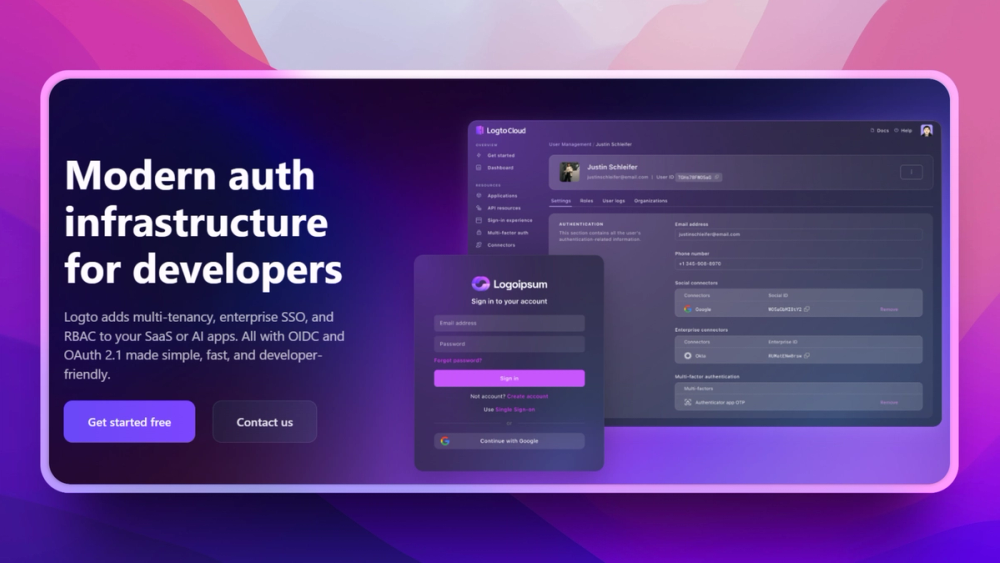
Best for developer teams building consumer or B2B products who want modern auth with excellent developer experience, pre-built UI components, and clear upgrade path to enterprise features.
Logto positions itself as Customer Identity and Access Management (CIAM) rather than just authentication; the distinction being a focus on the user journey (onboarding, social login, profile management) alongside the security primitives.
The developer experience is genuinely strong. SDKs for JavaScript, TypeScript, React, Next.js, Python, Go, PHP, and more. Pre-built sign-in UI components that are customizable without rebuilding from scratch. A management API for every operation. The docs are clear, the setup is fast. Logto's quickstarts get you from zero to working auth in under 30 minutes for most frameworks.
Where Logto shines over ZITADEL is the consumer-facing use case. Social login, passwordless email/SMS flows, and branded sign-in pages are all first-class. For developer tools, consumer apps, or B2C products, Logto's UX focus is a significant advantage.
Key Features
- Pre-built sign-in UI: customizable without building from scratch
- Social login: Google, GitHub, Apple, Facebook, and 20+ providers out of the box
- SMS and email passwordless: OTP-based login with pluggable providers
- MFA: TOTP, WebAuthn, backup codes
- RBAC: role-based access control with permission scopes
- Organizations: multi-tenant B2B support (with per-org SSO in Enterprise tier)
- SDKs: JavaScript, TypeScript, React, Next.js, Vue, Python, Go, PHP, iOS, Android
Pros
- Best developer experience (DX) of any open source auth tool
- Pre-built UI components cut integration time significantly
- Social and passwordless login are first-class citizens
- Well-documented with clear quickstarts for 20+ frameworks
Cons
- Some enterprise features (SAML SSO, advanced organizations) require paid cloud plan
- SAML SP/IdP support is more limited than ZITADEL
- Newer than Keycloak; less battle-tested at extreme enterprise scale
Self-Hosting
Docker Compose for development. Kubernetes Helm chart for production. Requires PostgreSQL. Logto Cloud provides managed hosting starting at $16/month. Self-hosted version is free and fully functional; no features gated behind the cloud tier.
License: MPL 2.0 (core) / Apache 2.0 (some components) | GitHub Stars: 9k+
View Logto on Open Source Alternatives
3. Better Auth: TypeScript-First Web App Auth
Best for Next.js, Remix, or SvelteKit developers who want drop-in auth that integrates directly into their framework without running a separate auth service.
Better Auth takes a fundamentally different approach from ZITADEL and Logto. Rather than being a standalone identity provider, it's a library you embed in your Next.js or TypeScript backend. Auth runs inside your application, using your database, without a separate auth service to deploy and maintain.
The result is the lowest-friction auth integration for TypeScript web apps. Add the library, configure your database adapter (Drizzle, Prisma, Mongoose), and you get email/password, social login, sessions, MFA, organizations, and more, all type-safe and colocated with your application code.
This approach has an important architectural implication: Better Auth is not an IdP. You cannot use it to add SSO login to a second application, or to federate identity across microservices. It's application-level auth, not identity infrastructure. For a single-app TypeScript product, this is a feature. For multi-app environments, you need ZITADEL or Logto.
Better Auth's plugin system is one of the most mature approaches in this space. Two-factor authentication, passkeys, magic links, organizations, RBAC, and admin panel, all available as first-party plugins with full TypeScript types. The plugin API is public, so community extensions follow the same pattern.
Key Features
- Framework-native: integrates directly into Next.js, Remix, SvelteKit, Express
- TypeScript-first: fully typed with automatic type inference for plugins
- Plugin architecture: official plugins for 2FA, magic links, passkeys, organizations, RBAC
- Multiple database adapters: Drizzle, Prisma, Mongoose, and more
- Social providers: Google, GitHub, Discord, Twitch, and 30+ more
- Session management: cookie or JWT-based sessions with configurable TTL
- Admin panel: manage users, sessions, and organizations via built-in UI
Pros
- Zero separate auth service to deploy; runs inside your application
- Best TypeScript type safety of any auth solution
- Plugin system covers enterprise features (orgs, RBAC, 2FA) without bloat
- Very active development with frequent releases and responsive maintainers
Cons
- Not suitable for multi-application SSO (it's app-level auth, not a standalone IdP)
- Less battle-tested than ZITADEL for large-scale enterprise deployments
- SAML support limited; primarily for OIDC-based federation
- Still maturing; some plugins are newer and less tested in production
Self-Hosting
Runs inside your application with no separate deployment. Your existing app server and database are sufficient. Add the npm package and configure a database adapter. Zero-infrastructure overhead.
License: MIT | GitHub Stars: 10k+
View Better Auth on Open Source Alternatives
Which Auth Tool Is Right for You?
| Use Case | Best Choice |
|---|---|
| B2B SaaS with enterprise SSO requirements | ZITADEL |
| Consumer app with social login and smooth onboarding | Logto |
| Next.js/TypeScript app needing drop-in auth | Better Auth |
| Multi-tenant with per-customer SSO | ZITADEL |
| Developer-focused product wanting fast setup | Logto |
| Service-to-service / machine-to-machine auth | ZITADEL |
| Single-app with Drizzle or Prisma ORM | Better Auth |
| Consumer CIAM with social login priority | Logto |
Self-Hosting Considerations for Auth
Authentication is a high-availability requirement; if your auth service is down, no one can log in. Plan for this before going to production:
- Run at least 2 replicas for any production auth service. Both ZITADEL and Logto support horizontal scaling. Better Auth scales with your application server.
- Database backup: auth data (users, sessions, credentials) must be backed up continuously, not just nightly. A restore-point RPO of minutes, not hours.
- SSL termination: auth endpoints must be HTTPS, no exceptions. Use Let's Encrypt or your cloud provider's certificate service.
- Session secret rotation: have a defined process for rotating signing secrets without logging everyone out. Test it before you need it.
- Monitoring: alert on auth service uptime and failed login rate anomalies. A spike in failed logins is both an availability issue and a potential security signal.
- Upgrade path: auth tools publish security releases. Pin your version in CI, but have a process to apply security patches within 24 hours of a critical CVE.
- Rate limiting: self-hosted deployments need explicit rate limiting on login endpoints. Cloud providers handle this for you; self-hosted you own it.
ZITADEL and Logto both support horizontal scaling via Kubernetes. Better Auth scales with your application server; if your app can handle the load, auth can too.
Security Checklist for Self-Hosted Auth
Use this checklist when deploying any self-hosted auth service:
- HTTPS everywhere; no HTTP fallback on auth endpoints
- TOTP or WebAuthn MFA enabled for admin accounts
- Audit logging configured and retained for 90+ days
- Database credentials stored in secrets manager (not env files)
- Rate limiting on login, registration, and password reset endpoints
- Responsible disclosure policy reviewed for the project
- Security notification mailing list or GitHub advisory watch set up
- Automated vulnerability scanning in CI pipeline
- Session expiry and rotation configured appropriately
- Backup and restore procedure tested end-to-end
Frequently Asked Questions
What's the best Auth0 alternative for self-hosting?
ZITADEL is the most direct Auth0 replacement with comparable feature breadth: multi-tenancy, SAML, OIDC, machine-to-machine, and enterprise SSO. Logto is better for consumer-facing CIAM with a focus on user experience. For TypeScript-first teams, Better Auth eliminates the separate service entirely.
Can I migrate users from Auth0 to an open source alternative?
Yes, but it requires careful planning. Passwords can't be migrated directly (Auth0 stores them hashed), but you can migrate user records and trigger password resets on first login. Session-based migration is complex; plan for a dual-running period where both systems accept logins while users naturally cycle through. Auth0's export API provides user data in JSON format that all three tools can ingest with an import script.
Is it safe to self-host authentication?
Self-hosted auth is as secure as you make it. ZITADEL and Logto are used in production by companies handling sensitive data at scale. The key requirements: HTTPS everywhere, regular security updates, proper database backup, rate limiting on login endpoints, and monitoring for anomalous login patterns. Follow the security checklist above before going to production.
Do these tools support passkeys and WebAuthn?
Yes. ZITADEL supports WebAuthn/FIDO2 natively as a primary authentication method. Logto supports WebAuthn. Better Auth has a passkeys plugin. All three support the modern passwordless authentication standards and comply with the FIDO2 specification.
How does multi-tenancy work for B2B SaaS?
ZITADEL's organization model is purpose-built for B2B: each customer gets an isolated "organization" with its own user pool, SSO configuration, and MFA policy. Logto also supports organizations. Better Auth has an organizations plugin for team-level isolation within a single application. For full B2B multi-tenancy with per-customer SSO, ZITADEL is the right choice.
What's the difference between an IdP and an auth library?
An Identity Provider (IdP) like ZITADEL or Logto is a standalone service; it runs separately from your app and issues tokens that your app validates. An auth library like Better Auth runs inside your app, directly managing sessions and credentials. IdPs are better for multi-app environments and enterprise federation; libraries are better for single-app architectures where you want auth colocated with application code.
Do these support SCIM for directory sync?
ZITADEL has SCIM support for enterprise directory synchronization. Logto is working on SCIM. Better Auth focuses on application-level auth rather than enterprise directory sync. For SCIM requirements in a B2B enterprise context, ZITADEL is the right choice.
What's the compliance story for self-hosted auth?
Self-hosting means you control the data, which simplifies some compliance requirements (data residency, sovereignty). However, you're responsible for your own audit trail, access controls, and breach response. All three tools provide audit logging. ZITADEL's Cloud offering has SOC 2 certification. For self-hosted deployments, audit log completeness and retention policy become your responsibility.
How do I handle social login (Google, GitHub) in self-hosted auth?
All three tools support OAuth2-based social login. You configure your OAuth app credentials (client ID and secret) from each provider in the auth tool's admin panel. ZITADEL and Logto have UI-driven provider configuration. Better Auth uses a code-based provider configuration. No social login traffic goes through the auth vendor's infrastructure; your self-hosted instance handles the OAuth flow directly.
Can I use Better Auth alongside an existing database without creating a separate auth database?
Yes. Better Auth supports any database you're already using and shares the schema with your application. You configure a database adapter (Drizzle, Prisma, Mongoose) and Better Auth creates its tables in your existing database. This is one of its primary design goals: zero infrastructure overhead for teams already running a TypeScript backend.