

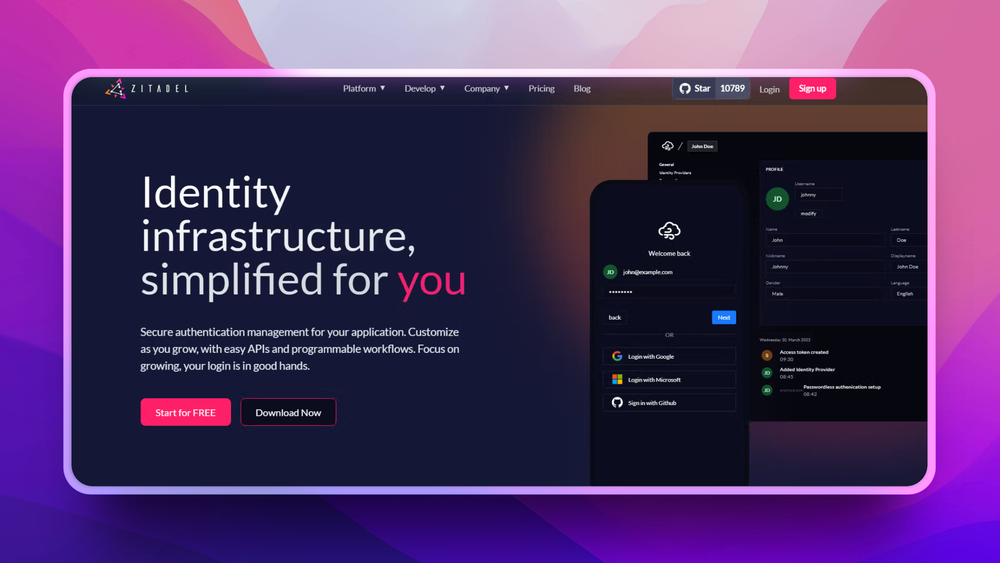
Who ZITADEL is for#
B2B SaaS teams managing customer tenants
ZITADEL fits products that need organizations, roles, SSO, MFA, and application-level identity controls for many customers.
Skip if:
Use a simpler auth library if your app only needs basic email login for a small user base.
Security teams requiring self-hosted identity
Teams with data residency or infrastructure-control requirements can run ZITADEL while still using modern identity protocols.
Skip if:
Use Auth0 or Okta if your team prefers managed identity operations and broad marketplace integrations.
The problem it solves#
Customer identity becomes a central dependency as soon as an application needs login, MFA, SSO, organizations, roles, machine users, and auditability. Hosted identity products reduce early setup but can create pricing pressure and data-residency concerns as user counts and tenants grow.\u000A\u000ABuilding identity internally is risky because modern auth requires protocol correctness, secure sessions, passkeys, MFA, tenant isolation, and admin tooling. Teams need control without inventing the identity stack from scratch.
How it solves it#
Modern authentication protocols
ZITADEL supports OAuth2, OpenID Connect, SAML, passkeys, MFA, and related identity standards. This lets teams integrate with modern apps and enterprise identity providers.
Multi-tenant organization model
ZITADEL is designed around organizations, projects, users, and roles. That fits B2B SaaS products where each customer needs isolated identity and access management.
Self-hosted or cloud deployment
Teams can run ZITADEL themselves or use ZITADEL Cloud. Self-hosting supports data residency and infrastructure control for security-sensitive applications.
APIs for identity workflows
REST and gRPC APIs let developers manage users, applications, roles, and identity flows programmatically. That helps integrate identity into product and operations workflows.
Strengths and trade-offs#
Strengths
- Strong fit for B2B SaaS identityThe organization and project model maps well to customer tenants, roles, and delegated administration. This is a key requirement for SaaS teams outgrowing simple auth libraries.
- Modern protocol coverage with self-hostingZITADEL combines common enterprise identity protocols with a self-hostable architecture. That gives teams more control than hosted-only customer identity products.
Trade-offs
- -Identity operations are sensitiveSelf-hosting ZITADEL means owning uptime, migrations, backups, key management, and incident response for login infrastructure. Many teams should consider ZITADEL Cloud if auth operations are not a core strength.
- -AGPL needs legal reviewZITADEL is AGPL-3.0 licensed. Teams modifying and providing it over a network should review obligations before choosing the self-hosted path.
ZITADEL vs alternatives#
ZITADEL vs Auth0
ZITADEL and Auth0 both handle customer identity, but they optimize for different constraints. ZITADEL gives you an open source, self-hostable identity stack. Auth0 gives you a managed proprietary service with less operational work.
| Criterion | ZITADEL | Auth0 |
|---|---|---|
| License | AGPL-3.0 | Proprietary SaaS |
| Hosting | Self-hosted or ZITADEL Cloud | Managed SaaS |
| Protocols | OAuth2, OIDC, SAML, SCIM, passkeys, MFA | Broad enterprise identity support |
| Best fit | B2B SaaS teams that need tenant control | Teams that want a hosted identity vendor |
ZITADEL is the stronger fit when tenant-aware identity, deployment control, and predictable self-hosted economics matter more than turnkey operations. Auth0 is the better fit when your team wants a commercial product with less infrastructure ownership and a larger integration marketplace.
What it's built on#
- Languages
- GoTypeScript
- Frameworks
- AngularNext.jsReact
- Infrastructure
- OAuth 2.0
- Tooling
- Webpack
FAQ#
What is ZITADEL used for?
ZITADEL is used for authentication, authorization, user management, SSO, MFA, passkeys, and multi-tenant identity infrastructure. It is aimed at developers building applications with modern identity needs.
Is ZITADEL open source?
Yes. ZITADEL is AGPL-3.0 licensed. Teams should review AGPL obligations before modifying and providing a self-hosted deployment over a network.
How does ZITADEL compare to Auth0?
ZITADEL gives teams a self-hostable identity stack with modern protocols, while Auth0 is a managed proprietary identity product. Auth0 may be easier operationally; ZITADEL gives more control.
Similar open-source tools#

limen
Composable authentication for modern Go backends

Logto
Multi-tenant auth platform with SSO, RBAC, and social login

Better Auth
Drop-in TypeScript auth with MFA, SSO, and multi-tenancy support

Warrant
Run fine-grained authorization with RBAC, ABAC, and ReBAC

Oso Cloud
Open source authorization with RBAC, ABAC, and ReBAC for any app

REA
AI-powered reverse engineering for binaries, apps, and assemblies.