

Who Cube is for#
SaaS teams embedding customer dashboards
Cube provides governed metrics and cached APIs for product analytics features shown inside an application.
Skip if:
Skip if all analytics are internal and your BI tool already handles performance well.
Data teams standardizing metric definitions
Use Cube to keep revenue, usage, and operational metrics consistent across BI, notebooks, and application APIs.
Skip if:
Skip if your organization is not ready to maintain semantic models in code.
The problem it solves#
Analytics teams often define the same metric in dashboards, notebooks, warehouse SQL, and application code. Revenue, activation, and retention numbers drift because each tool has its own formulas, filters, and joins.
The pain grows when product teams embed analytics into customer-facing apps. Developers need fast APIs and caching, while data teams need metric definitions that stay consistent across tools.
How it solves it#
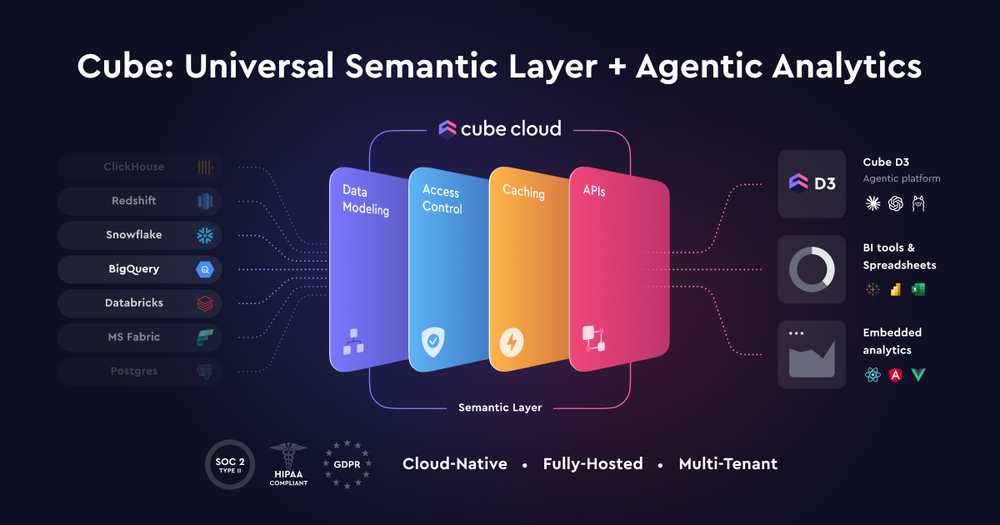
Code-defined semantic layer
Models cubes, measures, dimensions, joins, and access rules in code so metrics can be reviewed and versioned.
APIs for embedded analytics
Exposes REST, GraphQL, SQL, and client SDK paths for building dashboards and data apps on top of the same metric definitions.
Caching and pre-aggregations
Supports pre-aggregations and query acceleration so high-traffic embedded analytics do not hit the warehouse for every request.
Strengths and trade-offs#
Strengths
- Metric logic leaves the BI siloCube lets teams define metrics once and serve them to multiple frontends instead of copying SQL between dashboards and apps.
- Good fit for embedded analyticsThe API-first model serves product teams building analytics into SaaS applications, not only analysts using internal BI.
Trade-offs
- -Semantic modeling is upfront workTeams must design cubes, joins, measures, and cache strategy. For a small internal dashboard, a direct BI connection may be simpler.
Cube vs alternatives#
Cube vs Looker
Cube and Looker both help teams centralize metric definitions. Looker bundles modeling, exploration, dashboards, and governance into a proprietary BI platform; Cube focuses on an open semantic API layer that developers can embed in products.
Cube is better when analytics must appear inside your application or across multiple tools. Looker is still better when the organization wants a managed BI suite with mature analyst workflows and vendor support.
What it's built on#
- Languages
- JavaScriptRustTypeScript
- Frameworks
- Express
- Databases
- BigQueryMySQLPostgreSQLSnowflake
- Infrastructure
- AWSDatabricks
- Tooling
- Rollup
FAQ#
Is Cube open source?
Cube has an open source core and publishes its code on GitHub.
What is Cube used for?
Cube is used as a semantic layer and API layer for analytics, especially embedded dashboards and customer-facing data apps.
How does Cube compare to Looker?
Looker is a proprietary BI platform with its own semantic modeling layer. Cube focuses on an open source, API-first semantic layer that can power many frontends.
Similar open-source tools#

Redash
Connect to any data source, query, visualize, and share

Apache Superset
Open source data visualization and BI exploration tool

MindsDB
Delegate reports, inbox cleanup, and workflow tasks to an AI agent

Lightdash
Self-serve BI for dbt projects with metric definitions

Marker
Convert documents to clean markdown and JSON with open source AI.

Unstructured
Document parsing and ETL for LLMs, RAG pipelines, and AI agents.