

Who deer-flow is for#
Self-hosted agent runtime
Use DeerFlow when your team wants to operate a configurable agent harness rather than buy a closed hosted agent product.
Skip if:
You only need a simple chat assistant for support or internal Q&A.
Long-running research workflows
The harness fits multi-step research, coding, and creation tasks that need memory, tools, and sub-agent coordination.
Skip if:
Your tasks fit in one short prompt and do not need execution sandboxes.
Agent infrastructure experimentation
AI platform teams can use DeerFlow to test model routing, sandboxes, MCP servers, skills, and tracing.
Skip if:
You cannot allocate engineering time to configure and operate the runtime.
The problem it solves#
Long-running agent work needs durable orchestration, memory, tools, sandbox execution, and deployment controls. DeerFlow addresses that by packaging those pieces into an inspectable harness that teams can configure instead of relying only on single-agent chats or closed hosted products.
How it solves it#
Long-horizon agent harness
The README describes DeerFlow as handling tasks that can take minutes to hours across research, coding, and creation.
Sub-agents and skills
The harness supports sub-agent coordination and extensible skills so different capabilities can be loaded for different tasks.
Configurable memory
Memory support helps the runtime preserve context and prior work across longer agent sessions.
Sandbox execution modes
DeerFlow documents local, Docker, and Kubernetes-backed sandbox execution modes for running agent code.
Docker and local operation
Setup paths include make setup, make docker-start, make dev, and make up, with sizing notes for evaluation and server use.
Strengths and trade-offs#
Strengths
- Built for operatorsThe README covers configuration, deployment sizing, sandbox choices, tracing, and gateway behavior rather than hiding runtime details.
- Open runtime controlTeams can inspect and adapt the harness, model configuration, and execution modes under an MIT license.
- Multiple integration surfacesMCP server support, IM channels, skills, and model-provider configuration give teams several extension paths.
Trade-offs
- -Operationally heavier than a chatbotDeerFlow requires Python, Node.js, model configuration, sandbox choices, and service startup, so it is not a low-ops SaaS assistant.
- -Resource planning mattersThe README includes CPU, memory, and disk sizing guidance, which signals that heavier workflows need real infrastructure.
- -Advanced configuration surfaceTeams must understand model providers, sandbox modes, memory paths, and gateway limits to run DeerFlow well.
deer-flow vs alternatives#
Compared to Devin
Devin is a hosted autonomous developer product that packages the user experience and runtime for customers. DeerFlow is an open-source harness for teams that want to operate and configure their own agent runtime, including models, sandboxes, memory, skills, and integrations. Use Devin when you want a productized agent; use DeerFlow when you want control over the agent infrastructure.
Quick start#
git clone https://github.com/bytedance/deer-flow.git
cd deer-flow
make setup
make docker-init
make docker-startWhat it's built on#
- Languages
- PythonTypeScript
- Frameworks
- FastAPILangChainLangGraphNext.jsReact
- Runtimes
- Node.js
FAQ#
What is DeerFlow?
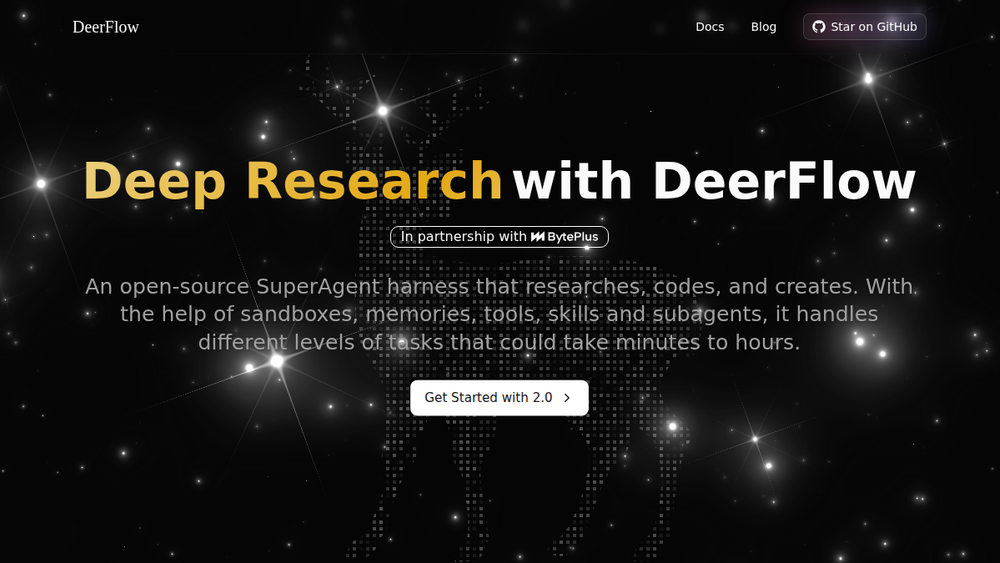
DeerFlow is an open-source super-agent harness for long-horizon workflows that use sub-agents, memory, sandboxes, tools, and skills.
What license does DeerFlow use?
GitHub metadata reports DeerFlow as MIT licensed.
Can DeerFlow run with Docker?
Yes. The README documents Docker development with make docker-init and make docker-start, plus production startup with make up.
Who should use DeerFlow?
DeerFlow fits teams building or operating custom agent runtimes. It is heavier than a simple hosted chatbot.
Similar open-source tools#

prime-agent
Automate coding workflows with a self-improving agent

ECC
Cross-harness skills, agents, and security for AI coding

orca
The ultimate IDE for coding agents

Agent Skills
Structured workflows for AI coding agents.

Flue Framework
Build powerful, autonomous agents with TypeScript.

jcode
Next-gen coding agent harness for efficient workflows