
Who Dagster is for#
Data platform teams managing asset lineage
Dagster helps teams see which data assets exist, what produces them, and what downstream jobs depend on them. This fits warehouses, lakehouses, dbt projects, and ML feature pipelines.
Skip if:
Skip it if your workflow is only a few simple cron jobs with no data lineage or asset ownership problem.
Analytics engineers coordinating dbt and Python
Dagster can orchestrate dbt transformations alongside Python jobs, checks, and external resources. It gives analytics teams a way to operate data workflows as software.
Skip if:
Use a warehouse-native scheduler if all transformations already live in one managed SQL environment and orchestration needs are minimal.
The problem it solves#
Data pipelines fail when teams can only see tasks instead of the data assets those tasks produce. Airflow-style DAGs can schedule jobs, but they often leave lineage, testing, asset ownership, and data quality checks scattered across notebooks, warehouse SQL, and monitoring tools.\u000A\u000AAs data teams support analytics, machine learning, and production AI features, they need orchestration that explains what data exists, how it updates, and what broke. A generic scheduler is not enough once data assets become part of product reliability.
How it solves it#
Asset-aware orchestration
Dagster models data assets directly, not only tasks. Teams can understand dependencies between tables, files, models, and downstream products in the same system that runs the jobs.
Python development workflow
Pipelines are defined in Python with testable code, local development tools, and clear resource configuration. That fits engineering-heavy data teams that want version control and review around orchestration logic.
Observability for runs and assets
Dagster tracks runs, materializations, metadata, and failures so teams can debug which asset changed and why. This is more actionable than a task-only success or failure log.
Integrations for modern data stacks
Dagster integrates with warehouses, dbt, Spark, Kubernetes, cloud storage, and ML workflows. It can coordinate data engineering and analytics engineering in one orchestration layer.
Strengths and trade-offs#
Strengths
- Better mental model for data productsAssets make Dagster easier to reason about when the real output is a table, feature set, dashboard input, or model artifact. That helps teams connect orchestration to business-facing data reliability.
- Open source with managed optionThe core is Apache-2.0 licensed, and Dagster Cloud is available for teams that want hosted operations. Teams can start self-hosted and move to managed support if operations become the bottleneck.
Trade-offs
- -Migration from Airflow takes redesignDagster's asset model is different from task-first DAGs. Teams migrating from Airflow should plan to rethink pipeline boundaries rather than mechanically port every operator.
- -Python-centric workflowDagster is strongest for teams comfortable with Python-defined orchestration. Teams that want a visual-only low-code data pipeline tool may prefer managed ETL products.
Dagster vs alternatives#
Dagster vs Airflow\u000A\u000ADagster and Airflow both orchestrate data workflows, but Dagster centers the data assets those workflows produce while Airflow centers scheduled tasks.\u000A\u000A| Criterion | Dagster | Airflow |\u000A| --- | --- | --- |\u000A| License | Apache-2.0 | Apache-2.0 |\u000A| Core model | Data assets and jobs | Task DAGs |\u000A| Development | Python with local tooling | Python DAG files and operators |\u000A| Best fit | Asset-aware data products | Broad scheduler ecosystem and legacy DAGs |\u000A\u000ADagster is the better choice when lineage, asset ownership, and data quality are central to the workflow. Airflow remains attractive when a team already has many DAGs, existing operators, and a mature Airflow operations practice.
What it's built on#
- Languages
- PythonTypeScript
- Frameworks
- Next.jsReact
- Tooling
- Webpack
FAQ#
What is Dagster used for?
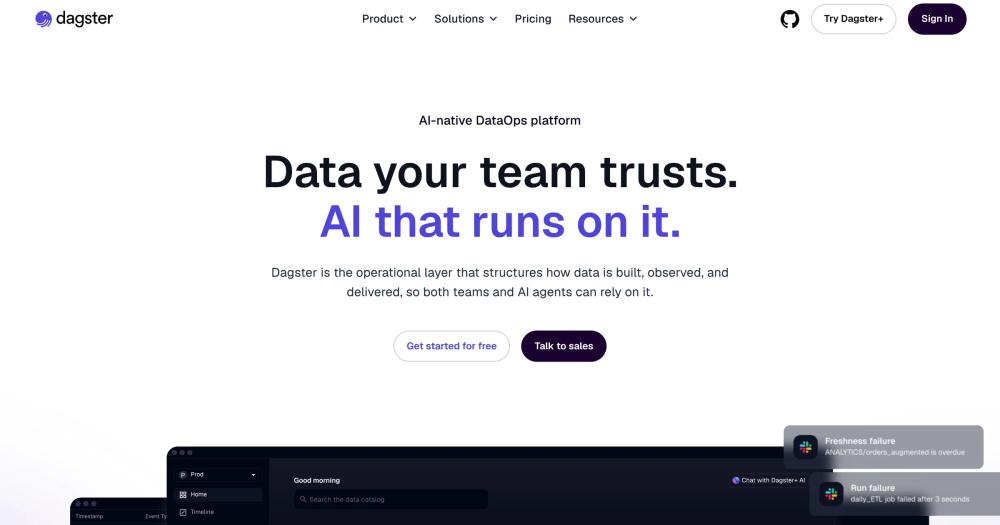
Dagster is used to orchestrate data assets, pipelines, dbt jobs, ML workflows, and production data processes. It focuses on data lineage and asset observability, not just task scheduling.
Is Dagster open source?
Yes. Dagster's core project is Apache-2.0 licensed. Dagster Labs also offers Dagster Cloud for teams that want managed orchestration operations.
How does Dagster compare to Airflow?
Dagster models data assets and their dependencies, while Airflow traditionally focuses on task DAGs. Airflow has broader legacy adoption; Dagster is often a better fit for teams that want asset-aware data operations.
Similar open-source tools#

Kestra
Declarative workflow orchestration for data and DevOps teams

Renart
SQL and Python pipelines, notebooks, and dashboards in Git

marin
Open lab for training foundation models together

open-notebook
Self-host private AI research notebooks

CocoIndex
Incremental data framework for AI agents.

Ollama
Run large language models locally on Mac, Linux, or Windows