

Who Unsloth is for#
Fine-tune LLMs on local hardware without cloud GPU costs
An ML engineer at a startup with two RTX 4090s uses Unsloth to fine-tune a Mistral 7B model on customer support transcripts. The same job that cost $200 on Lambda Cloud runs overnight on local hardware at zero marginal cost.
Skip if:
Your team has no local GPU hardware and prefers fully managed training services.
Cut research iteration cycles in half during academic model experiments
A PhD student studying domain adaptation fine-tunes Llama 3 8B on medical literature. Unsloth's 2x speedup lets them test two hypotheses per day instead of one, making the most of limited compute time on a shared lab GPU.
Skip if:
Your institution has ample managed GPU cluster time with no iteration bottleneck.
Run weekly fine-tuning jobs on free Colab T4 GPUs
An indie developer building a personal assistant fine-tunes a 7B model on their own writing using Unsloth's free Colab notebook. The memory savings mean the entire job fits on a free T4 without session timeouts.
Skip if:
You need repeatable production pipelines with audit logs and SLA guarantees.
Replace expensive SageMaker fine-tuning pipelines at a funded startup
A small ML team running Llama fine-tunes on AWS SageMaker ml.g5.4xlarge instances cuts their monthly AI infrastructure bill by moving the workload to on-premise A100s. Unsloth's drop-in HuggingFace API makes migration low-risk.
Skip if:
Your team relies on SageMaker's managed infrastructure for compliance and audit trail requirements.
Prototype new model architectures faster with validated kernel benchmarks
An AI researcher evaluating a new 13B architecture uses Unsloth to benchmark fine-tuning performance across multiple dataset configurations. Built-in kernel validation confirms results are numerically equivalent to full-precision baselines.
Skip if:
Your evaluation requires multi-node GPU cluster scale from day one.
The problem it solves#
Fine-tuning large language models on custom data requires significant GPU memory and compute time, putting it out of reach for researchers and engineers without expensive cloud GPU access. A 7B parameter fine-tune can exhaust a consumer GPU in minutes, forcing teams to pay $2 to $5 per hour for cloud GPU time on runs that take days. Standard training pipelines re-compute intermediate activations during backpropagation and store full optimizer states in VRAM, consuming far more memory than theoretically necessary. Unsloth targets ML engineers, researchers, and startup teams who need to adapt models to their own data on consumer hardware or reduce cloud GPU spend without sacrificing accuracy.
How it solves it#
Train 2x faster with custom Triton and CUDA kernels
Unsloth replaces PyTorch's default attention and gradient operations with hand-written Triton kernels that eliminate redundant computation. Benchmarked at 2x speedup on Llama 3 8B fine-tuning with no degradation in final model accuracy.
Cut VRAM usage by up to 70% versus standard HuggingFace setups
Memory-efficient gradient checkpointing and fused optimizer implementations reduce peak VRAM usage significantly. A Llama 3 13B QLoRA fine-tune that requires 36GB with standard tooling runs on a 24GB RTX 4090 with Unsloth.
Run large model fine-tunes on a single consumer GPU
Supports RTX 3090, 4090, and laptop GPUs alongside datacenter hardware. LoRA, QLoRA, and full fine-tuning modes all work on single-GPU consumer setups, removing the need for a cloud account for many workloads.
Fine-tune 60+ model architectures with a drop-in API
Llama, Mistral, Phi, Gemma, Qwen, and 50+ additional model families are pre-patched and tested. Unsloth wraps the HuggingFace Trainer API so existing training scripts need minimal changes to benefit.
Confirm zero accuracy loss with automatic kernel validation
Unsloth validates its custom kernels against PyTorch reference outputs and flags any numerical discrepancy. The project reports no accuracy degradation on standard benchmarks compared to full-precision baseline training.
Strengths and trade-offs#
Strengths
- Save hundreds per month by replacing cloud GPU fine-tune jobs with local runsUnsloth's memory efficiency lets a 13B model fit on a single RTX 4090. Teams running weekly fine-tune jobs on SageMaker ml.p3.2xlarge instances at $3.06 per hour can eliminate that spend entirely for models up to 13B parameters.
- Switch from HuggingFace Trainer with three-line code changesUnsloth wraps HuggingFace's FastLanguageModel and SFTTrainer APIs. Existing training scripts using Trainer or TRL need only replace the model-loading calls, keeping the rest of the training loop intact.
- Get support for new model architectures within days of community releaseThe Unsloth team has consistently added support for Llama, Mistral, Phi, Gemma, and Qwen releases quickly after they appear on HuggingFace. The GitHub repo is actively maintained with frequent commits.
- Start fine-tuning immediately with free Colab and Kaggle notebook templatesUnsloth publishes pre-built Jupyter notebooks for most supported architectures, runnable on free Colab T4 GPUs. This lets researchers prototype fine-tunes at zero cost before committing to a local GPU or cloud spend.
Trade-offs
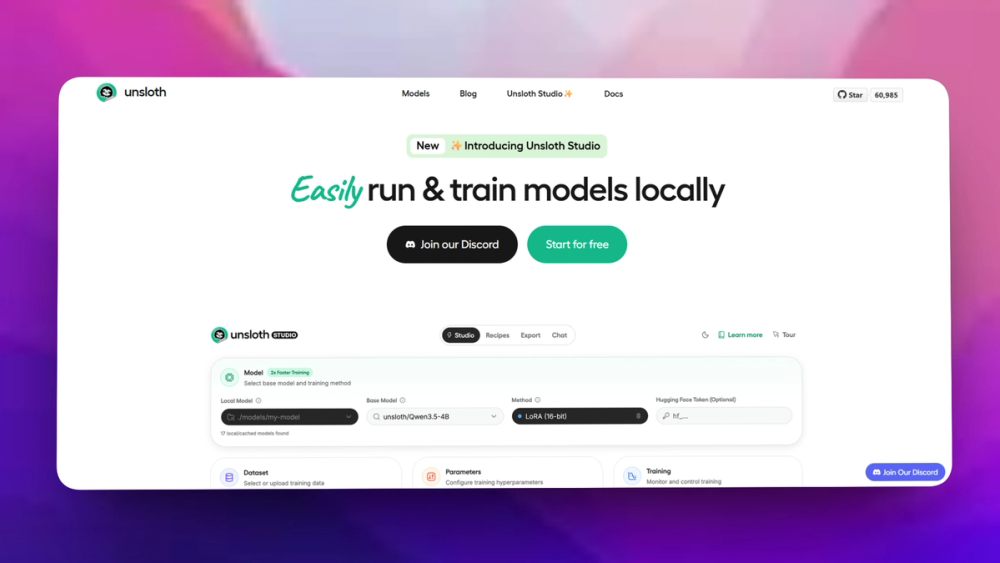
- -Check the AGPL-3.0 Studio license before building proprietary productsThe core Unsloth library is Apache 2.0 licensed, but Unsloth Studio, the graphical interface, is AGPL-3.0. Products that distribute or host Unsloth Studio-based services must open-source their code under AGPL-3.0.
- -Expect diminishing VRAM gains on models above 70B parametersUnsloth's memory savings are most dramatic on 7B to 13B models. For 70B+ parameter models, memory pressure may still require multi-GPU setups or gradient offloading, and the 2x speed claim may not hold at every scale.
- -Accept that custom kernels may lag behind new PyTorch releasesHand-written Triton and CUDA kernels need updates when upstream PyTorch or CUDA versions change. Users on cutting-edge CUDA versions may encounter compatibility issues before the Unsloth team pushes a fix.
- -Avoid Unsloth for multi-node distributed training across dozens of GPUsUnsloth is optimized for single-GPU and single-node training. Multi-node distributed training with DDP or FSDP requires standard PyTorch setups. Teams needing to scale across many GPUs should verify single-node constraints fit their workflow.
Unsloth vs alternatives#
Fine-tuning with AWS SageMaker managed training jobs on ml.g5.4xlarge instances costs $2.03 per hour, and typical Llama 7B runs take 6 to 12 hours. Unsloth cuts that time roughly in half, which for teams running weekly fine-tunes represents hundreds of dollars saved per month. SageMaker makes sense when you need managed infrastructure, audit logs, and enterprise compliance guarantees. Unsloth is the better fit when you have a local or cloud GPU and want to minimize both cost and iteration time.
Modal offers serverless GPU access starting at $0.90 per hour for an A10G, with pay-per-second billing. It is a strong option for teams without on-premise hardware who want to avoid SageMaker's overhead. When you combine Modal for GPU access with Unsloth for training efficiency, you get the cost flexibility of serverless billing alongside Unsloth's memory savings. If you run fine-tunes fewer than a few times per month, Modal paired with Unsloth is typically cheaper than maintaining a dedicated GPU server.
Quick start#
# Local Studio setup (macOS, Linux, WSL)
curl -fsSL https://unsloth.ai/install.sh | sh

# Local Studio setup (Windows PowerShell)
irm https://unsloth.ai/install.ps1 | iex

# Core library setup
pip install unslothWhat it's built on#
- Languages
- PythonRustTypeScript
- Frameworks
- React
FAQ#
Does Unsloth produce the same accuracy as standard fine-tuning?
Unsloth claims zero accuracy loss versus full-precision training on standard benchmarks. The project validates its custom kernels against PyTorch reference implementations. Independent community benchmarks on HuggingFace have confirmed equivalent results on Llama and Mistral models.
What license does Unsloth use?
The core Unsloth Python library is Apache 2.0 licensed. Unsloth Studio, the graphical fine-tuning interface, is AGPL-3.0. If you build a hosted service using Unsloth Studio, you must open-source that service under AGPL-3.0.
Which models does Unsloth support?
Unsloth supports 60+ model architectures including Llama 2, Llama 3, Mistral, Mixtral, Phi, Gemma, Qwen, DeepSeek, and others. The team typically adds support for new popular models within days of their HuggingFace release.
Does Unsloth work with multi-GPU setups?
Unsloth is optimized for single-GPU training. Multi-node distributed training with DDP or FSDP is not the design target. For single-node multi-GPU setups, some users report success, but this is not a primary supported configuration.
Can I use Unsloth without a paid GPU or cloud account?
Yes. Unsloth publishes free Colab and Kaggle notebooks for most supported architectures. A 7B model fine-tune fits on a free Colab T4 GPU (16GB VRAM) with Unsloth's memory optimizations, though training time will be longer than on an A100.
Similar open-source tools#

marin
Open lab for training foundation models together

open-notebook
Self-host private AI research notebooks

Ollama
Run large language models locally on Mac, Linux, or Windows

Moxin-LLM
Full transparency LLM: open weights, training code, and data

LLM Foundry
Apache 2.0 LLM fine-tuning toolkit for Llama and Mistral on GPU

Renart
SQL and Python pipelines, notebooks, and dashboards in Git