
Open Source Alternatives LogoOpen Source Alternatives
AlternativesBlogAdvertise
Open Source Alternatives LogoOpen Source Alternatives

Stay Updated

Subscribe to our newsletter for the latest news and updates about Alternatives

Open Source Alternatives LogoOpen Source Alternatives

Handpicked Open Source Alternatives to Paid Softwares

Product
  • Search
  • Categories
  • Tag
  • Sign In
Resources
  • Blog
  • Collection
  • Submit
  • Advertise your tool
Company
  • Privacy Policy
  • Terms of Service
  • Refund Policy
  • Sitemap
Copyright © 2026 All Rights Reserved.
Home/Categories/AI & Machine Learning/Falcon LLM
icon of Falcon LLM

Falcon LLM

Open source alternative to OpenAI, Google Cloud Vertex AI and Anthropic

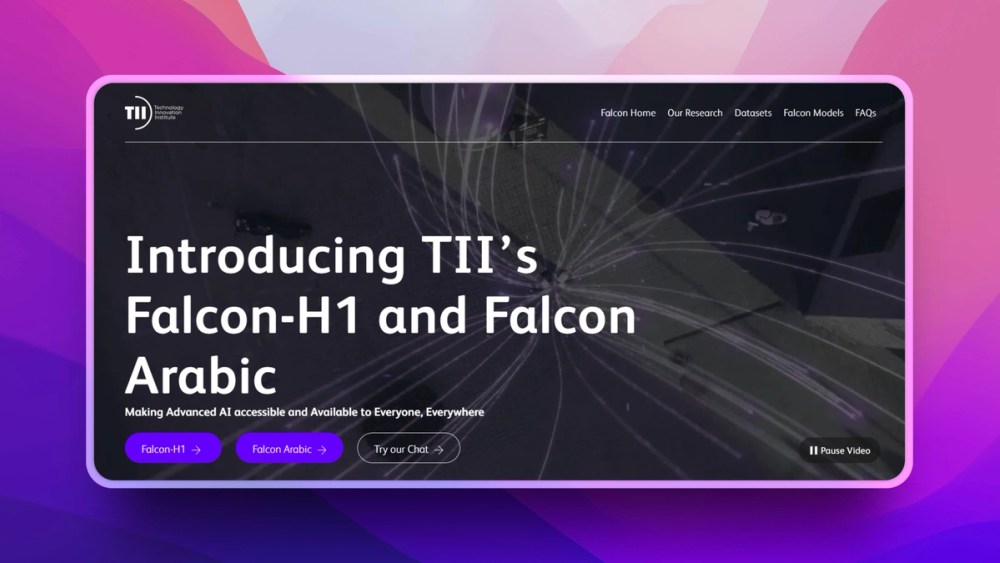
Falcon LLM is an open source large language model for commercial use — Apache 2.0-licensed weights from TII in sizes from 1B to 180B parameters, with no usage caps or MAU restrictions.

9.2K stars
Python
Apache-2.0
Active this month
Visit websiteGitHub repo
image of Falcon LLM
Contents
  1. 01Who Falcon LLM is for
  2. 02The problem it solves
  3. 03How it solves it
  4. 04Strengths and trade-offs
  5. 05Falcon LLM vs alternatives
  6. 06Tech stack
  7. 07FAQ
  8. 08Similar open-source tools
TL;DR

Falcon LLM is TII's family of open foundation models for text generation, instruction following, reasoning, code, and mathematics tasks. It replaces closed model-only workflows when teams want inspectable model cards, downloadable weights, and a path to run or fine-tune models outside one vendor API. Best for ML teams evaluating open model families rather than a hosted chatbot product.Apache-2.0 · Python · 9.2K stars · Active this month

who it's for

Who Falcon LLM is for#

ML teams evaluating open foundation models

Use Falcon LLM when model access, inspection, and local or controlled deployment matter more than the convenience of a single hosted API.

Skip if:

Skip if your product only needs managed inference calls and vendor-hosted operations.

Developers testing domain-specific fine-tuning

Falcon is a fit when teams want to fine-tune or adapt an open model family for summarization, chatbot, code, or language tasks.

Skip if:

Skip if your team lacks GPU capacity or a managed inference provider for the chosen model size.

the problem
tech stack · detected from GitHub

What it's built on#

Languages
Python
Infrastructure
AWS
frequently asked

FAQ#

What is Falcon LLM?
Is Falcon LLM open source?
Can Falcon LLM replace OpenAI or Anthropic APIs?
also worth a look

Similar open-source tools#

TinyLLaMA

TinyLLaMA

Compact 1.1B LLaMA model trained on 3 trillion tokens

9KPythonApache-2.0

Repository

Stars
9.2K
Forks
765
License
Apache-2.0
Latest
v0.8
Last commit
28 days ago
Last verified
May 13, 2026
Repo
oumi-ai/oumi ↗

Additional details

Language
Python
Open issues
11
Contributors
52
First release
2024

Categories

AI & Machine LearningLLMOps & AI ToolingDeveloper Tools

Tags

LLMLLMOpsAI SDKDeveloper ToolsSelf HostedAI AgentsAPI Infrastructure

The problem it solves#

how Falcon LLM solves it

How it solves it#

Falcon model family

TII publishes Falcon models across multiple sizes, including Falcon 3 instruct models from 1B to 10B parameters and earlier Falcon 7B, 40B, and 180B releases.

Transformer-based text generation

The Falcon model cards describe causal decoder-only architectures for generation workflows such as text generation, summarization, chat, and task-specific fine-tuning.

Documented model cards and licenses

Official Hugging Face model cards include architecture notes, language support, context length, usage examples, and license details such as Apache-2.0 for Falcon-7B and TII Falcon-LLM License 2.0 for Falcon 3.

strengths · trade-offs

Strengths and trade-offs#

Strengths

  • Open model access from TIIFalcon gives teams downloadable model artifacts and public model cards from Technology Innovation Institute instead of requiring every experiment to run through a closed hosted API.
  • Useful range of model sizesThe family spans smaller instruct models for lighter experimentation and larger releases for teams that need stronger foundation-model capability.

Trade-offs

  • -Licensing and hardware vary by modelFalcon releases do not all use the same license or hardware profile. Teams should review the specific model card before commercial use, fine-tuning, or self-hosted inference.
versus alternatives

Falcon LLM vs alternatives#

Ollama

Ollama

Run large language models locally on Mac, Linux, or Windows

173.7KGoMIT
Unsloth

Unsloth

Train LLMs locally without code using a browser-based interface

64.2KPythonApache-2.0
mTarsier

mTarsier

Free desktop app for managing MCP servers and AI agents

36TypeScriptMIT
N8N2MCP

N8N2MCP

Bridge n8n automations into MCP tools for Claude and Cursor

129HTMLMIT
Trieve

Trieve

Hybrid search and RAG infrastructure for AI knowledge bases

2.7KRustMIT

Falcon LLM is a family of large language models developed by Technology Innovation Institute, with model cards and weights published through official Falcon and Hugging Face channels.

Falcon models are open foundation models with public model cards and downloadable weights, but license terms vary by release. Review the exact model card before commercial use.

Teams that build on closed LLM APIs trade speed for dependency on one provider's model access, pricing, safety rules, and deployment surface. When the model itself is the product dependency, it becomes harder to inspect training context, test local inference, fine-tune for a narrow domain, or move workloads when a vendor changes terms. Open model families reduce that lock-in, but teams still need to choose a model with clear provenance, documented licenses, and realistic hardware expectations.

Falcon LLM vs OpenAI APIs

Falcon LLM is the better choice when teams need downloadable model weights, public model cards, and more control over inference or fine-tuning. OpenAI APIs are still the better fit when managed model quality, hosted operations, and simple API integration matter more than model ownership.

Falcon can replace closed API dependency when you need open model access and are ready to handle inference or fine-tuning operations. Hosted APIs remain easier for teams that want managed models only.