

Who hysteria is for#
Developer behind filtered network
Routes development traffic through a personal Hysteria server on a VPS to access blocked resources behind a heavily filtered corporate or national network.
Journalist in restricted region
Maintains secure communications that are not detectable as proxy traffic in a country with active deep-packet inspection.
Self-hosted infrastructure operator
Adds Hysteria as a backup tunnel for team members who need reliable access from restricted network locations.
Security researcher
Uses Hysteria's protocol documentation to implement a compatible client and test censorship circumvention techniques.
Team deploying private proxy
Deploys Hysteria with custom authentication to give employees private proxy access with per-user traffic statistics.
The problem it solves#
Standard proxies using TCP-based protocols are easily fingerprinted and blocked by deep packet inspection systems. Networks with high packet loss make TCP-based tunneling slow and unreliable, especially on mobile or satellite connections. Users in restricted environments need a proxy that performs well under both censorship and poor connectivity, without relying on protocols that are trivial for ISPs to identify and drop.
How it solves it#
HTTP/3 masquerade against DPI
Masquerades as standard HTTP/3 (QUIC) traffic, making it indistinguishable from normal web browsing to deep packet inspection systems
SOCKS5, HTTP, TProxy, and TUN in one binary
Supports SOCKS5, HTTP proxy, TCP/UDP forwarding, Linux TProxy, and TUN modes from a single binary
QUIC-based, tuned for lossy networks
Built on a customized QUIC implementation tuned for unreliable and lossy networks where TCP suffers head-of-line blocking
Cross-platform binaries
Cross-platform builds for every major OS and CPU architecture
Built-in auth and per-user traffic stats
Built-in custom authentication, traffic statistics, and access control for server operators managing multi-user deployments
Open protocol spec for third-party clients
Well-documented protocol spec enables third parties to build compatible client applications
Strengths and trade-offs#
Strengths
- HTTP/3 masquerade has high collateral cost to blockHTTP/3 masquerade is harder to block selectively than most proxy protocols because blocking it causes widespread collateral damage to legitimate QUIC/HTTP3 traffic
- Single binary for all proxy modesA single binary covers a wide range of proxy modes without requiring separate tools for different use cases
- 21.2K stars, active community21.2K GitHub stars with active maintenance and an active Telegram community and Discussions forum
- Open specs for third-party clientsWell-documented specifications lower the barrier for third-party client authors
Trade-offs
- -Requires self-hosted server in unrestricted locationRequires running your own server in an unrestricted location; there is no built-in server-discovery or relay network like some commercial VPN services offer
- -Higher CPU/battery than TCP proxies on stable networksThe QUIC-based approach consumes more CPU and battery than simple TCP proxies in stable, low-latency network conditions
- -Some edge-case rough spots236 open issues at last check; some edge-case platform configurations may have rough spots
hysteria vs alternatives#
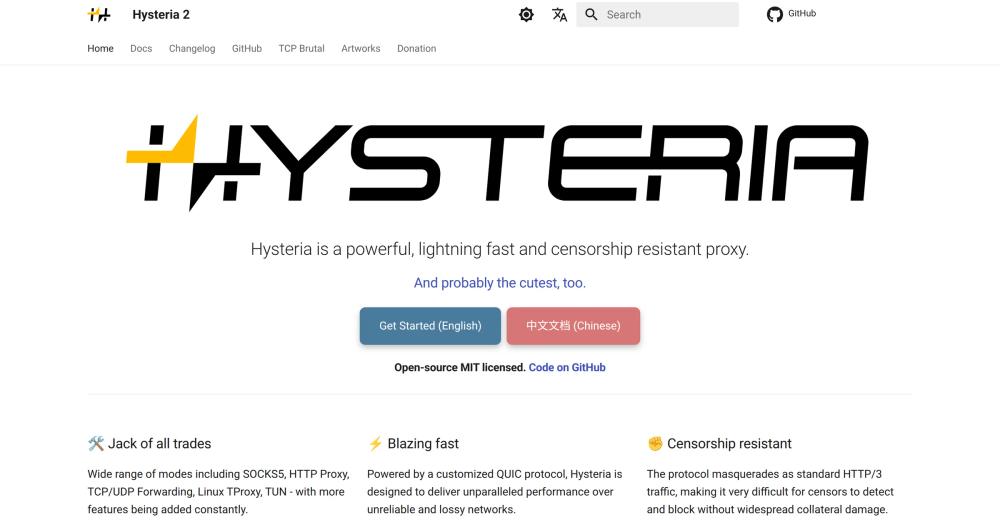
hysteria is an MIT-licensed self-hosted proxy that uses a customized QUIC protocol for fast, censorship-resistant TCP and UDP traffic.
vs NordVPN: NordVPN is the easier choice for consumers who want managed apps, a commercial server network, and support without running infrastructure. hysteria is better when you control the server, need SOCKS5, HTTP proxy, TUN, TCP or UDP forwarding modes, and want traffic shaped to look like standard HTTP/3.
vs ExpressVPN: ExpressVPN focuses on a polished managed VPN service with its own client apps and protocols such as Lightway and WireGuard support. hysteria asks you to operate the server yourself, but gives developers protocol documentation, custom authentication, traffic stats, access control, and deployment flexibility.
vs Tailscale: Tailscale is built for WireGuard mesh networking, identity, ACLs, and device-to-device access. hysteria is not a mesh VPN; it is better for proxying through unreliable or censored networks where QUIC behavior and HTTP/3 masquerading matter, while Tailscale remains better for zero-config private network access across a team.
What it's built on#
- Languages
- GoPython
- Frameworks
- Flask
FAQ#
How does Hysteria compare to Shadowsocks or V2Ray?
Hysteria uses UDP/QUIC and mimics HTTP/3 traffic at the protocol level. Shadowsocks and V2Ray primarily operate over TCP and are more easily identified by traffic-analysis tools. On high-latency or lossy networks, Hysteria's QUIC base typically outperforms TCP-based proxies significantly.
Do I need to run my own server?
Yes. Hysteria does not include a public relay network. You need a server in an unrestricted location running the Hysteria server binary. The documentation at v2.hysteria.network covers setup for common VPS providers.
Does it work on mobile?
Hysteria has an active third-party app ecosystem with iOS and Android clients available, though the core project ships only a command-line binary. Check the third-party apps section in the official documentation for current options.
Similar open-source tools#

Tor Browser
Secure browsing through the Tor network with anti-fingerprinting

tailcat
Encrypted tunnels between machines, no account or IP needed

OpenShell
Sandboxed runtime for autonomous AI agents, open source by NVIDIA

openbao
Open source secret management governed by the Linux Foundation

mvt
Mobile forensics toolkit for detecting spyware on Android and iOS

security-audit-skill
Multi-phase security audits with machine-readable findings