
Open Source Alternatives LogoOpen Source Alternatives
AlternativesBlogAdvertise
Open Source Alternatives LogoOpen Source Alternatives

Stay Updated

Subscribe to our newsletter for the latest news and updates about Alternatives

Open Source Alternatives LogoOpen Source Alternatives

Handpicked Open Source Alternatives to Paid Softwares

Product
  • Search
  • Categories
  • Tag
  • Sign In
Resources
  • Blog
  • Collection
  • Submit
  • Advertise your tool
Company
  • Privacy Policy
  • Terms of Service
  • Refund Policy
  • Sitemap
Copyright © 2026 All Rights Reserved.
Home/Categories/Data & Analytics/Meilisearch
icon of Meilisearch

Meilisearch

Open source alternative to Algolia and Elastic Cloud

Meilisearch is a fast open source search engine that delivers typo-tolerant, faceted full-text search in milliseconds, self-hosted with a single binary and no JVM dependency.

57.5K stars
Rust
Active this month
Visit websiteGitHub repo
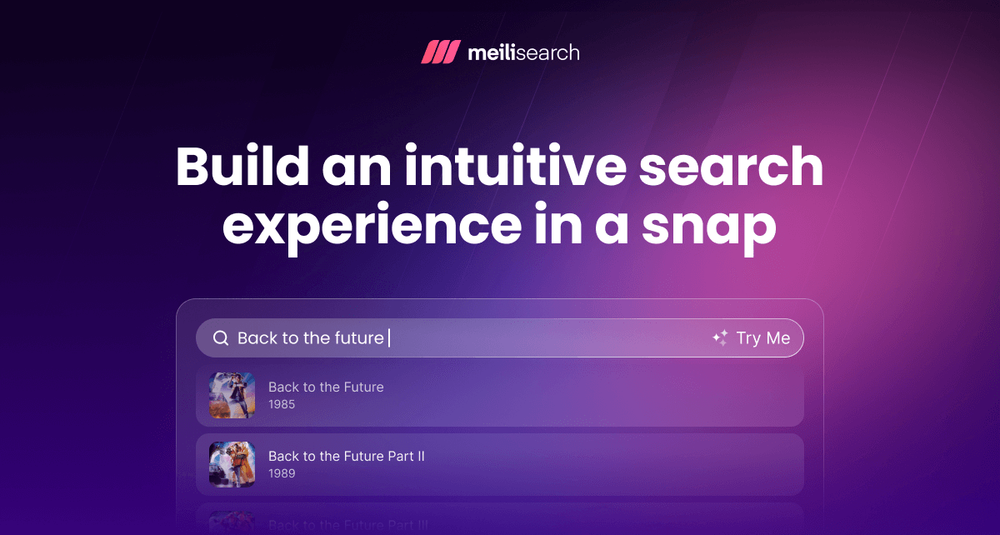
image of Meilisearch
Contents
  1. 01Who Meilisearch is for
  2. 02The problem it solves
  3. 03How it solves it
  4. 04Strengths and trade-offs
  5. 05Meilisearch vs alternatives
  6. 06Install and self-host
  7. 07Tech stack
  8. 08FAQ
  9. 09Similar open-source tools
TL;DR

Meilisearch is an open source, MIT-licensed search engine that returns typo-tolerant, hybrid full-text and vector results in under 50 milliseconds, deployed as a single Rust binary.Rust · 57.5K stars · Active this month

who it's for

Who Meilisearch is for#

E-commerce teams adding faceted product search

Meilisearch handles product catalogs with filterable facets (price, brand, size, color) and sub-50ms response times out of the box. The InstantSearch UI library provides pre-built React and Vue components for faceted navigation that connect directly to the Meilisearch API, cutting frontend development time significantly.

Skip if:

Your catalog exceeds tens of millions of SKUs at high concurrent write rates, or you need aggregation analytics on top of search data. Also skip if compliance certifications (SOC 2, HIPAA) are required on the managed service.

SaaS developers building per-tenant search

The tenant token system issues signed search tokens server-side, restricting each customer's search scope to their own data without routing queries through your application backend. This is purpose-built for multi-tenant apps where data isolation is a hard requirement and per-tenant index duplication would be expensive to maintain.

Skip if:

tech stack · detected from GitHub

What it's built on#

Languages
Rust
frequently asked

FAQ#

Is Meilisearch free to use?
How does Meilisearch compare to Elasticsearch?
Can Meilisearch handle semantic or AI-powered search?
also worth a look

Similar open-source tools#

Scira

Scira

Open source AI search engine that retrieves cited sources

11.7KTypeScriptAGPL-3.0

Repository

Stars
57.5K
Forks
2.5K
Latest
v1.43.1
Last commit
19 days ago
Last verified
May 13, 2026
Repo
meilisearch/meilisearch ↗

Additional details

Language
Rust
Open issues
290
Contributors
248
First release
2018

Categories

Data & AnalyticsDeveloper ToolsAPIs & Integration

Tags

Search EngineAI Search ToolsSelf HostedAPI InfrastructureDeveloper ToolsDatabaseRAG

Your tenants intentionally share a single search index (shared knowledge base, public catalog). In that case, standard API key scoping is simpler than tenant tokens.

AI engineers integrating RAG pipelines

Meilisearch stores document vectors natively and combines them with keyword search in hybrid mode, removing the need for a separate vector database in most RAG setups. It connects to OpenAI, Hugging Face, and Ollama for embedding generation via configuration, and is compatible with LangChain for orchestration.

Skip if:

Your retrieval application requires filtered approximate nearest-neighbor search at very large scale (hundreds of millions of vectors), where purpose-built vector databases have a meaningful performance advantage.

Developers replacing Algolia to cut search costs

Teams on Algolia's per-search pricing model can self-host Meilisearch and eliminate usage-based billing entirely. The API surface and InstantSearch library compatibility make migration practical: Algolia-based frontends often need only the host URL and API key swapped, since both libraries follow compatible search response shapes.

Skip if:

You need Algolia's managed global CDN distribution, AI-personalization features built on years of production training data, or its compliance certifications (SOC 2 Type II, HIPAA), none of which the community edition replicates.

the problem

The problem it solves#

Building good search is harder than it looks. Elasticsearch gives you the power but demands JVM expertise, cluster management, index tuning, and a team dedicated to keeping it healthy in production. Algolia gives you speed and relevance out of the box, but every search query adds up on the bill, and at scale the per-search pricing model puts a ceiling on how freely you can iterate or run internal tooling.

The result is that teams either over-engineer with Elasticsearch and spend months tuning relevance, or lock into Algolia and watch infrastructure costs climb as their user base grows. Adding semantic or vector search used to require stitching together a separate vector database on top of an existing keyword index. Most teams end up with search that is either too complex to maintain or too expensive to scale.

how Meilisearch solves it

How it solves it#

Sub-50ms typo-tolerant search

Returns relevant results in under 50 milliseconds on typical datasets, even when queries contain spelling mistakes. Typo tolerance is on by default and configurable per index, so common user errors like "appel" for "apple" resolve correctly without any setup. The ranking algorithm scores results by typo count, matched term proximity, and custom rules.

Hybrid full-text and vector search

Combines keyword-based full-text search with semantic vector search in a single query, with configurable weighting between the two approaches. Stores document vectors natively alongside text indexes, making it compatible with RAG pipelines and LLM-backed applications without adding a separate vector database to your infrastructure.

Faceted filtering and sorting

Supports filterable and sortable attributes out of the box: price ranges, category labels, date fields, and custom attributes can all be used as facets. Works directly with the InstantSearch UI library, giving you pre-built React and Vue components for checkboxes, sliders, and sort controls without custom frontend logic.

Geosearch

Filters and sorts results by geographic distance using a latitude/longitude field on each document. Supports filtering by radius, bounding box, and polygon, which covers location-aware search for delivery apps, real estate listings, and store-finder use cases without a separate geo data service.

Multi-tenancy via tenant tokens

Generates signed tenant tokens server-side that restrict each user to their own data subset without routing every search request through your application backend. Designed for SaaS products where each customer must see only their own records, with no per-tenant index duplication required.

Single-binary deployment, no JVM required

Ships as a self-contained Rust binary with no runtime dependencies. One Docker command or a downloaded binary is enough to have a running search instance. No Java Virtual Machine, no cluster coordination service, and no configuration files required to get a development instance handling queries.

strengths · trade-offs

Strengths and trade-offs#

Strengths

  • MIT-licensed core with no per-query costsThe community edition is MIT licensed and free to use commercially. Unlike Algolia, which charges per search operation, self-hosted Meilisearch has no usage-based billing. You pay for server infrastructure and nothing else, making cost predictable at any search volume, including internal tooling or high-frequency autocomplete calls.
  • Out-of-the-box relevance without tuningRelevance ranking applies multi-criteria scoring by default: typo count, number of matched terms, word proximity, and configurable custom ranking rules. Most teams get acceptable search quality without writing custom scoring functions, unlike Elasticsearch where relevance tuning requires specialist knowledge of BM25, field boosting, and function score queries.
  • Hybrid search without a separate vector storeStores document vectors natively and combines them with keyword search in a single query pass. Connects to OpenAI, Hugging Face, and Ollama for embedding generation via configuration, eliminating the need for a separate vector database in typical RAG setups. Teams migrating from Pinecone for retrieval use cases have documented successful moves to Meilisearch.
  • Wide SDK coverage and dashboard UIOfficial SDKs for JavaScript, Python, PHP, Go, Ruby, Rust, .NET, Swift, and Dart. The built-in dashboard at localhost:7700 lets you browse indexes, run test queries, and tweak ranking settings without writing code. LangChain and Model Context Protocol integrations are also available for AI pipeline use cases.

Trade-offs

  • -Horizontal sharding requires enterprise licenseThe community MIT edition runs as a single node. Sharding across multiple nodes to handle very high document volumes or extreme query throughput is only available in the Enterprise Edition, which uses the BUSL-1.1 license and requires a commercial agreement with Meili SAS. Teams with millions of documents at high concurrency may hit this ceiling.
  • -Not designed for log analytics or aggregation workloadsMeilisearch is optimized for end-user search (e-commerce, site search, SaaS records) where results need to be fast and typo-tolerant. It does not support aggregation pipelines, time-series analysis, or the full-text analytics workloads that Elasticsearch and OpenSearch handle. Do not use it as a replacement for observability or log infrastructure.
  • -Telemetry enabled by defaultAnonymous usage telemetry is collected and sent to Meilisearch by default. It can be disabled by setting the MEILI_NO_ANALYTICS environment variable, but this requires a deliberate configuration step. For privacy-sensitive deployments or air-gapped environments, disable it before running in production.
  • -Vertical scaling only on the community editionWithout sharding, handling larger datasets means provisioning a bigger single server rather than adding nodes. A single well-resourced Meilisearch node handles tens of millions of documents, but very large datasets (hundreds of millions of records) require either the Enterprise Edition for horizontal scaling or careful index partitioning by the application layer.
versus alternatives

Meilisearch vs alternatives#

Meilisearch competes most directly with Algolia. Both deliver fast, typo-tolerant search with faceting, geosearch, and multi-tenant support. The difference is deployment model and cost: Algolia charges per search operation, while self-hosted Meilisearch has no usage-based billing. Teams on Algolia can migrate with minimal frontend changes because both support the same InstantSearch library; swapping host and API key is often enough. Algolia has the edge in global CDN distribution, managed compliance certifications (SOC 2 Type II, HIPAA), and AI personalization trained on years of production click data.

Against Elasticsearch, Meilisearch wins on simplicity. Elasticsearch requires a JVM, cluster coordination, and significant tuning to get relevant results; Meilisearch runs as a single binary with typo tolerance and hybrid search on by default. The tradeoff is scope: Elasticsearch handles log analytics, aggregation pipelines, and very large distributed clusters that Meilisearch does not support. For most developer teams building user-facing web search, Meilisearch reaches production in hours, not days.

install · self-host

Install and self-host#

bash
# Docker (recommended)
docker run -p 7700:7700 \
  -e MEILI_ENV='development' \
  -v $(pwd)/meili_data:/meili_data \
  getmeili/meilisearch:v1.37

# cURL install script (Linux/macOS)
curl -L https://install.meilisearch.com | sh
./meilisearch

# Homebrew (macOS)
brew install meilisearch
meilisearch

# APT (Debian/Ubuntu)
echo "deb [trusted=yes] https://apt.fury.io/meilisearch/ /" | sudo tee /etc/apt/sources.list.d/fury.list
sudo apt update && sudo apt install meilisearch
meilisearch

Yes. Meilisearch supports hybrid search combining full-text and vector (semantic) search, with native vector storage built in. You configure an embedder (OpenAI, Hugging Face, Ollama, or a custom REST endpoint) and Meilisearch generates and stores embeddings at index time. The balance between keyword and semantic results is tunable per query via a semantic ratio parameter.

Does Meilisearch scale horizontally?

Single-node Meilisearch handles tens of millions of documents well on typical hardware. Horizontal sharding across multiple nodes is available only in the Enterprise Edition under a commercial license. For most SaaS and e-commerce workloads at standard scale, a single well-resourced server is sufficient without reaching the enterprise tier.

How does Meilisearch compare to Typesense?

Both are Rust-based, developer-friendly search engines built as simpler alternatives to Elasticsearch. Meilisearch has stronger hybrid search and vector support, broader SDK coverage, and a built-in dashboard UI. Typesense is licensed under Apache 2.0 for self-hosting. The practical choice often comes down to specific feature needs: Meilisearch edges ahead for AI/hybrid workloads; Typesense is worth evaluating for teams who prioritize a fully permissive open source license on all features.

Trieve

Trieve

Hybrid search and RAG infrastructure for AI knowledge bases

2.7KRustMIT
Metarank

Metarank

Open source personalization and search ranking engine

2.4KScalaApache-2.0
Jina AI

Jina AI

Open source embeddings and rerankers for semantic search and RAG

688TypeScriptApache-2.0
Manticore Search

Manticore Search

MySQL-wire search engine with full-text and real-time indexing

11.8KC++GPL-3.0
Open Wearables

Open Wearables

Open source health API for wearable device developers

1.7KPythonMIT

The community edition is MIT licensed and free for any use, including commercial production deployments. You pay only for the server infrastructure you run it on. The managed Meilisearch Cloud starts at $20 per month. Enterprise features like sharding and S3 snapshot streaming require a separate commercial license from Meili SAS.

Meilisearch is simpler to run and better suited to end-user search: typo tolerance, faceting, and instant results work out of the box with no tuning. Elasticsearch is more capable for log analytics, aggregation pipelines, and very large distributed clusters, but requires significantly more operational expertise. Meilisearch runs as a single binary with no JVM or cluster coordinator; a production Elasticsearch cluster requires more infrastructure and configuration before handling real traffic.