

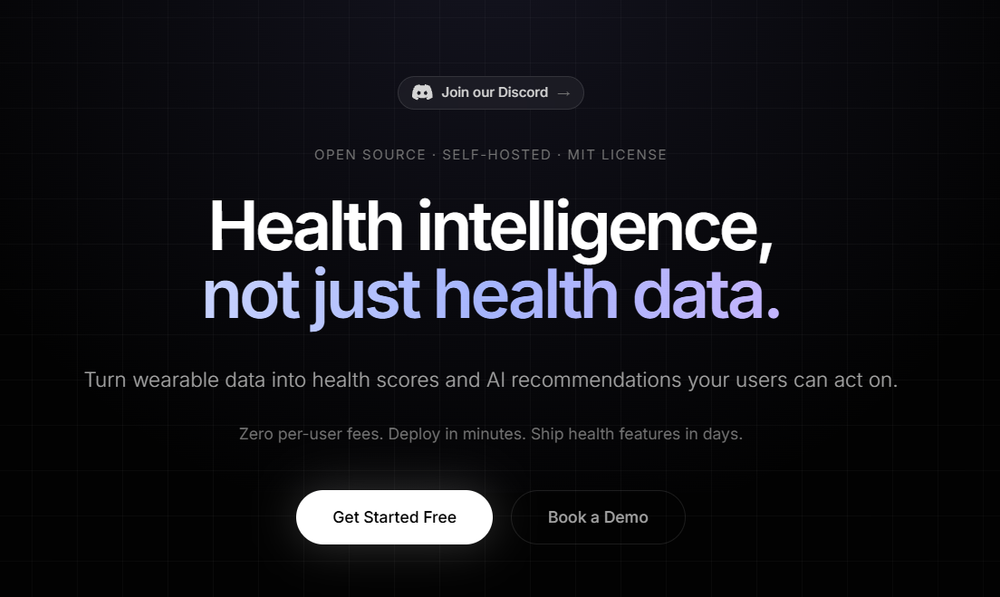
Who Open Wearables is for#
Health app developers unifying devices
Use Open Wearables when your app needs a single API over wearable data from multiple providers.
Skip if:
Your product only supports one wearable provider with a mature first-party API.
Teams building AI health insights
Use Open Wearables to normalize sleep, activity, and fitness data before building natural-language or automation features.
Skip if:
You cannot meet the privacy, consent, and compliance requirements around health data.
The problem it solves#
Wearable data is fragmented across device vendors, mobile ecosystems, and provider APIs. Developers building health, fitness, or quantified-self apps have to implement each integration separately before they can even start working on product logic.
That fragmentation gets worse when AI features need normalized data. Sleep, activity, heart rate, and workout fields need consistent structure before they are useful for insights, notifications, or user-facing automation.
How it solves it#
Unified wearable data API
Provides one API over multiple wearable and fitness data sources, reducing the need to build separate Garmin, Whoop, Apple Health, or Suunto integrations.
Developer portal and widgets
Includes developer-facing surfaces and embeddable widgets so health apps can connect users and display synced data more quickly.
AI-ready health data
Positions normalized wearable data for natural-language automations and health insights, which helps teams building AI features on top of fitness streams.
Strengths and trade-offs#
Strengths
- Reduces integration sprawlOpen Wearables gives developers one self-hosted layer for multiple wearable providers instead of a separate connector per device ecosystem.
- Self-hosted health data controlHealth data is sensitive. A self-hosted path helps teams reason about data handling and retention before adding AI or analytics features.
Trade-offs
- -Provider coverage must match your usersOpen Wearables is useful only if its supported device and provider integrations cover the wearables your audience actually uses.
What it's built on#
- Languages
- PythonTypeScript
- Frameworks
- FastAPISvelte
- Infrastructure
- AWS
- Cache
- Redis
FAQ#
What is Open Wearables?
Open Wearables is a self-hosted tool that unifies wearable health data through one API for health and fitness applications.
Which wearable providers does Open Wearables target?
The official source references providers such as Garmin, Whoop, Apple Health, and Suunto as examples of the integrations it aims to unify.
Who should use Open Wearables?
Open Wearables fits developers building health apps, quantified-self tools, or AI health workflows that need normalized data from multiple wearable sources.
Similar open-source tools#

Simdjson
Parse gigabytes of JSON per second with SIMD instructions

Renart
SQL and Python pipelines, notebooks, and dashboards in Git

jsreport
JavaScript report server with PDF, Excel, DOCX, and HTML output

FckSignups
Open-source tools that work instantly, no signup required

Typesense
Fast typo-tolerant search engine with instant results

Omnara
Open-source agent deployment API. Self-host or use Omnara Cloud.