

Open Source Alternatives LogoOpen Source Alternatives
AlternativesBlogAdvertise
Open Source Alternatives LogoOpen Source Alternatives

Stay Updated

Subscribe to our newsletter for the latest news and updates about Alternatives

Open Source Alternatives LogoOpen Source Alternatives

Handpicked Open Source Alternatives to Paid Softwares

Product
  • Search
  • Categories
  • Tag
  • Sign In
Resources
  • Blog
  • Collection
  • Submit
  • Advertise your tool
Company
  • Privacy Policy
  • Terms of Service
  • Refund Policy
  • Sitemap
Copyright © 2026 All Rights Reserved.
Home/Categories/Product & Project Management/OpenFlags
icon of OpenFlags

OpenFlags

Open source alternative to LaunchDarkly, Optimizely and Statsig

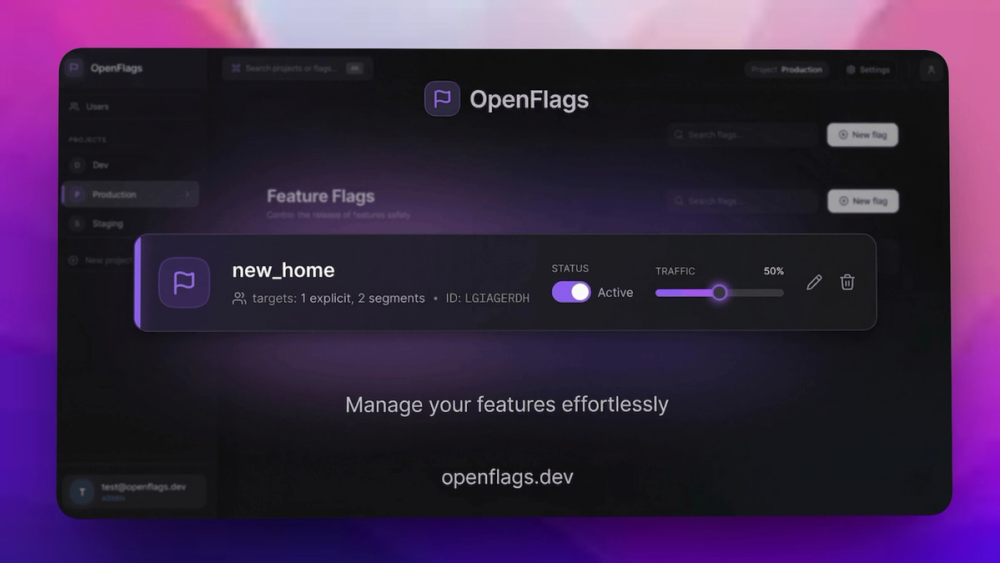
Self-hosted feature flags for modern JavaScript teams with zero latency local evaluation.

17 stars
image of OpenFlags
Contents
  1. 01What OpenFlags does

Repository

Stars
17
Forks
0
License
MIT
Latest
@openflagsdev/[email protected]
Last commit
73 days ago
Last verified
May 13, 2026
Repo
huextrat/openflags ↗
TypeScript
MIT
Active recently
Visit websiteGitHub repo
  • 02Who OpenFlags is for
  • 03The problem it solves
  • 04How it solves it
  • 05Strengths and trade-offs
  • 06Tech stack
  • 07FAQ
  • 08Similar open-source tools
  • TL;DR

    OpenFlags is an MIT-licensed feature flag tool for React, Bun, and Node.js teams. It gives developers a self-hosted control plane for local flag evaluation, progressive rollout, and feature gating without a large managed flag vendor.MIT · TypeScript · 17 stars · Active recently

    what it does

    What OpenFlags does#

    OpenFlags is an open-source feature flag management tool designed for modern JavaScript teams. It allows developers to implement feature flags with zero latency local evaluation, enabling faster and safer feature rollouts. Key features include:

    Key Features

    • Self-hosted: Keep your data secure and under your control by hosting OpenFlags on your own infrastructure.
    • Zero Latency Evaluation: Evaluate feature flags locally in your application, ensuring quick and reliable performance.
    • Percentage Rollouts: Gradually roll out features to a subset of users, allowing for controlled testing and feedback.
    • Lightweight Control Plane: A simple and efficient control plane that avoids the complexities and costs associated with enterprise solutions.

    Use Cases

    • Progressive Delivery: Implement features gradually to minimize risk and gather user feedback before a full rollout.
    • A/B Testing: Test different versions of features to determine which performs better with your audience.
    • Canary Releases: Release new features to a small group of users before a wider launch to ensure stability and performance.
    who it's for

    Who OpenFlags is for#

    JavaScript teams shipping progressive rollouts

    OpenFlags fits teams that want to gate React, Bun, or Node.js features without buying a larger flag service.

    Skip if

    You need mature enterprise governance, audit workflows, and many official SDKs.

    Founders testing features safely

    The self-hosted model gives small teams a way to turn features on gradually while keeping costs predictable.

    Skip if

    You need no-maintenance SaaS operations more than data ownership.

    the problem

    The problem it solves#

    how OpenFlags solves it

    How it solves it#

    Self-hosted feature flags

    OpenFlags provides a self-hosted feature flag control plane for teams that want ownership of flag data and rollout state.

    JavaScript stack focus

    The README positions OpenFlags for React, Bun, and Node.js applications.

    Hosted deploy templates

    The README includes Railway and Zeabur deploy buttons, giving small teams a quicker path than manual server setup.

    strengths · trade-offs

    Strengths and trade-offs#

    Strengths

    • Lightweight alternative to enterprise flag toolsOpenFlags focuses on core flag workflows, which can fit small JavaScript teams better than a full experimentation product.
    • Data stays in your deploymentSelf-hosting helps teams keep flag definitions and rollout state under their own operational control.

    Trade-offs

    • -JavaScript-centered adoptionTeams with polyglot backends, mobile apps, or complex experimentation needs should verify SDK coverage before standardizing on OpenFlags.
    tech stack · detected from GitHub

    What it's built on#

    Languages
    JavaScriptTypeScript
    Frameworks
    Next.jsReact
    Runtimes
    Node.js
    frequently asked

    FAQ#

    What is OpenFlags?

    OpenFlags is a self-hosted feature flag tool for modern JavaScript applications.

    Which stacks does OpenFlags target?

    The README positions OpenFlags for React, Bun, and Node.js teams.

    What license does OpenFlags use?
    also worth a look

    Similar open-source tools#

    GrowthBook

    GrowthBook

    Open source A/B testing and feature flag platform

    7.8KTypeScript
    Flipt

    Flipt

    Feature flags that store and evaluate on your own infrastructure

    4.8KGo
    Flagsmith

    Flagsmith

    Open source feature flags and remote config, self-hosted

    6.4KPythonBSD-3-Clause
    Unleash

    Unleash

    LaunchDarkly alternative with SDK for 30+ languages, self-hosted

    13.5KTypeScriptApache-2.0
    CocoIndex

    CocoIndex

    Incremental data framework for AI agents.

    9.7KPythonApache-2.0
    DeepSeek TUI

    DeepSeek TUI

    A coding agent that lives in your terminal.

    27.6KRustMIT

    Additional details

    Language
    TypeScript
    Open issues
    2
    Contributors
    2
    First release
    2026

    Categories

    Product & Project ManagementDeveloper ToolsDevOps & CI/CD

    Tags

    Feature FlagSelf HostedDeveloper ToolsA/B TestingCI/CD PlatformsAPI Development Tools

    Feature flags should reduce release risk, but managed flag tools can add cost, latency, and vendor dependency for small teams. Teams shipping JavaScript apps often need simple flag control before they need an enterprise experimentation suite.

    When flag evaluation depends on a hosted service for every request, reliability and speed become part of the release risk. Local evaluation and self-hosted control make more sense for teams that want predictable behavior close to the app.

    OpenFlags is MIT licensed according to repository metadata.