

Who Flagsmith is for#
Engineering teams practicing progressive delivery
Flagsmith helps teams release features gradually, target cohorts, and turn off risky changes without redeploying.
Skip if:
Choose a managed flag service if no one can operate a highly available flag backend.
Product teams managing remote configuration
Teams can adjust application behavior for environments, segments, or customer groups through remote config.
Skip if:
Skip it if you need deep experimentation statistics and warehouse-native metric analysis as the main requirement.
The problem it solves#
Shipping every feature as an all-or-nothing release increases risk. Without feature flags, teams need emergency rollbacks, branch gymnastics, or redeploys just to disable a broken feature for one segment.
Managed flag services solve rollout control, but they can become expensive and central to production availability. Teams that want cost and data control may prefer a self-hosted flag service.
How it solves it#
Feature flags and remote config
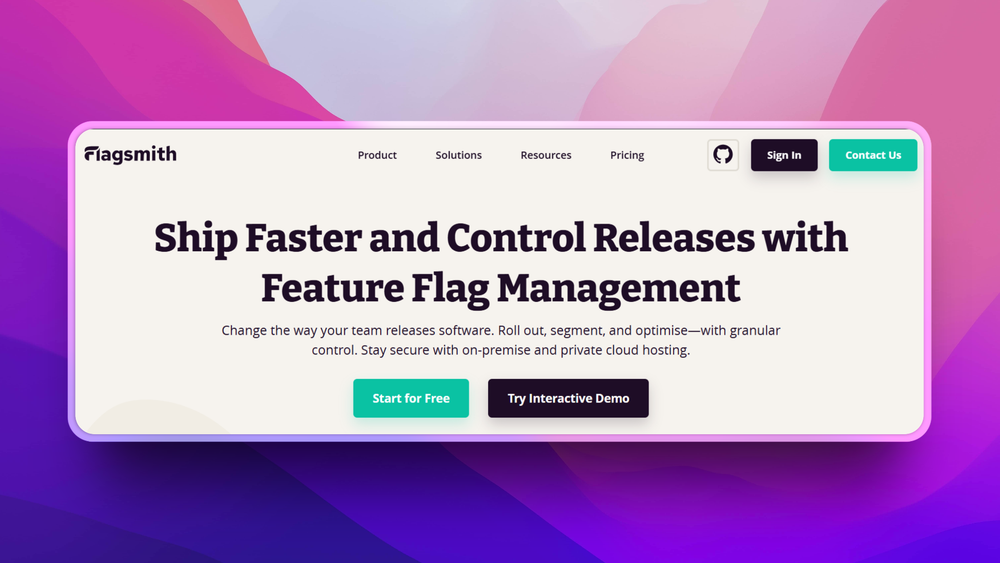
Flagsmith supports flag-controlled releases and remote configuration, letting teams change behavior without deploying new code.
Segmentation and targeting
Teams can target users or segments for gradual rollouts, experiments, or environment-specific behavior.
Self-hosted flag service
Flagsmith describes on-premise and private cloud hosting, giving teams control over flag infrastructure and data paths.
BSD-3-Clause license
The GitHub repository reports BSD-3-Clause licensing for the API repository.
Strengths and trade-offs#
Strengths
- Reduces release riskFlags let teams ship code separately from releasing features, which makes staged rollouts and quick disables easier.
- Open alternative to managed flag vendorsTeams can inspect and self-host the core service instead of putting production feature control entirely behind a proprietary vendor.
- Useful for product and engineering alignmentRemote config and targeting let product teams control exposure while engineering keeps deployment cadence steady.
Trade-offs
- -Flag service reliability becomes production-criticalIf apps depend on remote flag decisions, the Flagsmith deployment needs high availability, caching strategy, monitoring, and incident planning.
- -Experiment analytics may need pairingFlagsmith handles rollout and config, but teams should verify whether its analytics depth matches dedicated experimentation tools for their use case.
Flagsmith vs alternatives#
Flagsmith vs LaunchDarkly
Flagsmith and LaunchDarkly both help teams manage feature flags and remote configuration. Flagsmith gives teams an open-source and self-hostable path; LaunchDarkly offers a mature proprietary managed service with enterprise support.
Flagsmith is the better fit when source access, self-hosting, and cost control matter most. LaunchDarkly is still the better choice when the company wants a vendor-managed flag service, enterprise reliability, and broad commercial support.
What it's built on#
- Languages
- JavaScriptPythonTypeScript
- Frameworks
- DjangoExpressReact
- Databases
- PostgreSQL
- Infrastructure
- AWSDocker
- Tooling
- Webpack
FAQ#
What does Flagsmith do?
Flagsmith provides feature flags and remote configuration so teams can control rollouts and target application behavior.
Can Flagsmith be self-hosted?
Yes. Flagsmith describes on-premise and private cloud hosting and positions the project as an open-source alternative to managed feature flag vendors.
What license does Flagsmith use?
The Flagsmith API repository reports BSD-3-Clause licensing.
Similar open-source tools#

OpenFlags
Self-hosted feature flags for React, Bun, and Node.js

Flipt
Feature flags that store and evaluate on your own infrastructure

GrowthBook
Open source A/B testing and feature flag platform

Unleash
LaunchDarkly alternative with SDK for 30+ languages, self-hosted

FckSignups
Open-source tools that work instantly, no signup required

rakazo
AI teammates you own: your keys, your model, your machine.