
Who OpenLLaMA is for#
Researchers comparing LLM training methods
OpenLLaMA gives labs a known LLaMA-style baseline for controlled experiments across sizes and frameworks.
Skip if:
Use a newer open model if your goal is production answer quality rather than reproducible research.
Tool builders testing model infrastructure
Teams can use OpenLLaMA to test inference, fine-tuning, conversion, and evaluation pipelines without relying on a closed API.
Skip if:
Skip it if your system requires current instruction-following performance or commercial support.
The problem it solves#
Proprietary or restricted-weight LLMs make it hard to reproduce research, inspect training choices, or run controlled experiments. Teams can call an API, but they cannot easily compare tokenizer choices, pretraining data, fine-tuning methods, or deployment behavior against an accessible baseline.
Open-weight models help, but they age quickly. Researchers need to know whether they are choosing a current production model or a reproducible reference point.
How it solves it#
LLaMA-style open reproduction
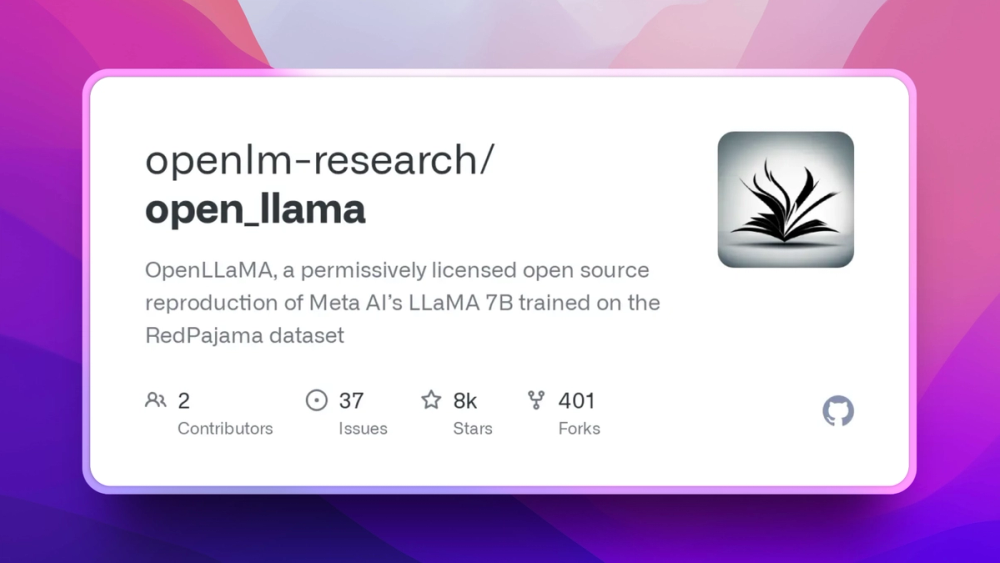
OpenLLaMA was created as an open reproduction of Meta's LLaMA family, giving researchers a downloadable model family for experimentation.
Multiple model sizes
The project published 3B, 7B, and 13B parameter versions, which lets teams choose between smaller experiments and larger baseline comparisons.
PyTorch and JAX compatibility
The project publishes PyTorch weights for Hugging Face Transformers and JAX weights for EasyLM, covering two common research and deployment stacks.
Apache-2.0 code and checkpoint license
The project README states that the EasyLM training framework and OpenLLaMA checkpoint weights are permissively licensed under Apache-2.0. Teams should still review the exact Hugging Face model page before commercial use.
Strengths and trade-offs#
Strengths
- Useful reproducible baselineOpenLLaMA gives researchers a known open-weight LLaMA-style baseline for experiments, model comparisons, and tooling tests.
- Smaller sizes lower experiment costThe 3B and 7B options are more practical for labs and individual builders than only working with very large models.
- Works with common ML stacksPyTorch and JAX compatibility makes it easier to integrate OpenLLaMA into existing research code and fine-tuning workflows.
Trade-offs
- -Not a current frontier modelOpenLLaMA is valuable as a baseline, but newer open models usually outperform it for production assistants, coding, and instruction-following tasks.
- -Weight terms need separate reviewRepository licensing does not always answer every model-weight use case. Teams should verify the exact terms attached to the weights they download.
FAQ#
Is OpenLLaMA the same as Meta LLaMA?
No. OpenLLaMA is an open reproduction inspired by LLaMA-style models, not an official Meta model release.
What model sizes did OpenLLaMA release?
OpenLLaMA is commonly associated with 3B, 7B, and 13B parameter model releases.
Should I use OpenLLaMA for production?
Usually no for new production apps. It is more useful as a research baseline or infrastructure test model than as a current best-performing LLM.
Similar open-source tools#

Qwen
Alibaba's Apache 2.0 LLM in sizes from small to frontier scale

LibreChat
One self-hosted interface for every AI model you use

free-claude-code
Route 9 AI coding agents through 1.3B+ free monthly tokens
needle
14MB on-device LLM for tool calling on edge devices

Steel‑LLM
1B Chinese LLM with public weights, training code, and data

TinyLLaMA
Compact 1.1B LLaMA model trained on 3 trillion tokens