

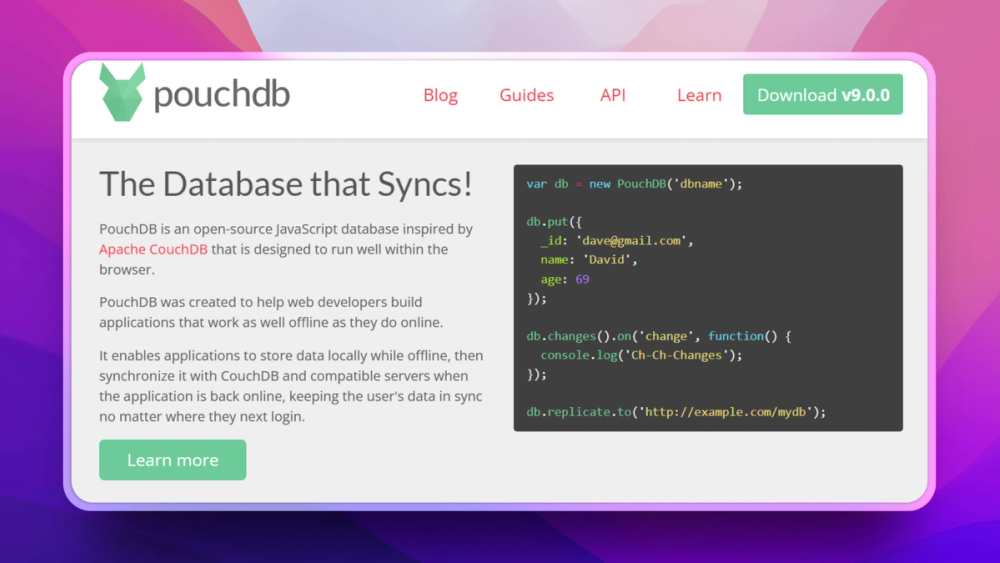
Who PouchDB is for#
Field apps working with unreliable networks
Use PouchDB when users must create or edit records before reconnecting to the server.
Skip if:
Skip if your app requires strict real-time central consistency for every write.
Offline-capable browser tools
PouchDB helps web apps cache structured data locally and sync later without inventing a custom offline queue.
Skip if:
Skip if your data model needs complex server-side relational queries in the client database.
The problem it solves#
Web apps that depend entirely on a network connection fail in common real-world conditions: field work, travel, warehouses, events, spotty mobile coverage, and locked-down networks. Adding offline behavior later often means bolting on local storage, conflict handling, and sync logic after the app is already built.
Developers need a database model that treats local persistence and server sync as core behavior, not an afterthought.
How it solves it#
Browser-side database
Stores application data locally in the browser so users can keep working while offline or on unreliable connections.
CouchDB-compatible sync
Replicates with CouchDB and compatible servers, giving developers a tested sync model instead of custom API queues.
JavaScript-first API
Works naturally in web applications and Node.js tooling, which keeps the offline data layer close to frontend code.
Strengths and trade-offs#
Strengths
- Offline-first by designPouchDB is built around local writes and later sync, which is cleaner than retrofitting offline mode onto a server-only app.
- Apache-2.0 license and mature ecosystemThe permissive license and long-running project history make it a practical option for teams that need inspectable browser storage.
Trade-offs
- -Conflict handling still needs product decisionsReplication can detect conflicts, but the application still needs rules for merging, showing, or rejecting conflicting edits.
PouchDB vs alternatives#
PouchDB vs Firebase Firestore
PouchDB and Firestore can both support offline-capable apps, but they use different ownership models. PouchDB is an open source JavaScript database that syncs with CouchDB-compatible servers; Firestore is a proprietary managed Google Cloud database.
PouchDB is better when local data ownership and open replication matter. Firestore is still better when teams want managed backend operations, hosted security rules, and Google Cloud integration.
What it's built on#
- Languages
- JavaScript
- Frameworks
- Express
- Tooling
- Rollup
FAQ#
Is PouchDB open source?
Yes. PouchDB is open source under the Apache-2.0 license.
What does PouchDB sync with?
PouchDB syncs with CouchDB and CouchDB-compatible servers using replication.
How does PouchDB compare to Firebase Firestore?
Firestore is a managed cloud database with offline client SDKs. PouchDB is an open source browser database focused on CouchDB-style replication and local ownership.
Similar open-source tools#

MongoDB
Popular open source NoSQL document database for modern apps

RethinkDB
Open source distributed document database with real-time feeds

Markdown Preview Editor
Browser-only Markdown editor with live preview and strict privacy.

Duckle
Self-hosted ETL on DuckDB with 385 connectors and no per-row billing.

Parson
Self-hosted music server. Folder in, music everywhere.

CodeBoarding
Review code changes as architecture maps, not line diffs