Black Friday at Hostinger: 15% off yearly and longer plans with BFVPS15, until 6 Dec. See plans

Black Friday: 15% off hosting with BFVPS15

Open Source Alternatives
  • Alternatives
  • Categories
    Categories by size1,345 projects
    • Developer Tools688
    • AI & Machine Learning557
    • Business & Productivity334
    • Web Development221
    • Security & Monitoring205
    • Communication & Collaboration173
    • IT Management166
    • Design & Creative151
    • DevOps & CI/CD145
    • LLMOps & AI Tooling144
    Browse all 21 categoriesCloud & Hosting, Product & Project Management and 9 more
  • Blog
  • Advertise
SearchNotion, Slack, password manager.../
Submit
Open Source Alternatives
  • Alternatives
    • Developer Tools688
    • AI & Machine Learning557
    • Business & Productivity334
    • Web Development221
    • Security & Monitoring205
    • Communication & Collaboration173
    • Browse all 21 categories
  • Blog
  • Advertise
Submit your project

New open source projects by email

The projects we add and every new guide. Free, unsubscribe any time.

Open Source Alternatives LogoOpen Source Alternatives

Handpicked Open Source Alternatives to Paid Softwares

Add Open Source Alternatives as a preferred source on Google

Product

  • Categories
  • Tag
  • Advertise

Resources

  • Blog
  • Collection
  • Submit

Company

  • Privacy Policy
  • Terms of Service
  • Refund Policy
  • Sitemap

Alternatives

  • Claude Code
  • Jira
  • Notion
  • Slack
  • Linear
  • Wispr Flow
  • All alternatives
© 2026 Open Source Alternatives. All rights reserved.
Open SourceAlternatives
Home/Categories/Data & Analytics/DuckDB
icon of DuckDB

DuckDB

Open source alternative to Snowflake, Google BigQuery, ClickHouse Cloud and MotherDuck

  • 43.4K stars
  • MIT
  • Active this week
  • Last commit 2 days ago

Last verified Nov 26, 2026

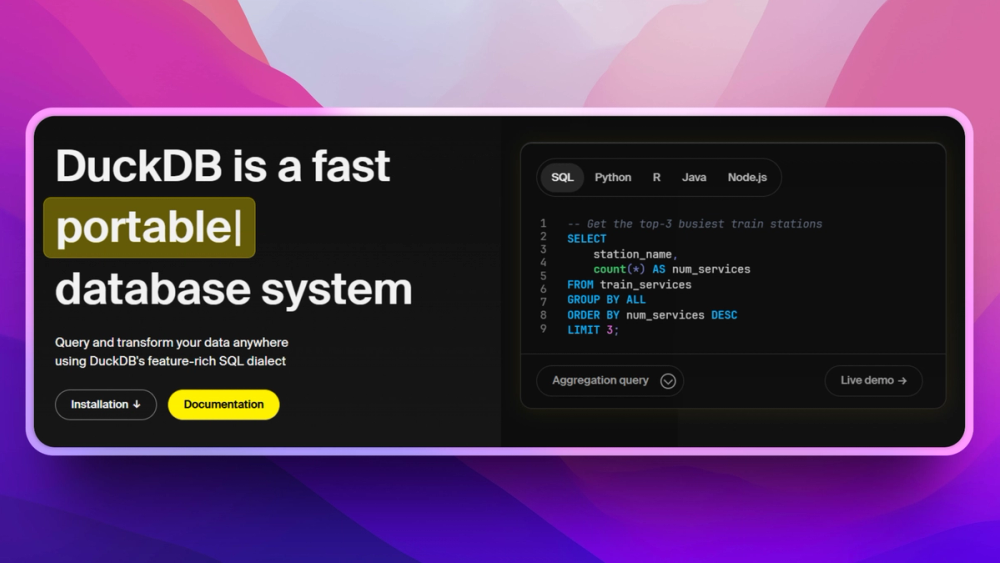
Query data files and cloud storage with SQL, a standard database language, right inside your app. MIT licensed, no server needed.

Visit websiteGitHub43.4K stars
image of DuckDB
TL;DR

DuckDB is a free analytics engine you install as a library. It reads CSV (comma-separated spreadsheet) files, Parquet (a compact column format), JSON (a text format for data), and cloud storage like S3 (Amazon's file service) directly with SQL queries. No server and no monthly fee. It is a free alternative to paid cloud services like Snowflake and BigQuery for work that fits on your own machine. MIT licensed. Best for developers and analysts who need fast file queries without managing a server.

Read the full breakdownHide the full breakdownWho it is for, how it works, trade-offs, the quick start and the FAQ
who it's for

Who DuckDB is for#

Data analysts querying CSV or Parquet exports

DuckDB reads those files directly with SQL queries. You can filter, group, and join without loading anything into a database first. A CSV export from a contact database or Parquet files from a data warehouse are both usable in one line.

Skip if:

Your data already lives in a database that can run analytical queries. If your Postgres or MySQL instance is fast enough for the queries you need, DuckDB adds nothing here.

Python developers building data pipelines

DuckDB works alongside pandas and replaces slow Python loops for aggregations and joins. You write SQL where it is faster and cleaner, and pass the results back to pandas for the rest. For reading large Parquet files or joining several CSV exports, it is typically much faster.

Skip if:

Your pipeline's bottleneck is network calls or writing results back to storage. DuckDB speeds up the query and transformation steps, not the data-fetching steps.

Teams running analytics on their own cloud storage

DuckDB reads files directly from S3 or Azure without copying them. You can run queries against your data in cloud storage without paying for a managed warehouse. The results come back to your machine; nothing moves to a third-party service.

Skip if:

Your team runs dozens of queries from many people at the same time. DuckDB on one machine works for one analyst at a time. For heavy concurrent use from many people, a managed warehouse like Snowflake handles it better.

the problem

The problem it solves#

Most paid data warehouse services charge you by the query or by the amount of data they read. With Snowflake or BigQuery, a single query that scans a large table can cost several dollars. For teams running dozens of queries a day, those costs add up fast.

The other common path is writing scripts to process files in Python or another language. Those scripts are slow to write, hard to maintain, and break when you change the file format. If a data file grows larger than the memory on your machine, they fail entirely.

how DuckDB solves it

How it solves it#

Direct file queries with SQL

You can query a CSV, Parquet, or JSON file with a single SQL statement: `SELECT * FROM 'data.parquet'`. No loading or importing step. DuckDB reads only the columns and rows the query needs, so large files run fast.

Runs inside your app, no server process

DuckDB runs in-process, inside the same program that calls it. There is no separate database process to manage, no port to open, and no network call. You import it as a library in Python, Node.js, Go, Rust, R, or Java.

Reads directly from cloud storage

DuckDB reads files directly from S3, Azure file storage, and Google Cloud Storage. You write `SELECT * FROM 's3://bucket/file.parquet'` and it handles the connection. Your data never has to leave cloud storage.

Connects to PostgreSQL, MySQL, and SQLite

DuckDB can attach to a live PostgreSQL or MySQL database and query it in place, without copying data. You can join a local CSV file with a table from your production database in one query.

Extensions for new formats and databases

Extensions add new file formats and database connectors. Core extensions come bundled; they include Apache Iceberg (an open format for large datasets in cloud storage) and Delta Lake (a similar open file format for analytics). Community extensions install at runtime with one command.

strengths · trade-offs

Strengths and trade-offs#

Strengths

  • Free to run, foreverDuckDB is MIT licensed. You can run it on your own machine at no cost, modify it, and use it commercially. There are no seat licenses, no per-query fees, and no self-hosting restrictions. The managed MotherDuck service is separate and optional.
  • Query files without loading them firstDuckDB reads directly from CSV, Parquet, and JSON files and from cloud storage. It scans only the columns your query needs. For analytical queries on large files, this is much faster than loading data into a table first.
  • Works everywhere Python or Node runsThe Python library works with pandas and Arrow (a column format for in-memory data), so you can move data between them without copying. DuckDB also runs in the browser through WebAssembly, which lets compiled code run in a web page. That means you can add client-side analytics to a website.
  • One library, every major languageOfficial clients exist for Python, R, Java, Go, Rust, Node.js, and the command line. Each client is a native library, not a database driver that needs a running server. You can embed DuckDB in a desktop app, a web server, or a data pipeline.

Trade-offs

  • -Not designed for high-write workloadsDuckDB is built for reading and analyzing data, not for fast writes or updates. If your app handles many small inserts at once (a shopping cart, a logging system, user activity), use a database like PostgreSQL instead. It handles that kind of work much better.
  • -Only one process can write at a timeMultiple processes cannot write to the same DuckDB file at the same time. For a team sharing one database file, only one person can be writing at any moment. If you need several services writing at the same time, you need a server-based database instead.
versus alternatives

DuckDB vs alternatives#

DuckDB vs Snowflake

Snowflake is a cloud data warehouse where you pay per second of compute and per byte stored. DuckDB is free and runs on your own machine.

FeatureDuckDBSnowflake
LicenseMITProprietary
HostingYour machine or serverSnowflake-managed cloud
CostFreePay per query
Data locationYour storageSnowflake's storage

DuckDB is the better choice when your datasets fit on one machine or in your own cloud storage, and you want zero per-query cost. Snowflake is worth it when you need many analysts running queries at the same time. It also makes sense when you need Snowflake's data-sharing features, which let other Snowflake accounts access your data.

DuckDB vs Google BigQuery

BigQuery is Google's data warehouse in the cloud. It charges you for each byte of data it reads through a query. For teams already deep in Google Cloud with very large data, BigQuery is a natural fit.

DuckDB is a better fit when your data is not in Google Cloud. It also suits you when query costs at scale are a concern, or when you want to keep your data off Google's servers.

DuckDB vs MotherDuck

MotherDuck is a managed cloud service built on DuckDB. It adds shared notebooks, team collaboration, and cloud-hosted storage on top of the same query engine. DuckDB is the free self-hosted core. MotherDuck wraps it with managed servers and a subscription fee.

Pick MotherDuck when you need to share queries or data with teammates without managing any servers yourself. Use DuckDB directly when you want full control, no subscription fee, and your data to stay on your own storage.

install · quick start

Quick start#

bash
Install DuckDB for the command line, or add it to your project.

```bash
# Command line
curl https://install.duckdb.org | bash

# Python
pip install duckdb

# Node.js
npm install @duckdb/node-api
```
tech stack · detected from GitHub

What it's built on#

Languages
CC++PythonSwift
frequently asked

FAQ#

Is DuckDB free to use?

Yes. DuckDB is MIT licensed and free to run on your own machine for any purpose, including commercial use. There is no self-hosted fee and no per-query cost. MotherDuck, a managed cloud version built on DuckDB, is a separate paid service with its own free tier.

Can DuckDB replace Snowflake or BigQuery for my team?

For workloads where your data fits on one machine or in your own cloud storage, yes. DuckDB reads files directly from S3 and other cloud storage without a managed warehouse in between. It does not replace Snowflake or BigQuery in every case. Those services are better when you need many people querying at the same time, or petabyte-scale storage managed for you.

Does DuckDB work with Python and pandas?

Yes. The Python library works directly with pandas. You can query a pandas DataFrame with SQL, convert a DuckDB result to a DataFrame, or read a Parquet or CSV file into a DataFrame, all without copying the data. It also works with Arrow, a column format for in-memory data, for fast data exchange.

What is the difference between DuckDB and SQLite?

SQLite is built for small transactional reads and writes, like storing settings or user data in an app. DuckDB is built for analytical queries on large datasets. It scans columns in parallel and returns aggregation results much faster than SQLite on large tables. If you are summing millions of rows, DuckDB is the right tool. If you are storing app state, SQLite is.

Can I query files stored in S3 or other cloud storage?

Yes. DuckDB reads files directly from S3, Azure file storage, and Google Cloud Storage. You write the cloud storage path in the FROM clause the same way you would write a local file path. No data needs to move to your machine first.

also worth a look

Similar open-source tools#

ClickHouse

Alternative toSnowflake

Fast open source column-oriented database for analytics

  • 51,154 GitHub stars
  • Apache-2.0Licence Apache-2.0

timesfm

Alternative toGoogle BigQuery

Foundation model for time-series forecasting

  • 35,701 GitHub stars
  • Apache-2.0Licence Apache-2.0

Trino

Alternative toStarburst Enterprise

SQL query engine that spans databases, data lakes, and cloud stores.

  • 13,546 GitHub stars
  • Apache-2.0Licence Apache-2.0

Apache AsterixDB

Alternative toCouchbase Capella

Scalable Big Data management with high-performance analytics

  • 322 GitHub stars
  • Apache-2.0Licence Apache-2.0

Trench

Alternative toAmplitude

Open source analytics infrastructure powered by ClickHouse

  • 1,666 GitHub stars
  • MITLicence MIT

Dolt

Alternative toPlanetScale

Git-native SQL database with branching, merging, and row-level diffs.

  • 25,002 GitHub stars
  • Apache-2.0Licence Apache-2.0
by category

Open source tools in these categories#

125

Data & Analytics

Firecrawl, ragflow, Worldmonitor
79

Databases & Storage

Immich, Supabase, Redis
688

Developer Tools

REA (Reverse Engineer Anything), Skills for Real Engineers, superpowers

Sponsors

SnitchFeed

Live monitoring on LinkedIn, X, Reddit & more. Agentic social listening for startups.

Marketing & Growth

Windshift

Alternative toJira

Self-hosted work management for teams leaving Jira

  • 481 GitHub stars
  • AGPL-3.0Licence AGPL-3.0

Nuphos

Alternative toConductor

Agent workspace for teams running Claude Code or Codex

  • 821 GitHub stars
  • Apache-2.0Licence Apache-2.0
  • #AI Agents
Advertise your product

New open source projects by email

The projects we add and every new guide. Free, unsubscribe any time.

Find open source alternatives to paid software

/
  • Claude Code to OpenCode
  • Jira to Windshift
  • Notion to AppFlowy
  • Slack to Mattermost
  • Linear to GitLab
  • Wispr Flow to Handy
  • Microsoft To Do to Super Productivity
  • Arc to Zen Browser
  • CapCut to Concat
  • Grok Bot to Rakazo
  • Superhuman to Inbox Zero
  • Discord to Stoat
  • Airtable to AITable
  • Datadog to SigNoz
  • Muse to OpenClaw
  • Railway to Coolify
  • GitHub Copilot to Cline
  • Confluence to Wiki.js
  • Microsoft Teams to Rocket.Chat
  • 1Password to KeePassXC
  • Zapier to n8n
  • Pinecone to Qdrant
  • Contentful to Strapi
  • Firebase to Supabase