
I researched the best open source monitoring tools so you don't have to burn a quarter of your cloud budget discovering that full-stack observability from a SaaS vendor scales badly. These tools give you full infrastructure and application observability: metrics, logs, and traces, without Datadog's $15-31/host/month pricing that turns a 50-node production environment into a $60,000/year cost center.
Datadog's public pricing page tells the story: infrastructure monitoring starts at $15/host/month, APM at $31/host/month, log management at $0.10/GB ingested plus $0.05/GB indexed. You end up paying $50-100/host/month for a medium-complexity stack. New Relic switched to a consumption model that sounds flexible until your first production-volume bill arrives. Grafana Cloud, Splunk, Dynatrace: the pattern repeats. Monitoring is a cost center that scales with your success, which is exactly backwards from what you want.
Open source monitoring tools don't charge per host or per GB. You pay for infrastructure, typically a single server or small cluster, and retain as much data as your storage allows. The trade-off is operational overhead: someone has to run the monitoring stack. For most engineering teams, that trade-off is worth it by an order of magnitude at scale.
TL;DR: If you want one tool that handles logs, metrics, and traces, deploy OpenObserve. If you want zero-instrumentation Kubernetes visibility, use Coroot. For the most battle-tested metrics setup, combine Prometheus with Grafana. For APM and distributed tracing with all three pillars, SigNoz is the best Datadog alternative with full OpenTelemetry support.
Key Takeaways:
- Best all-in-one observability (logs + metrics + traces): OpenObserve: modern, storage-efficient, 140x cheaper storage than Elasticsearch
- Best for infrastructure-focused monitoring: Coroot: eBPF-based, auto-instruments Kubernetes and VMs without SDK changes
- Best metrics visualization: Grafana: the de facto standard dashboard layer for any monitoring stack
- Best time-series metrics collection: Prometheus: the pull-based metrics standard with the largest exporter ecosystem
- Best APM + distributed tracing: SigNoz: OpenTelemetry-native, covers logs + metrics + traces, Apache 2.0
Quick Comparison
| Tool | Type | Self-Hosted | Metrics | Logs | Traces | Setup Difficulty |
|---|---|---|---|---|---|---|
| OpenObserve | All-in-one | Yes | Yes | Yes | Yes | Easy |
| Coroot | Infra + APM | Yes | Yes | Yes | Yes | Easy |
| Grafana | Visualization | Yes | Via plugins | Via Loki | Via Tempo | Intermediate |
| Prometheus | Metrics | Yes | Yes | No | No | Intermediate |
| SigNoz | APM | Yes | Yes | Yes | Yes | Intermediate |
How I Evaluated These Tools
In my evaluation, every tool had to clear a minimum bar before earning a place in this list: OSI-approved license, active maintenance (commits in the last 6 months), self-hostable on a single server, and evidence of real production use. Beyond that baseline, I weighted five criteria:
- Data coverage: does it handle metrics, logs, and traces, or do you need multiple tools?
- Query performance: can you query 30 days of data in under 5 seconds?
- Storage efficiency: at scale, monitoring data grows fast; compression and tiering matter
- Instrumentation overhead: how much effort does setup require? Can teams without dedicated SREs run it?
- Operational complexity: how much time does the monitoring stack itself demand after initial setup?
I excluded tools that are unmaintained, require proprietary cloud components for core functionality, or use non-OSI licenses (BSL, SSPL, Elastic License).
What to Look For in Open Source Monitoring Tools
In my research, monitoring tools fail in predictable ways. Not at deployment, but at 3am when something breaks and you need to find the root cause fast. Here is what I look for when evaluating whether a monitoring tool actually helps:
- Data coverage: does it handle metrics, logs, and traces, or do you need multiple tools?
- Query performance: can you query 30 days of data in under 5 seconds?
- Storage efficiency: at scale, monitoring data grows fast; compression and tiering matter
- Alert quality: are alerts actionable, or do they produce alert fatigue?
- Cardinality handling: high-cardinality metrics (per-user, per-request) are where many tools break
- Operational complexity: how much time does the monitoring stack itself require?
1. OpenObserve: Modern All-In-One Observability
Best for teams who want a single tool for logs, metrics, and traces without the storage costs of the ELK Stack or the operational complexity of a multi-tool setup.
OpenObserve (O2) is the most interesting new entry in the open source observability space. It is designed from scratch for cloud-native environments with a single-binary deployment, built-in compression (140x better storage efficiency than Elasticsearch per their published benchmarks), and SQL-based querying across all telemetry types.
The value proposition is direct: you get logs, metrics, traces, and dashboards in one tool, without stitching together Elasticsearch plus Kibana plus Prometheus plus Grafana plus Jaeger. The storage efficiency means you can afford to retain more data for longer, critical for incident retrospectives and capacity planning.
Key Features
- Single binary: runs as one process, not a multi-service cluster
- Unified query: SQL and PromQL across logs, metrics, and traces
- Columnar storage with Parquet: extremely efficient for analytical queries
- OpenTelemetry native: ingest via OTEL collector out of the box
- Built-in dashboards: no separate visualization tool needed
- S3-compatible storage backend: store data on Minio, S3, GCS, or local disk
- Alerting with Prometheus-compatible alert rules
Pros
- 140x lower storage cost than Elasticsearch per their published benchmarks
- All three observability pillars in a single deployment
- SQL querying across all telemetry types is genuinely powerful for ad-hoc debugging
- Scales from single binary to distributed cluster
Cons
- Newer project, less battle-tested than Prometheus and Grafana at extreme scale
- Ecosystem integrations still growing (Prometheus has 10+ years of exporters)
- Machine learning and anomaly detection features still maturing
Self-Hosting
Single binary, available for Linux, macOS, and Windows. Docker image and Kubernetes Helm chart provided. Can use local disk, S3, Azure Blob, or GCS for storage. Remarkably low operational overhead for what it provides.
License: Apache 2.0
GitHub Stars: 13k+
View OpenObserve on Open Source Alternatives
2. Coroot: eBPF-Based Infrastructure Monitoring
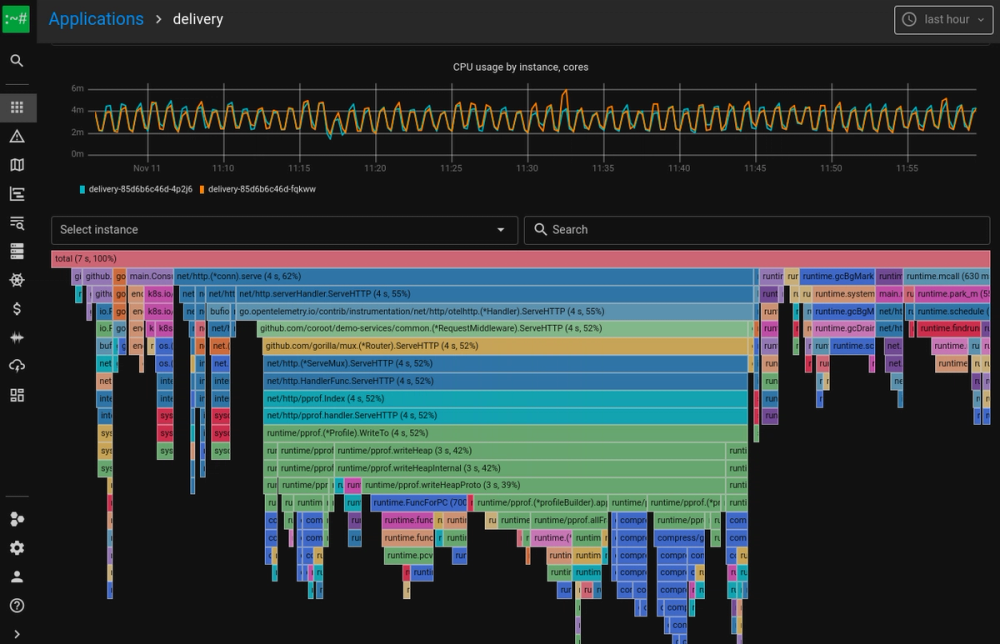
Best for DevOps and SRE teams who want automatic service maps, RED metrics, and root cause analysis for Kubernetes environments without touching application code.
Coroot takes a fundamentally different approach to the instrumentation problem. Instead of asking you to add SDKs to every service, it uses eBPF (extended Berkeley Packet Filter) to observe your infrastructure at the kernel level. This means it can map service dependencies, measure latency, and identify bottlenecks without code changes.
The result is a monitoring tool that works in minutes on any Kubernetes cluster or Linux VM. Deploy the Coroot agent, and you get automatic service topology, RED metrics (Rate, Errors, Duration), and log collection, all without touching application code. For teams with a large number of services or legacy codebases, this is a significant operational advantage.
Key Features
- eBPF-based auto-instrumentation: no SDK required, no code changes
- Automatic service topology: visualizes how services communicate and depend on each other
- RED metrics: Rate, Errors, and Duration for every service, automatically
- Root cause analysis: correlates incidents across metrics, logs, and traces
- Log analysis: automatic log pattern detection and anomaly scoring
- SLO tracking: define and monitor service level objectives
- Cost monitoring: tracks cloud resource costs per service
Pros
- Truly zero-configuration for basic infrastructure visibility
- eBPF instrumentation works for any language or runtime
- Automatic service dependency maps are genuinely useful for complex environments
- Root cause analysis correlates signals faster than manual dashboard navigation
Cons
- Requires Linux (eBPF is Linux-specific), no Windows support
- Advanced APM features require additional instrumentation for some use cases
- Newer project with less ecosystem breadth than Prometheus and Grafana
Self-Hosting
Kubernetes DaemonSet deployment. Docker image available for non-Kubernetes environments. Stores data in ClickHouse (can be co-located). Lightweight agent footprint with minimal resource overhead.
License: Apache 2.0
GitHub Stars: 5k+
View Coroot on Open Source Alternatives
3. Grafana: The Universal Dashboard Layer
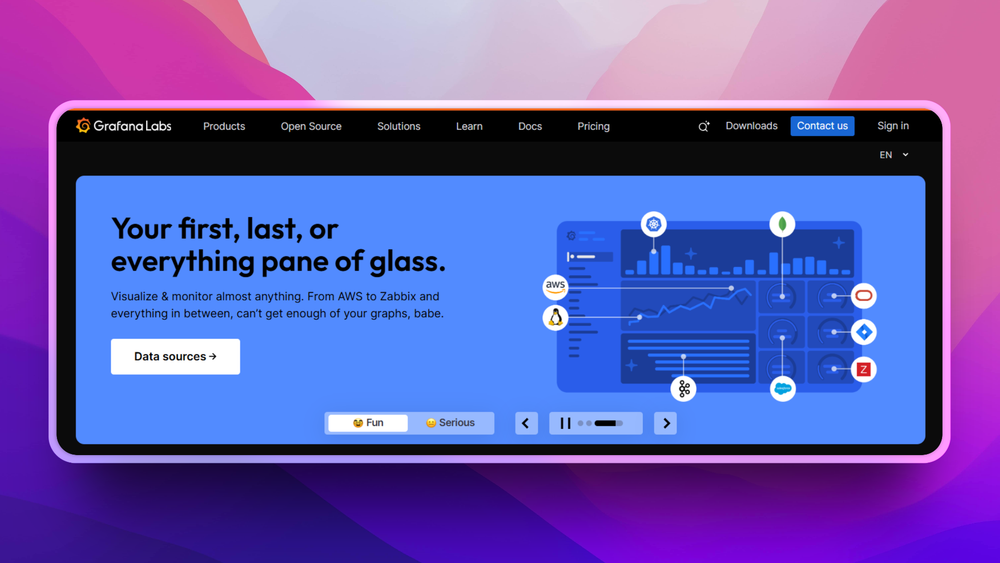
Best as the visualization and alerting layer for any monitoring stack, pairing with Prometheus, Loki, Tempo, and dozens of other data sources.
Grafana is the de facto standard for metrics visualization in the open source world. It is not a data collection tool: it is a dashboard and alerting layer that connects to virtually any data source: Prometheus, InfluxDB, Elasticsearch, Loki, MySQL, PostgreSQL, and 60+ more.
Every serious monitoring stack needs Grafana. The combination of Prometheus (metrics) plus Loki (logs) plus Tempo (traces) plus Grafana (visualization) is the open source equivalent of Datadog, and many companies run this exact stack in production at massive scale. The community has produced prebuilt dashboards for virtually every common service: databases, Kubernetes, nginx, Redis, AWS, and thousands more.
Key Features
- Universal data source support: 60+ integrations including Prometheus, Loki, InfluxDB
- Alerting with multi-dimensional rules, notification channels, and silencing
- Dashboard templating: variable-driven dashboards for multi-tenant environments
- Explore mode: ad-hoc query interface for real-time debugging
- Unified alerting across all data sources
- Plugin ecosystem for custom visualizations and data sources
- Grafana OnCall: incident management (open sourced)
Pros
- Largest community and ecosystem of any monitoring visualization tool
- Prebuilt dashboards available for virtually every common service
- Grafana Cloud free tier makes getting started easy
- Highly stable and production-proven at large scale across thousands of organizations
Cons
- Requires separate data sources for metrics, logs, and traces
- Alert management can become complex in large-scale environments
- Self-hosting requires pairing with storage backends (Prometheus, Loki, etc.)
Self-Hosting
Docker image and Kubernetes Helm chart available. Grafana itself is stateless except for dashboard configuration (stored in a database). Lightweight: approximately 200MB RAM for the Grafana process itself.
License: AGPL v3
GitHub Stars: 64k+
View Grafana on Open Source Alternatives
4. Prometheus: The Metrics Standard
Best for time-series metrics collection in Kubernetes and microservice environments, the foundation most open source monitoring stacks are built on.
Prometheus is the Kubernetes-era metrics standard. The pull-based collection model works as follows: Prometheus scrapes metrics from endpoints rather than receiving pushes, which works well with dynamic container environments where services come and go. The Prometheus data model (time-series identified by metric name plus label key-value pairs) is now the standard that InfluxDB, Grafana Mimir, and OpenMetrics all target.
If you are running Kubernetes, you are probably already running Prometheus. The kube-state-metrics project and node-exporter give you deep cluster visibility out of the box, covering everything from node CPU and memory to pod scheduling and persistent volume status.
Key Features
- Pull-based metrics collection with configurable scrape intervals
- PromQL: powerful functional query language for time-series data
- Service discovery: automatically discovers targets in Kubernetes, Consul, EC2, and more
- Alerting rules with Alertmanager for deduplication and routing
- Long-term storage options: Thanos, Cortex, or Grafana Mimir for scalable retention
- Massive exporter ecosystem: PostgreSQL, Redis, nginx, JVM, AWS, and thousands more
Pros
- De facto standard for Kubernetes metrics with enormous community backing
- PromQL is expressive, well-documented, and widely understood by engineers
- Active CNCF project with long-term stability guarantee
- Exporters exist for almost every infrastructure component imaginable
Cons
- No built-in long-term storage (use Thanos or Grafana Mimir for multi-week retention)
- Pull model can be complex in network-segmented or firewall-restricted environments
- No logs or traces, metrics-only (pair with Loki and Tempo for full observability)
License: Apache 2.0
GitHub Stars: 55k+
View Prometheus on Open Source Alternatives
5. SigNoz: Full-Stack APM and Distributed Tracing
Best for engineering teams migrating off Datadog or New Relic who need a single tool covering APM, distributed tracing, logs, and metrics with native OpenTelemetry support.
SigNoz is the most direct open source replacement for Datadog's APM product. Built natively on OpenTelemetry and ClickHouse, it gives you distributed tracing, metrics dashboards, log management, and application performance monitoring in one self-hosted deployment. Unlike Jaeger (traces-only) or Prometheus (metrics-only), SigNoz handles all three observability pillars together.
The key differentiator is the APM correlation experience. When a request is slow, SigNoz lets you move from a trace flamegraph to the relevant logs to the infrastructure metrics for that service, all in one UI, without switching tools or manually correlating timestamps. That end-to-end visibility is what makes paid tools like Datadog worth paying for, and SigNoz delivers it self-hosted.
Key Features
- Distributed tracing with flamegraph and span analysis
- OpenTelemetry native: instrument once, no vendor lock-in
- Correlated signals: jump from trace to logs to metrics in one click
- Service health dashboards: RED metrics (Rate, Errors, Duration) per service
- Log management: structured log search and filtering
- Alerts: set anomaly and threshold-based alerts
- ClickHouse backend: high-performance columnar storage for trace and log data
Pros
- Most complete Datadog APM alternative available as open source
- Native OpenTelemetry support means standard SDK instrumentation works without changes
- ClickHouse backend handles high trace volume efficiently
- Active development with frequent releases and growing community
Cons
- Requires OpenTelemetry SDK instrumentation (not zero-config like Coroot)
- ClickHouse adds operational complexity compared to simpler storage backends
- Younger project than Grafana or Prometheus, with some rough edges in the UI
Self-Hosting
Docker Compose or Kubernetes deployment. Docker Compose quickstart gets you running in under 10 minutes. ClickHouse is bundled and co-located by default; can be externalized for production scale.
License: Apache 2.0
GitHub Stars: 20k+
View SigNoz on Open Source Alternatives
Also Worth Considering
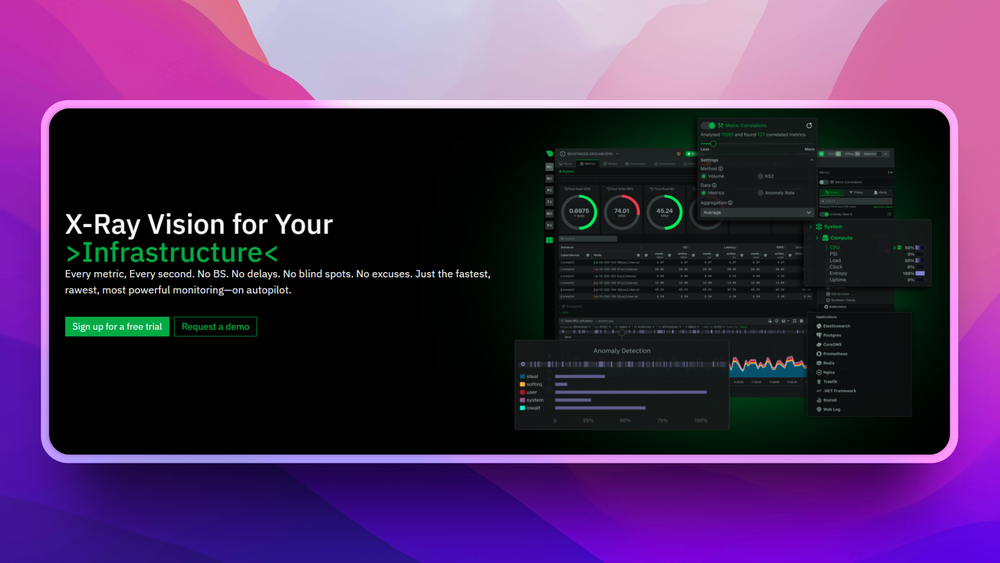
The five tools above cover the core observability use cases. For specific scenarios, two more tools from the Security & Monitoring category deserve mention:
Netdata: Real-time, per-second infrastructure monitoring with a built-in dashboard that requires zero configuration. Ideal for per-host visibility and quick health checks. Install with a one-line script and you get CPU, memory, disk, and network metrics immediately. Less suited for distributed tracing or log aggregation, but nothing beats it for raw real-time infrastructure visibility. View Netdata on Open Source Alternatives
Uptime Kuma: A lightweight, self-hosted uptime monitoring tool in the style of UptimeRobot. Monitors HTTP, TCP, DNS, Docker containers, and more, with alert integrations for Slack, PagerDuty, email, and others. Not a full observability stack, but an essential complement for external availability monitoring and status page generation. View Uptime Kuma on Open Source Alternatives
How to Choose an Open Source Monitoring Tool
Use this decision framework based on your team's actual situation:
Are you on Kubernetes and want zero-configuration visibility first?
Start with Coroot. eBPF-based instrumentation means you deploy the DaemonSet and get service maps, RED metrics, and log collection without touching a line of application code. Add Grafana and Prometheus later if you need custom dashboards and alerting.
Do you want a single binary that handles everything?
Deploy OpenObserve. One binary, one deployment, all three pillars covered. Best for teams that want to minimize operational complexity and storage costs. The SQL query interface is particularly useful for ad-hoc debugging.
Are you migrating an existing Prometheus + Grafana stack?
Keep it. Add Loki for logs and Tempo for traces if you need them. This combination is the most battle-tested path for teams already invested in the Prometheus ecosystem. Grafana has prebuilt dashboards for almost everything and a community that will outlast any individual project.
Do you need APM and distributed tracing as the primary use case?
Use SigNoz. It is the most complete open source replacement for Datadog APM with native OpenTelemetry support. The correlated signals experience (trace to logs to metrics) is the closest open source gets to Datadog's core value.
Are you a small team with limited ops capacity?
OpenObserve's single binary and S3 backend minimize operational overhead. Coroot's zero-instrumentation approach is also practical for small teams without dedicated SREs.
Do you need per-host real-time system monitoring specifically?
Netdata. Nothing else gives you per-second metrics with zero configuration.
Building a Complete Open Source Monitoring Stack
The most common architectures for teams adopting open source monitoring:
Option 1: OpenObserve (simplest)
Single tool handles metrics, logs, and traces. Add OpenTelemetry Collector as the agent for application instrumentation. Lowest operational overhead. Best for teams starting fresh or migrating away from a managed service.
Option 2: Prometheus + Loki + Tempo + Grafana (most common)
- Prometheus for metrics collection and alerting rules
- Loki for log aggregation (Prometheus-style, low cost)
- Tempo for distributed tracing
- Grafana for unified visualization
- Alertmanager for alert routing and deduplication
This stack is the open source equivalent of Datadog. Every component is independently scalable, battle-tested at production scale, and backed by a large community.
Option 3: Coroot (lowest instrumentation effort)
For Kubernetes-native environments where zero-instrumentation visibility is the priority. Deploy the Coroot DaemonSet and get service maps and RED metrics immediately. Pair with Grafana for custom dashboards and deeper metrics analysis.
Option 4: SigNoz + Prometheus (APM-first)
Use SigNoz for application-level observability (traces, logs, APM metrics) and Prometheus for infrastructure metrics. Both support OpenTelemetry, so instrumentation is shared.
Frequently Asked Questions
What is the best Datadog alternative for open source monitoring?
For a direct functional replacement, SigNoz covers APM, distributed tracing, logs, and metrics in a single deployment with native OpenTelemetry support. OpenObserve is the better choice if storage cost and operational simplicity are the primary drivers. The Prometheus plus Loki plus Grafana stack is the most battle-tested path for teams with existing Prometheus investments.
Can these tools handle production scale?
Yes. OpenObserve, Grafana, and Prometheus all run at massive scale in production environments. Prometheus handles thousands of metrics per second per instance; Grafana serves hundreds of engineers simultaneously. The key is proper capacity planning: use Thanos or Grafana Mimir for Prometheus long-term storage, and size storage appropriately for log volume.
Do I need to instrument my code to use these tools?
Coroot requires no code changes, relying on eBPF-based instrumentation. OpenObserve, Prometheus, and SigNoz require OpenTelemetry or Prometheus SDK instrumentation for application-level APM. Grafana itself requires no code changes: it visualizes existing data sources.
How much storage does monitoring data require?
Prometheus stores approximately 1-3 bytes per sample after compression. At 100 time series scraping every 15 seconds, that is roughly 28MB per day. Logs are more variable; compressed Loki storage runs 0.5-2GB per day for moderate-traffic applications (typical compression at 6:1 for structured logs). OpenObserve claims significantly better compression than Elasticsearch for log storage.
Is Prometheus hard to run?
A single Prometheus instance is straightforward, a single binary or Docker container. Scaling to millions of time series or months of retention requires Thanos or Grafana Mimir, which adds complexity. Most teams start with a single Prometheus instance and add long-term storage only when they need it.
What is OpenTelemetry and do I need it?
OpenTelemetry (OTEL) is a vendor-neutral standard for instrumenting applications for metrics, logs, and traces. Most modern monitoring tools (OpenObserve, SigNoz, Grafana Tempo) support OTEL natively. Adopting OTEL means you can switch monitoring backends without re-instrumenting your code. It is the right default instrumentation choice for any new project.
Can I replace Datadog for Kubernetes monitoring specifically?
Yes. Prometheus plus kube-state-metrics plus node-exporter covers Kubernetes infrastructure metrics deeply. Coroot gives you zero-config service topology and RED metrics. SigNoz adds APM-level application visibility. All three are production-proven in large Kubernetes environments.
What about alerting?
Prometheus Alertmanager handles alert routing, deduplication, and silencing for the Prometheus stack. OpenObserve and SigNoz both have built-in alerting. Grafana Unified Alerting works across all connected data sources. All of these integrate with PagerDuty, Opsgenie, Slack, and generic webhooks.
How does SigNoz compare to Jaeger for distributed tracing?
SigNoz covers the same distributed tracing use cases as Jaeger and adds metrics and log management on top. Both use OpenTelemetry for instrumentation. SigNoz is the better default choice for teams starting fresh because it reduces the number of tools you need to operate. Jaeger remains a valid choice if you only need tracing and want a lightweight, purpose-built tool.
Is the AGPL license on Grafana a problem for self-hosting?
No. AGPL only affects distribution. If you run Grafana internally without distributing it to others, the AGPL license has no practical impact on your operations. The vast majority of teams self-hosting Grafana never distribute it, so the license is not a concern in practice.
What is the difference between metrics, logs, and traces?
Metrics are aggregated numeric measurements over time (CPU usage, request rate, error count). Logs are text records of individual events (application errors, audit trails). Traces follow a single request across multiple services to show exactly where time was spent. Full observability requires all three: metrics tell you something is wrong, logs tell you what happened, and traces tell you where in the request path the problem occurred.
Which tool is best for a startup with one or two engineers?
OpenObserve is the most practical choice: single binary, S3 storage backend, all three pillars covered, and minimal ops overhead. Coroot is a close second if you are on Kubernetes and want zero-configuration visibility without any instrumentation work.