

Who OpenObserve is for#
SRE teams reducing log storage costs
Use OpenObserve to retain more telemetry in object storage while keeping search, dashboards, and alerting available.
Skip if:
Skip if your team depends heavily on Datadog-specific integrations and managed workflows.
Startups consolidating observability tools
Logs, metrics, and traces in one open source platform can replace a patchwork of tools early in the infrastructure lifecycle.
Skip if:
Skip if no one on the team can operate an observability backend reliably.
The problem it solves#
Observability data grows faster than most infrastructure budgets. Logs, traces, metrics, and session data can create unpredictable bills in proprietary platforms, and teams often reduce retention or sampling just to control spend.
The operational risk is clear: when an incident happens, the missing data is often the data the team dropped to save money. Teams need observability they can afford to retain and query without giving all telemetry to a vendor.
How it solves it#
Unified telemetry platform
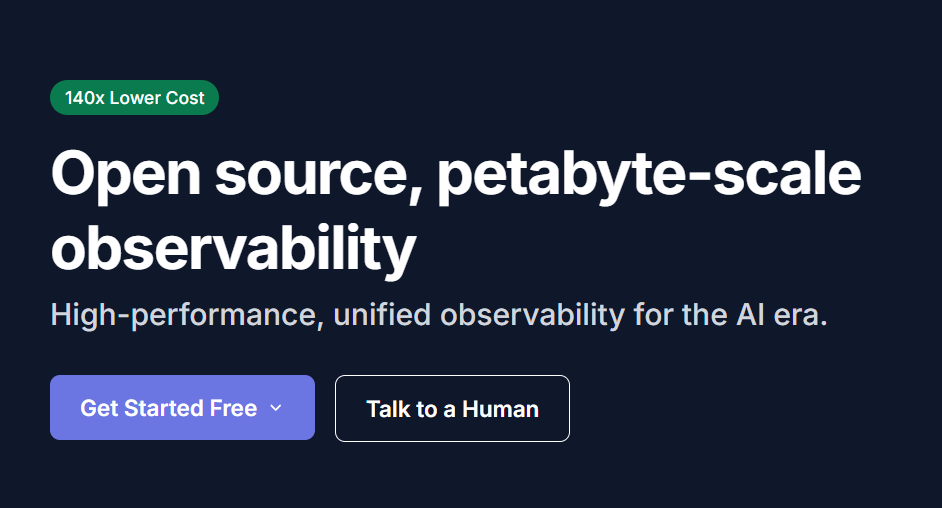
Ingests logs, metrics, and traces into one observability interface with dashboards, search, and alerts.
Object-storage based architecture
Uses object storage for telemetry data, which can lower retention cost compared with vendor-priced hot storage.
Self-hosted and cloud options
Teams can run OpenObserve themselves or use the managed service depending on their operations capacity.
Strengths and trade-offs#
Strengths
- Cost control for high-volume logsThe architecture is attractive for teams whose proprietary observability bill is driven by log volume and retention.
- Open source observability stackAGPL-3.0 source availability gives teams a path to inspect and modify the platform instead of treating observability as a black box.
Trade-offs
- -Datadog ecosystem is broaderOpenObserve covers core observability needs, but Datadog still has a larger integration catalog, mature enterprise workflows, and many specialized monitoring products.
OpenObserve vs alternatives#
OpenObserve vs Datadog
OpenObserve and Datadog both help teams search telemetry, build dashboards, and alert on system behavior. OpenObserve focuses on open source self-hosting and object-storage cost control; Datadog focuses on a broad managed observability suite.
OpenObserve is better when telemetry volume and retention cost are the main pain. Datadog is still better when a team wants the richest managed integration catalog and can accept vendor pricing.
What it's built on#
- Languages
- JavaScriptPythonRustTypeScript
- Frameworks
- Vue
- Search
- Elasticsearch
FAQ#
Is OpenObserve open source?
Yes. OpenObserve is open source under the AGPL-3.0 license.
What data can OpenObserve handle?
OpenObserve handles common observability data including logs, metrics, traces, dashboards, and alerts.
How does OpenObserve compare to Datadog?
OpenObserve gives teams an open source, self-hostable observability platform with a cost-control focus. Datadog remains stronger for managed enterprise features and its integration ecosystem.
Similar open-source tools#

Prometheus

ClawTrace
Visualize agent execution trees and track token costs per step

Stakpak
Open source agent that automates app deployment and monitoring

Coroot
Instant observability with no-code setup.

Grafana
Open source dashboards for metrics, logs, and traces

Netdata
Real-time infrastructure monitoring with zero configuration