
Who Coroot is for#
SRE teams debugging microservice incidents
Coroot helps SREs identify failing services, dependency paths, SLO breaches, and resource spikes from one interface.
Skip if:
Skip it if your environment is a small app with basic uptime checks and no distributed tracing or profiling needs.
Kubernetes teams reviewing deployments
Coroot discovers rollouts and compares releases, which helps teams connect performance changes to deployments.
Skip if:
Choose a simpler monitoring tool if you only need host metrics and alerts without service maps or root-cause analysis.
The problem it solves#
Collecting telemetry does not automatically make systems understandable. Teams often have metrics in one place, logs in another, traces in a third, and no clear service map that explains which dependency caused an outage.
This becomes painful during incidents. Engineers spend time jumping between tools, searching logs manually, and guessing whether a deployment, dependency, or resource spike started the problem.
How it solves it#
eBPF-based visibility
Coroot gathers metrics, logs, traces, and profiles automatically with eBPF, reducing the amount of manual instrumentation needed for supported environments.
Service map coverage
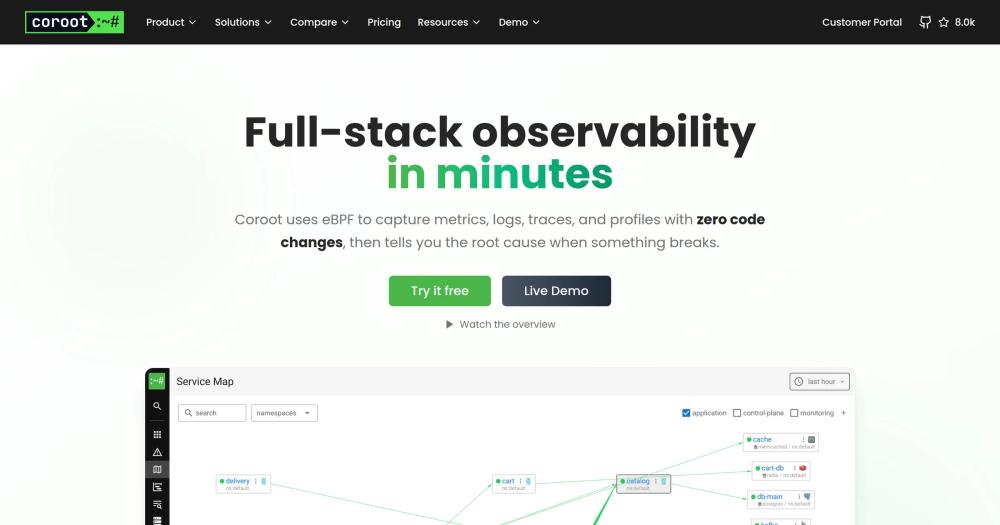
The README describes a service map that covers the system and shows internal and external dependencies, which helps teams trace incident blast radius.
SLO-based alerting
Coroot tracks service level objectives and can alert with inspection results when an application misses its SLO, reducing noisy symptom-only alerts.
Logs, traces, and profiles together
Coroot combines log pattern analysis, logs-to-traces correlation, distributed tracing, and one-click profiling for CPU and memory spikes.
Deployment and cost tracking
Coroot discovers Kubernetes rollouts, compares releases, and includes cost monitoring for AWS, GCP, and Azure environments.
Strengths and trade-offs#
Strengths
- Faster incident contextCoroot's service map, predefined inspections, and SLO summaries help teams move from raw telemetry to likely causes during outages.
- Less instrumentation workeBPF capture and OpenTelemetry compatibility make it useful for mixed services, including legacy or third-party components that are hard to instrument directly.
- Self-hosted observabilityApache-2.0 licensing and self-hosted deployment give teams more control over telemetry storage and operational cost than SaaS-only APM tools.
Trade-offs
- -Best fit for Kubernetes and service-heavy systemsCoroot's strongest features target microservices, Kubernetes rollouts, and infrastructure telemetry. Smaller monoliths may not need this much observability surface.
- -Telemetry storage still costs moneySelf-hosting avoids vendor pricing, but logs, traces, profiles, and metrics still need storage and retention planning, especially with ClickHouse-backed log search.
Coroot vs alternatives#
Coroot vs Datadog APM
Coroot and Datadog both help teams understand production systems, but Coroot focuses on self-hosted observability with eBPF-driven service maps and root-cause inspections. Datadog is a proprietary managed observability suite with broad integrations and vendor-operated storage.
Coroot is the better fit when telemetry ownership, Kubernetes service maps, and self-hosted cost control matter most. Datadog is still the better choice when a team needs a managed enterprise observability suite, broad SaaS integrations, and less responsibility for operating telemetry storage.
What it's built on#
- Languages
- GoJavaScript
- Frameworks
- ReactVue
FAQ#
Does Coroot require manual instrumentation?
Not for every signal. Coroot uses eBPF for automatic metrics, logs, traces, and profiles, while also supporting vendor-neutral OpenTelemetry instrumentation.
Can Coroot be self-hosted?
Yes. Coroot can run as a Docker container or inside a Kubernetes cluster, according to the project README.
What does Coroot replace?
Coroot can replace parts of an APM, observability, incident investigation, and service-map workflow. Teams with deep SaaS APM dependence should compare required integrations before switching.
Similar open-source tools#
ClawTrace
Visualize agent execution trees and track token costs per step
Stakpak
Open source agent that automates app deployment and monitoring
OpenObserve
Self-hosted observability for logs, metrics, and traces
Grafana
Open source dashboards for metrics, logs, and traces
Netdata
Real-time infrastructure monitoring with zero configuration
SigNoz
Open source APM with logs, traces, metrics, and dashboards

