TL;DR: For almost every new self-hosted cloud storage deployment, Nextcloud is the stronger pick. It has a massive community, a full productivity suite built in, and its parent company is based in Germany. OwnCloud is worth considering if you need high-throughput file sync with minimal infrastructure, or if you already have an ownCloud deployment to maintain. One important caveat: Kiteworks, a US-based compliance company, acquired ownCloud in 2024. That changes the sovereignty equation for teams that chose ownCloud specifically to stay out of US corporate hands.
Key Takeaways
- Nextcloud wins for feature breadth: video conferencing, collaborative document editing, 400+ apps, all under AGPL-3.0 with no feature tiers
- OwnCloud Infinite Scale (OCIS) is architecturally simpler: a single Go binary, no external database, better raw throughput for large files
- The Kiteworks acquisition (2024) puts ownCloud under a US parent company; sovereignty-focused teams should factor this in
- Both are fully self-hostable for free; ownCloud's managed support plans start at EUR 5.24/user/month with a 25-user minimum
- For most individuals, small teams, and privacy-conscious organizations: pick Nextcloud
Quick Comparison
| Criteria | Nextcloud | ownCloud (OCIS) |
|---|---|---|
| License | AGPL-3.0 (all features) | Apache 2.0 (OCIS core, from 2026) |
| Architecture | PHP + PostgreSQL + Redis | Go (single binary, no DB) |
| Self-Hosted | Yes, Docker AIO or Compose | Yes, single Docker container |
| Best For | Full collaboration suite | High-throughput file sync |
| GitHub Stars | ~35,000 | ~8,700 (core) |
| Video Conferencing | Yes (Nextcloud Talk) | No |
| App Ecosystem | 400+ apps | Small marketplace |
| Parent Company | Nextcloud GmbH (Germany) | Kiteworks (US, acquired 2024) |
| Min. Paid Support | Negotiated (enterprise) | EUR 5.24/user/month (25-user min) |
Nextcloud
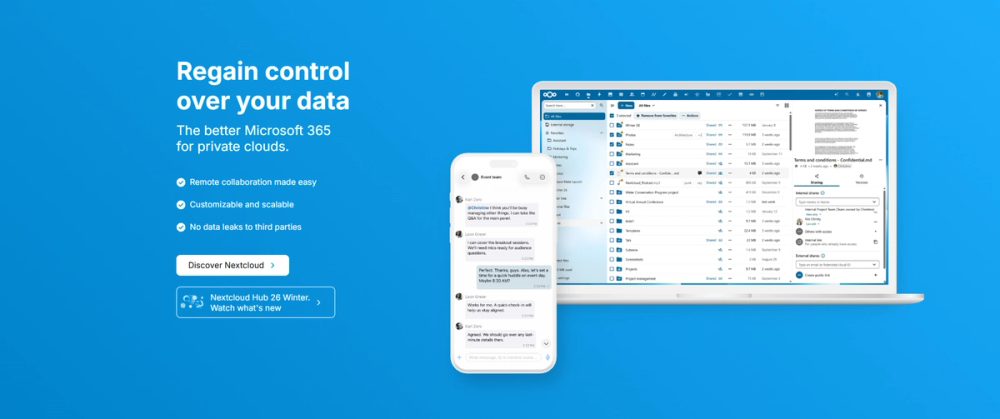
Nextcloud launched in 2016 when Frank Karlitschek, founder of ownCloud, left that project along with most of the core development team. What started as a file sync-and-share fork has grown into one of the most feature-rich self-hosted productivity suites available. It now competes directly with Google Workspace and Microsoft 365 for teams that want to run everything on their own infrastructure.
Key Strengths
- Full productivity suite. Nextcloud Hub bundles Talk (video conferencing and team chat), Office (real-time collaborative document editing via Collabora or OnlyOffice), and Groupware (calendar, contacts, mail) all in one install. You are not piecing together separate services.
- 400+ apps in the marketplace. Password managers, project boards, AI assistants, forms, digital signatures, and more are available as plug-in apps. Most are free.
- Fully open AGPL-3.0. Every feature is available in the community edition. Enterprise subscriptions buy you support from Nextcloud GmbH, not access to locked features.
- Large, active community. ~35,000 GitHub stars on the main server repo. Active forums, Discourse, and Matrix channels. If you hit a problem, someone has likely solved it already.
- EU-based parent company. Nextcloud GmbH is headquartered in Stuttgart, Germany. For teams with GDPR commitments or European data-residency requirements, this matters.
Key Weaknesses
- PHP stack requires more moving parts. A production Nextcloud setup uses PHP-FPM, a database (PostgreSQL recommended), Redis, and optionally a cron container. The official AIO Docker image simplifies this considerably, but you are still running a multi-container stack under the hood.
- Upgrade path can be bumpy. Major version upgrades occasionally break app compatibility. Community forums document most issues, but staying current requires attention.
Self-Hosting Nextcloud
The quickest way to self-host Nextcloud is via the official All-in-One (AIO) Docker image. It handles PHP, the database, Redis, and Collabora in a single setup wizard. For most teams, the command is:
docker run --init --sig-proxy=false --name nextcloud-aio-mastercontainer \
  --restart always --publish 80:80 --publish 8080:8080 --publish 8443:8443 \
  --volume nextcloud_aio_mastercontainer:/mnt/docker-aio-config \
  --volume /var/run/docker.sock:/var/run/docker.sock:ro \
nextcloud/all-in-one:latestEstimated setup time: 20-30 minutes including domain configuration.
Best For
Nextcloud is the right pick for individuals, small teams, and organizations that want one self-hosted platform to replace Google Workspace or Microsoft 365 functionality. It is also the default recommendation for European privacy advocates, given that Nextcloud GmbH is EU-based.
View Nextcloud on Open Source Alternatives
ownCloud
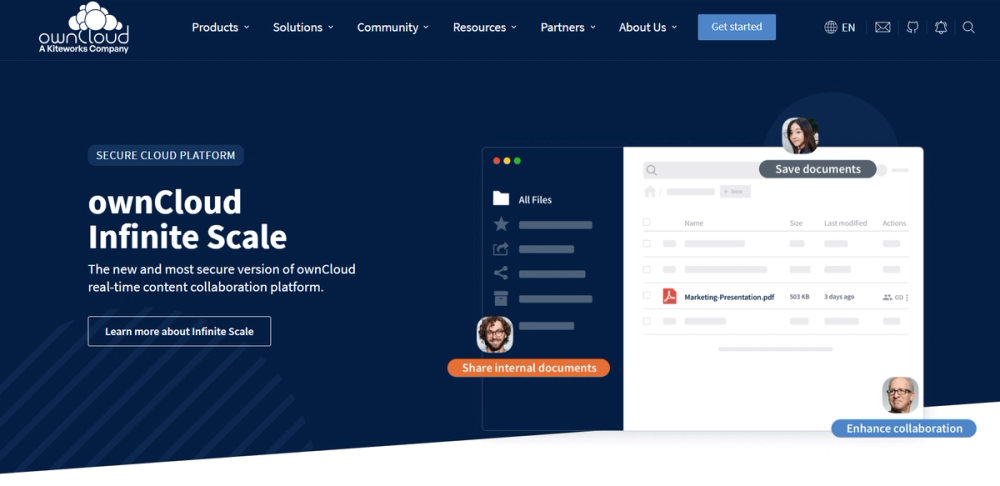
ownCloud is the original project, predating Nextcloud by six years. Most of its developer community left with Frank Karlitschek in 2016, but ownCloud has continued development on two separate tracks: the legacy PHP-based Classic edition and the ground-up Go rewrite called Infinite Scale (OCIS).
The major news from 2024: Kiteworks, a US-based company focused on secure enterprise content communications, acquired ownCloud. This changes the governance and sovereignty profile of the project significantly. In May 2026, Kiteworks launched an Open Source Program Office (OSPO) for ownCloud with a governance charter, retiring the contributor CLA in favor of a Developer Certificate of Origin and relicensing more than 100 projects to Apache 2.0. These are positive steps, but the US corporate parent remains.
ownCloud Classic vs ownCloud Infinite Scale
ownCloud Classic (v10.x): PHP-based, architecturally similar to Nextcloud. This track is on a maintenance path. No significant new features are coming. If you are running ownCloud Classic today, you are on legacy software.
ownCloud Infinite Scale (OCIS): A complete rewrite in Go, in active development since 2019-2020 with stable releases from 2021 onward. This is the current development track. OCIS runs as a single Docker container with no external database required, making it significantly simpler to deploy than either Classic or Nextcloud.
Key Strengths
- Simpler infrastructure. OCIS is a single Go binary. Spin it up with one
docker runcommand. No PostgreSQL to configure, no Redis to tune. For teams that want file sync without operational overhead, this is a genuine advantage. - Better raw throughput. The Go backend handles large file transfers and high concurrency more efficiently than PHP. For deployments moving large files across many concurrent users, OCIS outperforms Nextcloud in raw throughput benchmarks.
- Project Spaces. OCIS introduces Spaces, a multi-root namespace concept that gives different teams or projects isolated storage areas within one deployment. Useful for organizations managing storage for multiple departments.
Key Weaknesses
- No video conferencing. OCIS has no equivalent to Nextcloud Talk. If your team needs integrated video calls and file sharing together, ownCloud is not the answer without adding a separate service.
- Small app ecosystem. The marketplace is a fraction of Nextcloud's. Many features Nextcloud ships by default (password manager integration, AI assistants, collaborative documents) require additional services or are simply absent.
- US corporate parent. For organizations choosing self-hosted cloud to maintain data sovereignty from US tech companies, Kiteworks as parent company is a complication. The OSPO governance steps help, but the corporate structure does not change.
- Smaller community. Finding ownCloud-specific help is harder. Forum threads are sparser; GitHub issues move more slowly. The GitHub star gap (35k vs 8.7k) reflects this reality.
Best For
OwnCloud OCIS is the right pick for enterprises that need high-performance, focused file sync with minimal infrastructure, and who already have separate tools for video and collaboration. It also makes sense for existing ownCloud Classic deployments planning a migration to the Go-based OCIS track.
View ownCloud on Open Source Alternatives
Head-to-Head Comparison
Feature Set and Collaboration
Nextcloud wins clearly. The Hub model bundles video conferencing (Talk), collaborative document editing (Office), calendar, contacts, and mail into one deployment. You get a functional Google Workspace replacement without touching any additional service.
OwnCloud OCIS focuses on files. It does file sync well, adds Spaces for multi-team organization, and supports external office editors via integration, but it does not ship video conferencing or an integrated mail client. If you need those features, you are managing a second service.
Winner: Nextcloud
Deployment and Infrastructure
OwnCloud OCIS has the edge on simplicity. A single Docker container, no database configuration, no Redis tuning. For teams that want to minimize operational work, OCIS is genuinely easier to operate.
Nextcloud's AIO Docker image closes the gap considerably: it handles the full stack in one setup wizard. But you are still running a multi-container stack. The production AIO configuration requires more attention to keep healthy over time.
For teams using Coolify or another self-hosting platform, both deploy straightforwardly. Both work with Traefik as a reverse proxy for TLS termination and routing.
Winner: ownCloud OCIS (by a narrow margin on simplicity)
App Ecosystem and Extensions
Nextcloud has 400+ apps in its marketplace. Password manager, AI assistant, forms, Kanban board, two-factor authentication plugins, and hundreds more are available as one-click installs. Most are free. The ecosystem is large enough that you can replace most SaaS tools with something from the Nextcloud app store.
OwnCloud's marketplace is significantly smaller. Core file sync and sharing work well, but if you need feature extensions, your options are limited. Enterprise customers get additional modules, but those require a commercial subscription.
Winner: Nextcloud (not close)
Community Health and Longevity
Nextcloud's community is one of the strongest in self-hosted software. ~35,000 GitHub stars, thousands of contributors, an annual conference, and active forums mean that help is available and development is continuous. The project has shipped major releases consistently since 2016.
OwnCloud's community has been smaller since the 2016 fork. The Kiteworks acquisition in 2024 created uncertainty. The OSPO launch in May 2026 is a constructive attempt to rebuild contributor trust, but community momentum is still recovering. The GitHub star gap (35k vs 8.7k) is a reasonable proxy for developer mindshare.
Winner: Nextcloud
Sovereignty and Licensing
Both tools offer self-hosted deployments where your data stays on your servers. On that axis they are equal.
The licensing difference matters: Nextcloud's AGPL-3.0 gives you all features without a commercial tier. OwnCloud's managed services and support contracts run through a US-based parent company.
For EU organizations with strict data-sovereignty requirements, Nextcloud GmbH's German domicile is a meaningful differentiator. For organizations using any of ownCloud's managed or support services, the US corporate parent is a complication that the OSPO charter does not fully resolve.
Winner: Nextcloud
The Verdict
For most users: Choose Nextcloud. The combination of a complete productivity suite, a fully open license, a large community, and an EU-based parent company makes it the clear default for individuals, small teams, and organizations replacing SaaS tools with self-hosted software.
For high-throughput file sync: If your primary requirement is moving large files across many concurrent users, and you have separate tools for video conferencing and collaboration, ownCloud OCIS is worth evaluating. The single-binary Go architecture delivers better raw throughput than Nextcloud's PHP stack.
For existing ownCloud deployments: If you are running ownCloud Classic today, your immediate priority is migrating to OCIS before Classic reaches end-of-life. Whether you move to OCIS or take the opportunity to switch to Nextcloud depends on whether you need the richer feature set Nextcloud provides.
For sovereignty-focused teams: Nextcloud. The Kiteworks acquisition makes ownCloud a harder sell for teams choosing self-hosted specifically to maintain European data sovereignty.
Whichever you choose, both integrate with automation tools like n8n for workflow automation connecting your cloud storage to other services in your self-hosted stack.
FAQ
Is Nextcloud free to self-host?
Yes. Nextcloud's community edition is free to self-host under AGPL-3.0. You get all features: file sync, Talk, Office, Groupware, and the full app marketplace. Paid subscriptions buy enterprise support from Nextcloud GmbH, not additional functionality.
Is ownCloud still actively maintained?
Yes. OwnCloud Infinite Scale (OCIS) is under active development as of 2026, now under Kiteworks stewardship. OwnCloud Classic (the PHP-based v10.x line) is on a maintenance path with no new features planned. New deployments should use OCIS.
What happened when Kiteworks acquired ownCloud in 2024?
US-based Kiteworks, which focuses on secure enterprise content communications, acquired ownCloud in late 2024 as part of a broader consolidation that also included DRACOON. The acquisition raised sovereignty concerns in the ownCloud community. In May 2026, Kiteworks launched a formal Open Source Program Office (OSPO) for ownCloud, retired the contributor CLA in favor of a Developer Certificate of Origin, and announced plans to relicense more than 100 projects to Apache 2.0. These governance steps improve the open-source posture, but ownCloud remains a subsidiary of a US company.
Can I migrate from ownCloud to Nextcloud?
Yes, migration is possible. Both platforms use WebDAV for file sync, so file data transfers are straightforward. User accounts, shares, and metadata require more work; Nextcloud has published migration guidance for ownCloud users. It is a planned migration, not a one-click switch, but it is well-documented and commonly done.
Does ownCloud have video conferencing?
No. OwnCloud OCIS does not include video conferencing or an integrated chat tool. If you need video calls alongside self-hosted file storage, you would need a separate service. Nextcloud Talk is built into Nextcloud Hub and handles video conferencing, team chat, and screen sharing.
Which is easier to set up: Nextcloud or ownCloud?
OwnCloud OCIS is simpler at the infrastructure level: a single Docker container with no external database required. Nextcloud's AIO (All-in-One) Docker image makes setup straightforward but still involves a multi-container stack. For teams comfortable with Docker, both are manageable; for minimal operational overhead, OCIS has the edge on initial setup.
What is ownCloud Infinite Scale (OCIS)?
OCIS is ownCloud's complete architectural rewrite, built in Go rather than PHP. It runs as a single binary or single Docker container with no external database, giving it a smaller infrastructure footprint and better performance for large file operations. OCIS has been in active development since 2019-2020 with stable releases from 2021 onward and is the current primary track for ownCloud. OwnCloud Classic (the PHP-based v10.x line) is legacy and on a maintenance path.
Is Nextcloud GDPR-compliant for EU organizations?
Self-hosted Nextcloud keeps all data on infrastructure you control, which is the foundational requirement for GDPR compliance. Nextcloud GmbH is based in Germany and the project is used by EU government organizations including German federal ministries. Compliance still requires proper access controls, data processing agreements, and security practices on your end, but Nextcloud does not create structural GDPR barriers.
Are ownCloud and Nextcloud clients compatible with each other?
The desktop and mobile sync clients are separate applications and are not interchangeable. Nextcloud desktop client connects to Nextcloud servers; ownCloud client connects to ownCloud servers. Both use WebDAV under the hood, but direct client cross-compatibility is not supported. If you migrate from ownCloud to Nextcloud, users need to switch to the Nextcloud client.
Which has a better app marketplace: Nextcloud or ownCloud?
Nextcloud by a significant margin. Nextcloud's app marketplace has 400+ apps covering collaboration, productivity, security, and integrations. OwnCloud's marketplace is smaller and many advanced features require an enterprise subscription. If app ecosystem depth matters for your use case, Nextcloud is the clear choice.