
Multi-tenant SaaS teams
Use Cerbos when tenants, roles, and resource-level rules change often and need clear policy ownership.
Skip if:
Your app only has one or two static roles and no compliance pressure.

Open source alternative to PlainID, Axiomatics and Permit.io
Last verified
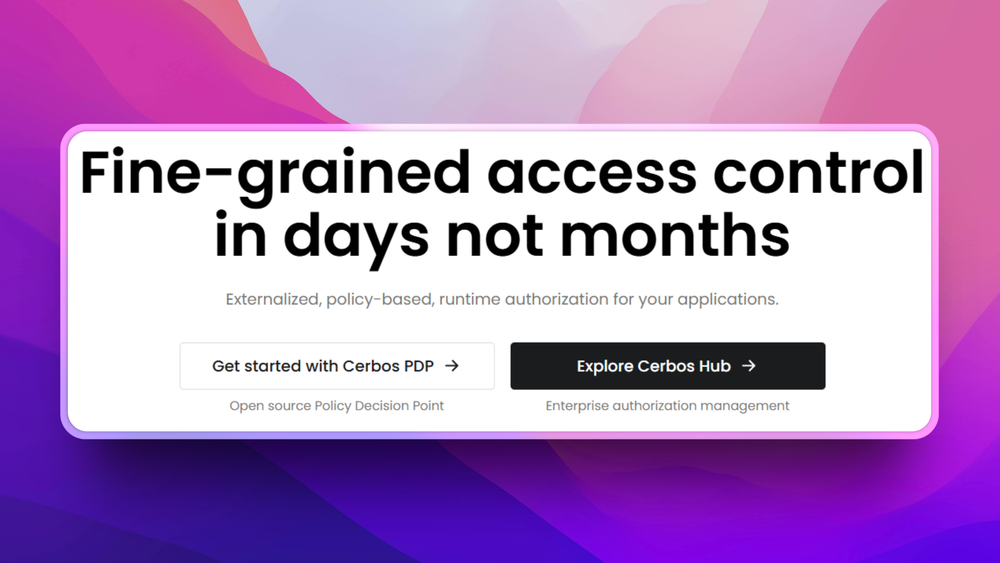
Cerbos is an open-source authorization service that externalizes access control policies from application code into versioned, testable YAML rules. Apache 2.0 licensed, deployable as a sidecar or standalone service.
Use Cerbos when tenants, roles, and resource-level rules change often and need clear policy ownership.
Your app only has one or two static roles and no compliance pressure.
Use Cerbos to provide a shared authorization layer across services without forcing every team to invent permission checks.
Each service has unrelated authorization rules and no shared policy governance.
Use Cerbos when access decisions need version history, tests, and explainable policy files.
A managed identity platform already covers your authorization needs with acceptable audit output.
Authorization logic gets dangerous when every service implements permissions differently. Route handlers, database filters, and business logic accumulate scattered checks that are hard to audit and harder to change. Enterprise customers then ask for new roles, attributes, or compliance evidence, and each policy change becomes an application release risk.
Cerbos runs as a PDP that receives principal, resource, and action data, then returns allow or deny decisions through APIs.
Access rules live in structured YAML policies that can be stored on disk, in Git, cloud object stores, or supported databases.
Cerbos supports role-based rules and attribute-based conditions, allowing teams to model simple roles and more granular contextual access checks.
Kubernetes service, sidecar, systemd service, and AWS Lambda deployment paths let teams place the PDP near the applications it protects.
Cerbos evaluates authorization policies outside application code and returns access decisions for principals, resources, and actions.
No. Cerbos handles authorization and can work with identity providers that supply user or service principal data.
Yes. Cerbos supports self-hosted PDP deployment through Kubernetes, sidecar, systemd, and serverless options.

Alternative to Permit.io
Open source authorization with RBAC, ABAC, and ReBAC for any app

Alternative to WorkOS FGA
Run fine-grained authorization with RBAC, ABAC, and ReBAC

Alternative to Kong Konnect
Unified API keys, gateways, and observability for developers.


Alternative to Clerk
Clerk
Drop-in TypeScript auth with MFA, SSO, and multi-tenancy support

Alternative to RevEng.AI
AI-powered reverse engineering for binaries, apps, and assemblies.
Run Cerbos on your own server
Hostinger sets Cerbos up as a one-click app on a VPS.
Deploy on HostingerFeatured

Alternative toClaude Managed Agents
Open-source agent deployment API. Self-host or use Omnara Cloud.

Alternative to Grok Bot
AI teammates you own: your keys, your model, your machine.

Alternative to Superhuman
AI email assistant that drafts replies and clears your inbox
The projects we add and every new guide. Free, unsubscribe any time.
 Claude Code to
  OpenCode
 Jira to
  Windshift
 Notion to
  AppFlowy
 Slack to
  Mattermost
 Linear to
  GitLab
 Wispr Flow to
  Handy
Handy CapCut to
  Concat
 Grok Bot to
  rakazo
 Superhuman to
  Inbox Zero
 Airtable to
  AITable
 Muse to
  OpenClaw
 GitHub Copilot to
  Cline
Cline Datadog to
  Netdata
 Microsoft Teams to
  Rocket.Chat
 Pinecone to
  Qdrant
 Zapier to
  n8n
n8n Devin AI to
  OpenHands
 Firebase to
  Supabase
 1Password to
  KeePassXCConfluence to
  Docmost
 Contentful to
  Strapi
 Adobe Premiere Pro to
  Shotcut
 ChatGPT to
  AnythingLLM
 LangSmith to
  Langfuse


