

Who Local Deep Research is for#
Analysts researching sensitive topics
Local Deep Research helps analysts keep queries and drafts under more direct control while still running multi-step web research.
Skip if:
Skip it if your organization already approves a hosted research agent and wants managed reliability over local control.
Developers testing local agent research
Developers can experiment with search connectors, model backends, and research loops without building the whole stack from scratch.
Skip if:
Use a simpler search API or notebook if you only need one-off retrieval, not an agentic research workflow.
The problem it solves#
Hosted research agents are convenient, but they can expose sensitive prompts, research topics, documents, and browsing trails to third-party services. For competitive analysis, legal research, security work, or personal projects, that data path can be unacceptable.
Local research tools reduce that exposure, but quality depends on the search connectors, chosen model, and local hardware. Users should expect more setup work than a hosted assistant.
How it solves it#
Local-first research workflow
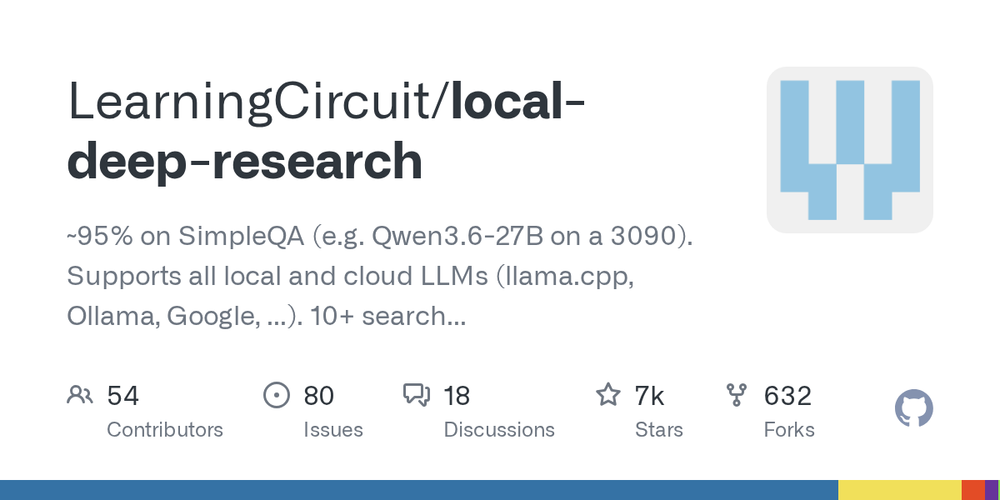
The project focuses on running deep research locally, giving users more control over prompts, search data, and generated notes.
Multiple search sources
The README describes web, academic, and document search plus specialized engines such as arXiv, PubMed, Wikipedia, Semantic Scholar, and OpenAlex, which helps researchers avoid relying on one provider.
Multiple LLM backends
Local Deep Research can work with different LLM backends, making it adaptable to local models or API-backed models depending on privacy and quality needs.
Agentic research loop
The tool is designed for multi-step research rather than single-prompt search, which fits long investigations and source gathering.
Strengths and trade-offs#
Strengths
- Better privacy posture than hosted agentsRunning the workflow locally reduces dependence on a third-party research product for every query and document interaction.
- Flexible model choiceUsers can choose LLM backends based on cost, privacy, speed, and quality instead of being locked into one hosted model.
- Search-source diversitySupport for multiple search engines helps analysts compare coverage and reduce blind spots from a single search provider.
Trade-offs
- -Results depend on local setupResearch quality depends on the configured model, search providers, network access, and hardware. A weak local model will not match a strong hosted research assistant.
- -More operational frictionLocal research workflows need configuration and maintenance. Users who want a zero-setup product should choose a hosted research assistant.
Local Deep Research vs alternatives#
Local Deep Research vs hosted deep research agents
Local Deep Research and hosted deep research agents both aim to automate multi-step research. Local Deep Research prioritizes local control, configurable search sources, and model choice; hosted agents prioritize convenience, managed browsing, and strong default models.
Local Deep Research is the better fit when privacy, experimentation, and backend control matter. Hosted research tools are still better when a user wants the strongest managed model and no setup work.
What it's built on#
- Languages
- JavaScriptPython
- Search
- SearXNG
FAQ#
Is Local Deep Research fully local?
The workflow is designed for local operation, but actual privacy depends on the configured search sources and LLM backend. Using external APIs still sends data to those providers.
Who should use Local Deep Research?
It fits researchers, analysts, and developers who want more control over research prompts, data paths, and model choice than a hosted deep research agent provides.
Does Local Deep Research replace ChatGPT deep research?
It can replace some hosted deep research workflows for users who accept more setup and tuning. Hosted tools may still provide stronger default models and lower maintenance.
Similar open-source tools#

LibreChat
One self-hosted interface for every AI model you use

hyperresearch
Deep research agent with a persistent vault for Claude Code

scientific-agent-skills
AI-driven research automation for complex tasks

GenericAgent
Autonomous agent that evolves skills over time

Thunderbolt
Control your AI infrastructure with Thunderbolt

Jan
Run open source LLMs on your own hardware with no cloud required