
Who comma.ai is for#
Commuter upgrade on a supported older vehicle
improve long-distance lane assist and cruise comfort on a compatible car instead of replacing the vehicle
Skip if:
your car is not in the supported list.
ADAS research team
run experiments on logging, control behavior, and feature changes with inspectable code
Skip if:
you need a certified OEM-grade production toolchain only.
Engineering education program
use openpilot as a practical ADAS baseline for teaching sensor fusion and control logic
Skip if:
curriculum requires official vendor certification.
Small fleet pilot for single platform
standardize assist behavior across repeated vehicle variants with one software stack
Skip if:
your fleet spans many unsupported makes.
The problem it solves#
Drivers rely on factory driver-assistance features that can be inconsistent across vehicles, expensive to upgrade, and hard to inspect or customize. openpilot gives an open source ADAS path for compatible cars with stronger transparency for software behavior, logs, and deployment control. It is for technically minded drivers, researchers, and teams that want a configurable roadmap, not a closed vendor lock-in model.
How it solves it#
Open-source ADAS stack for supported cars
upgrades lane centering, adaptive cruise control, forward collision warning, and lane departure warning on supported vehicles through the openpilot stack.
Device-based rollout on comma four
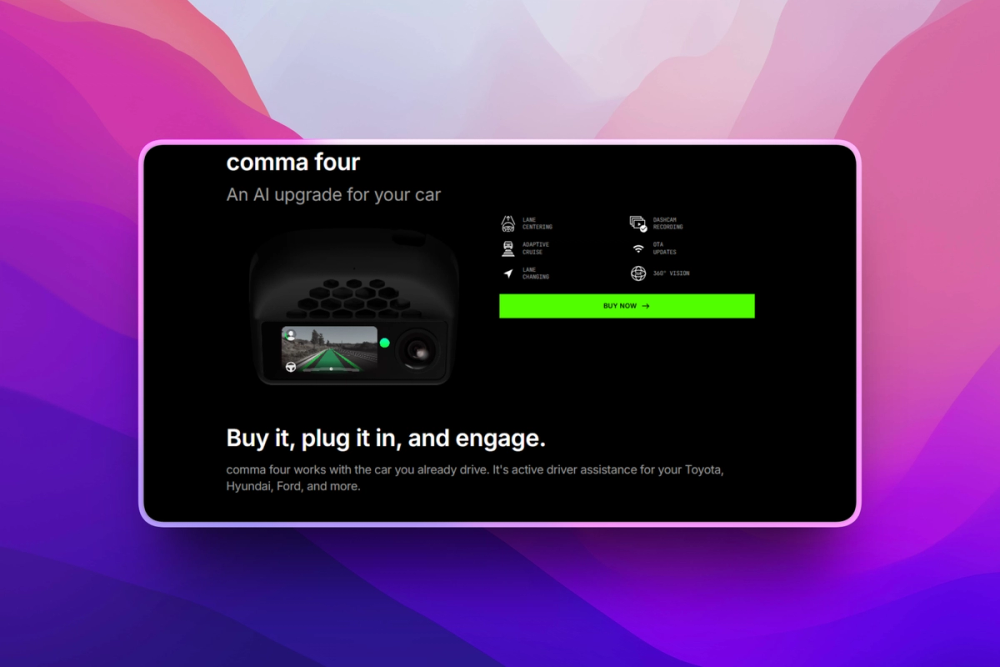
uses comma hardware with setup flow documentation for supported vehicle installs.
Broad model support target
supports 300+ cars with an active compatible car list maintained in the project docs.
Safety-first engineering practices
follows ISO 26262 references, SIL safety process, and continuous software-in-the-loop and hardware-in-the-loop validation in the openpilot workflow.
MIT license
source is licensed as MIT, enabling code reuse, audits, and local customization under standard MIT terms.
Strengths and trade-offs#
Strengths
- Full code visibilityteams can inspect logic and behavior instead of treating ADAS logic as a hidden service.
- Cost control for experimentersavoids the same closed subscription lock pattern seen in premium assist stacks and lets teams stage rollout on their own schedule.
- Developer-friendly pathrelease and branch model supports experimentation and local testing while keeping a stable release branch for non-advanced users.
Trade-offs
- -Harness and compatibility dependencydeployment depends on supported car models, comma hardware, and a correct harness path for each vehicle.
- -Not a full autonomy solutionlane centering and cruise support are assistance features, not full self-driving in all conditions.
- -Research orientation and risk postureopenpilot is alpha-quality software for research use, so teams need stronger process control before broad consumer rollout.
- -Data behavior defaultsdata upload defaults may be enabled, so teams should review settings and privacy expectations before deployment.
comma.ai vs alternatives#
openpilot vs Tesla FSD vs factory premium ADAS packages
openpilot, Tesla FSD, and factory premium ADAS packages all target lane centering and adaptive cruise use cases, but they target different control models. openpilot runs as an open platform with device-based setup for compatible cars, while Tesla FSD is a proprietary, Tesla-only stack that is tightly coupled to the Tesla vehicle ecosystem.
| Feature | openpilot | Tesla FSD | Factory premium ADAS package |
|---|---|---|---|
| License | MIT (open source) | Proprietary | Proprietary |
| Platform | Multi-brand retrofit path | Tesla-only | OEM-specific |
| Code control | Inspectable and forkable | Closed | Closed |
| Install model | User-managed updates on comma device | Vendor-managed OTA | OEM-managed and hardware-specific |
openpilot is usually the better fit if you want transparency, custom integration, and avoid closed software lock-in on supported models. Tesla FSD is usually the better fit for Tesla owners who want a fully managed, integrated stack. Factory packages can still win for users who prioritize turnkey OEM-grade integration, certification posture, and zero aftermarket changes.
Quick start#
bash <(curl -fsSL openpilot.comma.ai)What it's built on#
- Languages
- CC++Python
FAQ#
What does openpilot replace?
It replaces or upgrades stock L2 assist experiences on supported non-Tesla vehicles with a custom, open alternative that runs on comma hardware.
Do I need a supported car and harness?
Yes. You need one of the supported comma devices and a compatible car plus harness setup, otherwise openpilot cannot run properly.
Is openpilot a full autonomous driving system?
No. It is driver assistance software with limitations and conditions, and the driver remains responsible for safe operation.
Is there a paid subscription to run openpilot?
The software stack is open source, so no software subscription is required to run openpilot itself on supported hardware, though hardware and optional services may cost extra.
Can I disable data uploads?
You can disable features like driver-facing camera logging in settings, but you should review data and account settings before use.
Similar open-source tools#

REA
AI-powered reverse engineering for binaries, apps, and assemblies.

Omnara
Open-source agent deployment API. Self-host or use Omnara Cloud.

rakazo
AI teammates you own: your keys, your model, your machine.

Agent Reach
Give any AI agent internet access, free and local

Hermes Agent
Self-hosted AI agent with persistent memory, multi-channel chat, and model choice across OpenAI, OpenRouter, and custom endpoints.

Duckle
Self-hosted ETL on DuckDB with 385 connectors and no per-row billing.