

Who SigNoz is for#
Engineering teams replacing Datadog
Use SigNoz when a team wants logs, metrics, traces, dashboards, and alerts with OpenTelemetry and a self-hosted deployment path.
Skip if:
Skip it if the team wants a vendor to own observability storage, scaling, uptime, and support.
Startups controlling telemetry spend
Use SigNoz when telemetry volume is growing and the team wants more control over retention and data flow.
Skip if:
Skip it if the organization needs a large managed marketplace, enterprise procurement, and mature cross-product integrations immediately.
The problem it solves#
Observability costs can rise quickly once traces, logs, metrics, and dashboards all flow into a hosted vendor. The pain is not only the bill: teams also lose flexibility when instrumentation, retention, query behavior, and alerting all depend on one vendor interface. OpenTelemetry helps standardize collection, but teams still need a backend that can make the telemetry useful.
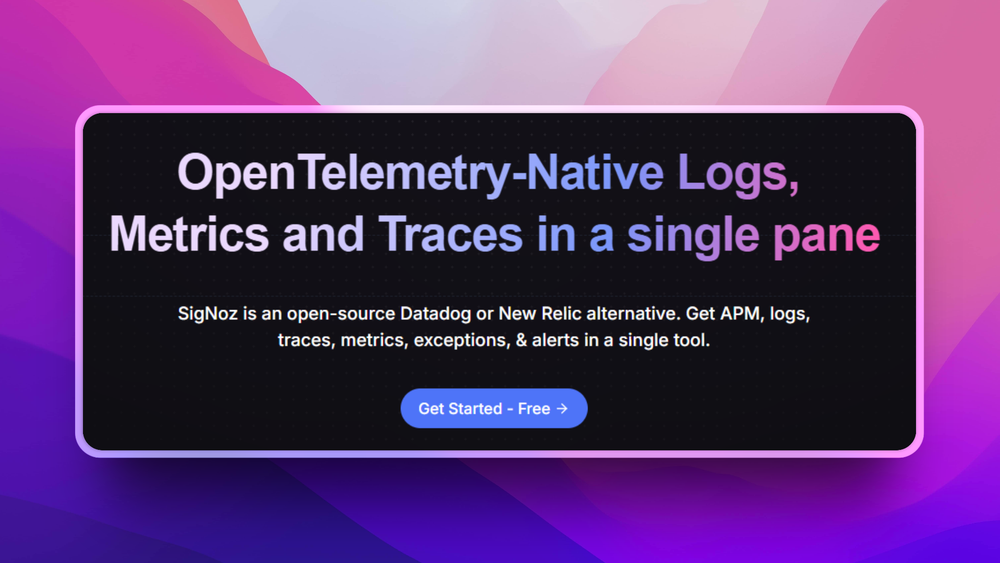
SigNoz focuses on that backend layer. It gives teams one place for traces, logs, metrics, dashboards, and alerts while staying close to OpenTelemetry data models and supporting self-hosted operation.
How it solves it#
Logs, metrics, and traces together
Investigate application behavior across telemetry types from one product instead of switching between a log tool, metrics store, and trace viewer.
OpenTelemetry-native ingestion
SigNoz is built around OpenTelemetry, which helps teams avoid instrumentation lock-in and reuse standard collectors across services.
Dashboards and alerts
Create dashboards and alert rules from the telemetry you collect. Engineering teams can turn raw traces and metrics into operational views without adding a separate alerting product.
Self-hosted observability path
Teams can run SigNoz themselves when telemetry data, retention, and infrastructure control matter more than buying a fully managed APM suite.
Strengths and trade-offs#
Strengths
- Clear Datadog replacement angleSigNoz directly targets the Datadog and New Relic pain point: application observability with less vendor lock-in and a self-hosted option.
- Works with standard telemetry pipelinesOpenTelemetry support means teams can instrument services with a portable standard before choosing how much of the backend they want to operate themselves.
Trade-offs
- -You operate the observability backendSelf-hosting observability is not lightweight. Teams must plan storage, upgrades, retention, backups, query performance, and incident access when SigNoz itself is part of the production monitoring path.
SigNoz vs alternatives#
SigNoz vs Datadog
SigNoz is the better fit when a team wants OpenTelemetry-native logs, metrics, traces, dashboards, and alerts with the option to self-host. Datadog is stronger when a team wants a broad managed observability suite, vendor-operated scale, and many packaged integrations. Choose SigNoz for telemetry control and open standards; choose Datadog when managed breadth matters more.
What it's built on#
- Languages
- GoPythonTypeScript
- Frameworks
- FastAPINext.jsReact
- Databases
- PostgreSQL
FAQ#
What does SigNoz replace?
SigNoz can replace parts of Datadog, New Relic, Jaeger, and log-management tools when the team wants OpenTelemetry-based observability in one product.
Is SigNoz self-hosted?
Yes. SigNoz offers a self-hosted path and positions itself as an open-source Datadog or New Relic alternative for teams that want to run observability on their own infrastructure.
What license does SigNoz use?
This draft does not make a specific license claim because the OSA item record lists NOASSERTION. Verify the current upstream license before commercial redistribution or modified hosted use.
Similar open-source tools#

Prometheus

ClawTrace
Visualize agent execution trees and track token costs per step

Stakpak
Open source agent that automates app deployment and monitoring

OpenObserve
Self-hosted observability for logs, metrics, and traces

Coroot
Instant observability with no-code setup.

Grafana
Open source dashboards for metrics, logs, and traces