

Who Hoppscotch is for#
API QA engineer
Use Hoppscotch for fast regression calls across REST and GraphQL endpoints when validating feature changes before deployment.
Skip if:
Skip if your team already requires built-in SSO and deep governance templates from a hosted platform.
Backend team for real-time APIs
Use the WebSocket and MQTT clients to test live channels and event payload formats during integration work.
Skip if:
Skip if your stack only uses request-response HTTP and has no event streams.
Independent contractor building microservices
Use Hoppscotch as a lightweight, browser-accessible toolkit for testing client and service APIs while moving between projects.
Skip if:
Skip if you need native desktop-only integrations that are outside browser-based workflows.
Small dev team lead
Use self-hosted workspaces to keep API collections, auth settings, and request history in one repository-sized workflow for your whole team.
Skip if:
Skip if your team already uses another enterprise API portal as the single source of truth for API contracts.
The problem it solves#
API teams using Postman or similar paid clients often pay for the full package, not just core request testing, once they add collection sharing, workspace history, and team sync. The result is recurring cost, hidden portability risk, and workflow lock-in. Hoppscotch targets teams that need fast request debugging and reusable API collections without giving up control of test data and history. It also helps solo developers who want an API client that can keep pace across REST and WebSocket-style tools in one place without adding new subscriptions.
How it solves it#
Protocol coverage
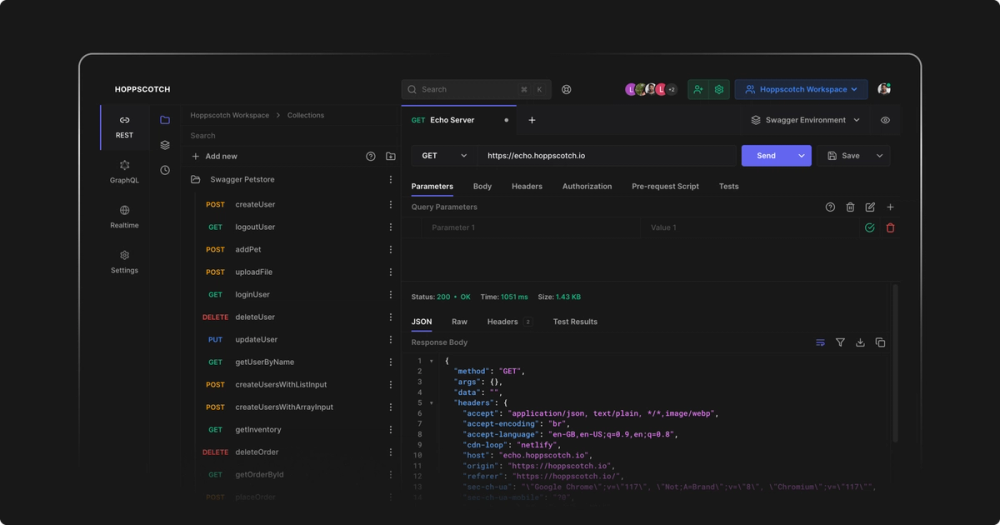
Supports HTTP/REST, GraphQL, WebSocket, MQTT, Socket.IO, and Server-Sent Events from one request composer. This avoids context switching when debugging mixed backends or event-driven APIs.
Workspace and history model
Stores collections, environments, and response history in self-hosted project state with role-aware workspace sharing. That gives teams the same starting point for collaboration, plus local control over team data.
Code and import flexibility
Exports request examples as curl and language snippets, and imports files or GitHub gists. This helps teams keep API examples close to implementation workflows and documentation pipelines.
Cross-device access
Offers desktop and browser entry points plus browser-based testing that works quickly on lightweight laptops. Teams can use the web app during incident work without installing a native client on every machine.
Self-hosting path
Uses a Docker deployment option with a preset compose profile and migration step, including backend services and a database option. That lets operations teams run it on managed cloud or private infrastructure.
Strengths and trade-offs#
Strengths
- Open source with MIT termsThe core web and desktop tools are MIT, so teams can run the code in their own stack, review behavior, and adjust deployment if needed. This lowers operational risk when compliance requires vendor control.
- Protocol-first API testingFew API clients bundle REST, GraphQL, WebSocket, and event-stream tools together with a single interface. Hoppscotch works where API stacks mix sync and real-time traffic, reducing tool fatigue.
- Browser-first speedFast startup and a lightweight interface helps engineers run ad-hoc tests during incidents. You get immediate request execution and response inspection without waiting on heavyweight startup flows.
Trade-offs
- -Feature tradeoff in enterprise controlsAudit logs, advanced access controls, and some governance controls are in the enterprise self-hosted path. If your team needs strict role policies and advanced compliance reporting, those capabilities may require paid extensions.
- -Operational dependency for full stackA production self-hosted setup is easiest with Docker, Postgres, and basic ops routines for upgrades. Teams wanting zero-maintenance SaaS behavior need to account for patching and service uptime.
- -Team management maturityBasic sharing is available, but organizations needing enterprise-grade identity federation may need extra provisioning work. In these cases, dedicated enterprise support can reduce setup friction.
Hoppscotch vs alternatives#
Hoppscotch vs Postman and Insomnia
Postman, Insomnia, and Hoppscotch target the same API testing workflows, so the main decision is deployment control versus managed convenience. Postman delivers a large managed ecosystem with polished enterprise admin features, but much of team collaboration and sync sits in Postman's cloud domain. Insomnia is strong for desktop API development with a clean local client flow, yet many teams still use it in parallel for WebSocket or streaming cases.
| Tool | Hosting model | Collaboration model | Best fit |
|---|---|---|---|
| Postman | Managed SaaS + paid plans for most advanced team controls | Strong managed workspace and governance defaults | Teams that want zero infra operations |
| Insomnia | Mixed client focus with commercial tiers | Desktop-first workflows with local and cloud blend | Developers preferring a native app-centric flow |
| Hoppscotch | MIT self-hosted option with Docker profile | Browser-first collaboration with self-hosted workspace scope | Teams needing local control and protocol breadth |
Choose Hoppscotch when your priority is self-hosted data ownership, faster protocol coverage in one tool, and lower lock-in for request and collection data. Choose Postman or Insomnia if you need managed account orchestration and polished enterprise controls with minimal infrastructure overhead.
Quick start#
# Clone the repository

git clone https://github.com/hoppscotch/hoppscotch.git
cd hoppscotch

# Prepare local environment
cp .env.example .env

# Start Hoppscotch with Docker Compose
docker compose --profile default upWhat it's built on#
- Languages
- JavaScriptRustTypeScript
- Frameworks
- ExpressNestJSVue
- Databases
- PostgreSQL
- Messaging
- WebSocket
- Tooling
- GraphQLRollup
FAQ#
Can I self-host Hoppscotch?
Yes. Use the official Docker compose profiles from the repository. The default profile starts the all-in-one service plus database and migration handling, while the default-no-db profile supports external database setups.
How does Hoppscotch compare to Postman?
Postman has a broad ecosystem, but it can route your work through its own collaboration and account flows. Hoppscotch gives you self-hosted ownership for collections and history while covering the same core testing protocols in most workflows.
Can I test event and streaming APIs with Hoppscotch?
Yes. Hoppscotch includes WebSocket, MQTT, Socket.IO, and Server-Sent Events support in the same request panel so you can validate both sync and streaming APIs without opening a second tool.
Which paid option is closest to Hoppscotch?
Postman remains the most common paid replacement for teams moving from familiar workspace workflows, while Insomnia offers a different desktop-first developer experience. If you want browser-first testing with strict self-hosted control, Hoppscotch is the clearer fit for many teams.
Similar open-source tools#

Echolon
58 GitHub starsLocal-first API client for HTTP, REST, and GraphQL
Alternative to Postman

Yaak
19,325 GitHub starsLocal-first API client for HTTP, GraphQL, and WebSocket
Alternative toPostman

Octrafic
35 GitHub starsAI-powered CLI for automated API testing with natural language
Alternative toPostman

Keploy
18,614 GitHub starsAI-powered tool that converts API traffic into test cases
Alternative toPostman

servers
91,299 GitHub starsOpen reference servers for connecting AI to external tools and data
Alternative to Composio

jsreport
1,321 GitHub starsJavaScript report server with PDF, Excel, DOCX, and HTML output
Alternative to Stimulsoft Reports.JS