
Who Languine is for#
Frontend teams maintaining locale files
Use Languine when developers need to update translation files as UI strings change in the repository.
Skip if:
Your localization process requires professional translators, translation memory, and formal approval workflows for every string.
Startups adding multi-language support
Use Languine to get initial translations and CI-friendly sync before investing in a larger localization management suite.
Skip if:
Your product already has a mature enterprise localization stack with vendor-managed translation operations.
The problem it solves#
Localization often breaks because translations live behind code changes. Developers add strings, product teams wait on manual translation updates, and stale locale files ship missing or inconsistent copy.
Hosted localization tools help coordinate work, but they can add another account, workflow, and pricing layer around files that still need to land back in the repository. Developer teams need i18n automation that fits CI/CD and source control.
How it solves it#
CLI-based translation workflow
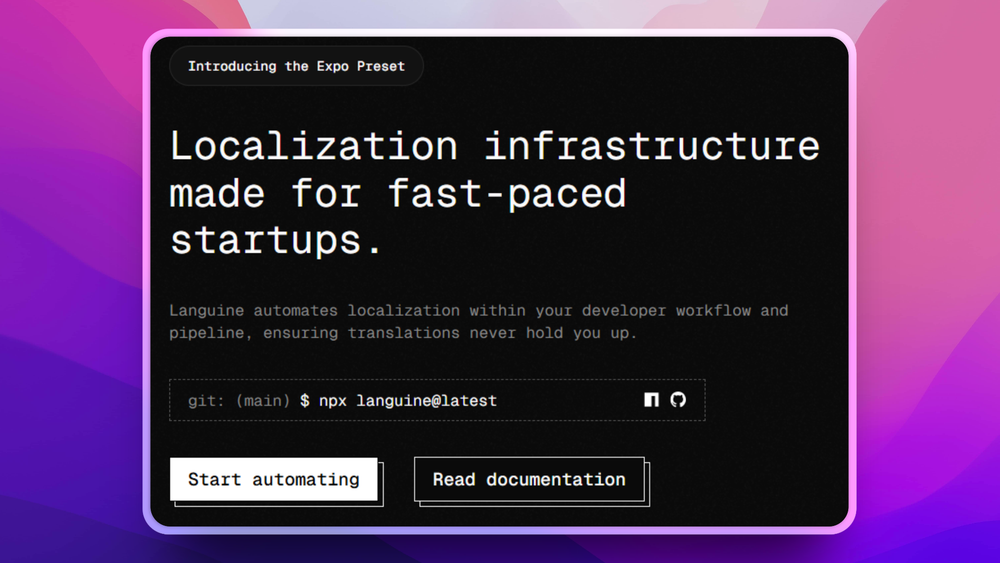
Runs from the command line with npx, letting teams translate and sync application strings close to the codebase.
Self-hosted web app
The project provides a Vercel-native self-hosted app with a Postgres-backed setup, so teams can operate localization infrastructure in their own account.
AI-assisted locale updates
Uses an AI model configuration to help translate changed strings, reducing the manual pass needed for routine UI copy updates.
Strengths and trade-offs#
Strengths
- Fits developer i18n workflowsLanguine keeps localization close to code and CI rather than forcing every translation update through a separate hosted dashboard.
- One-click deployment pathThe official README documents a Vercel deployment flow with Postgres provisioning, making it easier to try than a fully custom localization service.
Trade-offs
- -AI output needs reviewAI translations can drift in tone, product vocabulary, or legal meaning. Teams should keep human review for important product, support, and compliance copy.
What it's built on#
- Languages
- TypeScript
- Frameworks
- Next.jsReact
FAQ#
What is Languine used for?
Languine is used to translate application strings and keep localization files in sync through a CLI and self-hosted app.
Can Languine be self-hosted?
Yes. The official source describes a Vercel-native self-hosted deployment with a Postgres-backed setup.
Does Languine replace human translators?
No. Languine can speed up routine translation updates, but teams should still review important copy for accuracy, tone, and product language.
Similar open-source tools#
agent-toolkit-for-aws
Empower AI agents to build and manage AWS applications
DeepSeek TUI
A coding agent that lives in your terminal.
Goose
Run repeatable multi-step coding workflows from CLI or desktop
Octrafic
AI-powered CLI for automated API testing with natural language
Maestro
Simple end-to-end testing for iOS, Android, and web apps
Grit
Automate code migrations at scale using a pattern-matching DSL

