

Who Temporal is for#
Backend teams orchestrating payment or fulfillment flows
Temporal tracks each step of a multi-service process and retries failed activities without losing the workflow state.
Skip if:
Skip if your process is a single short request that can finish inside one service transaction.
Platform teams replacing brittle job chains
Use Temporal to consolidate cron jobs, queues, and manual retry scripts into versioned workflows with visible histories.
Skip if:
Skip if your team cannot operate the server and does not want a managed workflow service.
The problem it solves#
Long-running business processes are hard to build with only queues, cron jobs, and database status flags. Payment retries, order fulfillment, onboarding steps, and data pipelines can fail halfway through, leaving engineers to reconstruct state from logs and custom tables.
Managed workflow products reduce some pain but can lock teams into vendor-specific definitions, pricing, and operational limits. Engineering teams need workflows that behave like normal code while preserving state through crashes, deploys, and network failures.
How it solves it#
Durable workflow execution
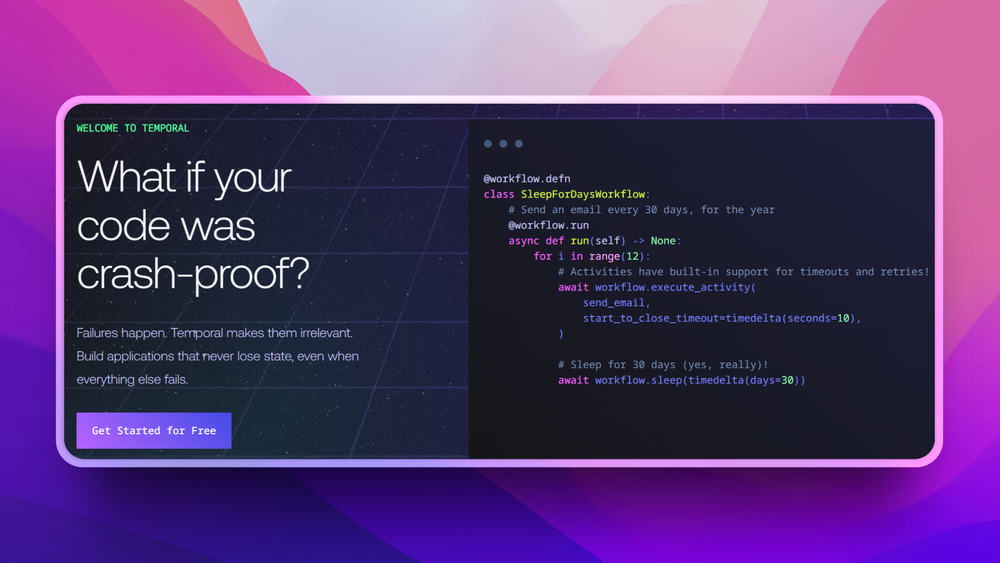
Runs workflows that preserve progress across worker crashes, retries, and restarts, so business processes can continue from the last recorded event.
Code-first SDKs
Developers write workflows in familiar languages instead of modeling every step in a cloud console or YAML-only workflow definition.
Workers and task queues
Separates workflow state from worker execution, letting teams scale workers independently for CPU-heavy, IO-heavy, or service-specific tasks.
Strengths and trade-offs#
Strengths
- Failure handling is built into the modelRetries, timeouts, activity history, and deterministic replay are core Temporal concepts, reducing the amount of custom orchestration code teams maintain.
- Open source server with managed optionTeams can run Temporal themselves or use Temporal Cloud, which makes adoption possible before committing to an operations model.
Trade-offs
- -Requires workflow design disciplineTemporal asks teams to learn deterministic workflow rules, activity boundaries, and worker operations. Small jobs may be simpler with a queue or cron task.
Temporal vs alternatives#
Temporal vs AWS Step Functions
Temporal and AWS Step Functions both coordinate multi-step work, but they use different operating models. Temporal is a code-first open source platform; Step Functions is a managed AWS service built around state machines.
Temporal is the better choice when teams want portable workflow logic, local development, and control over execution infrastructure. Step Functions is still better when the workload lives entirely inside AWS and the team wants AWS to own the workflow runtime.
What it's built on#
- Languages
- Go
FAQ#
Is Temporal open source?
Yes. Temporal Server is open source under the MIT license.
What is Temporal used for?
Temporal is used for durable execution of long-running workflows such as payments, provisioning, onboarding, data pipelines, and background jobs.
How does Temporal compare to AWS Step Functions?
Temporal lets developers define workflows in application code and run the open source server themselves. AWS Step Functions is a managed AWS service with state machines defined for the AWS platform.
Similar open-source tools#

Kestra
Declarative workflow orchestration for data and DevOps teams

FckSignups
Open-source tools that work instantly, no signup required

fmt
Fast, type-safe C++ formatting that replaces printf and iostreams

portabase
Self-hosted backup tool for PostgreSQL, MySQL, MongoDB, and 7 more

openship
Self-hosted deployment platform with built-in CI/CD

Nginx
Serve static files, proxy requests, terminate TLS, and cache content.