Who OBS Studio is for#
Game streamers running live productions
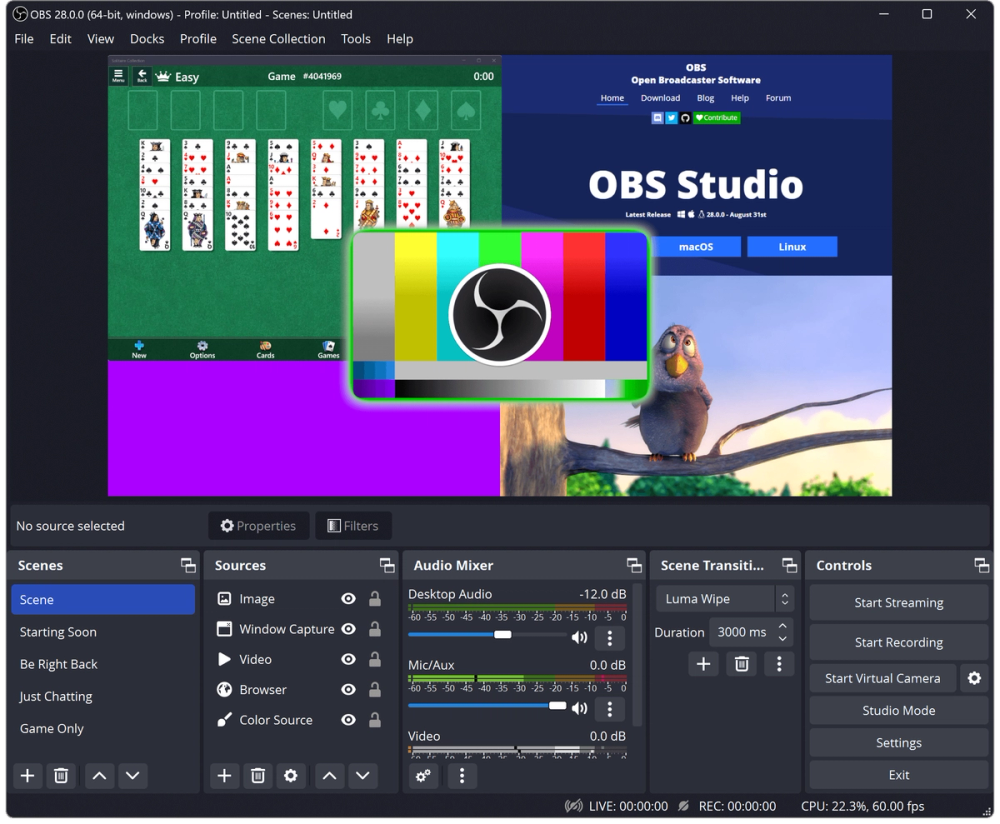
Build scenes for gameplay, webcam, browser overlays, alerts, and intermission screens, then switch between them with hotkeys or transitions while streaming.
Skip if:
You want a hosted service that manages overlays, chat widgets, monetization, and cloud backups from one account.
Educators recording lessons and walkthroughs
Capture screen, camera, browser tabs, and microphone into repeatable scenes for lectures, tutorials, and software demos without watermarks or export limits.
Skip if:
You only need quick async clips with automatic transcript sharing and comments.
Webinar producers managing multiple inputs
Use Studio Mode, custom transitions, audio filters, and Multiview to control cameras, slides, guests, and holding screens before anything goes live.
Skip if:
Your team needs attendee registration, email reminders, and analytics inside the same product.
Developers and AV teams automating workflows
Use plugins, Lua/Python scripts, and the OBS API to build custom sources, controls, and broadcast automation around existing production hardware.
Skip if:
You need a locked-down tool for nontechnical users who should never touch scene or audio routing.
The problem it solves#
Short async video recorders work for quick clips, but they break down when someone needs a real broadcast: multiple scenes, webcams, capture cards, desktop or window captures, overlays, audio filters, and live transitions. Paid broadcast suites can put advanced production features behind subscriptions or accounts, and browser-based recorders often depend on cloud upload paths. Teams running tutorials, webinars, game streams, or internal demos need a local tool that records and streams reliably while keeping project files and media on their own machines.
How it solves it#
Real-time scene composition
Combine windows, displays, images, text, browser sources, webcams, and capture cards into scenes for live switching or local recording.
Unlimited scene switching
Set up any number of scenes and move between them with custom transitions, which supports run-of-show layouts for streams, webinars, and tutorials.
Per-source audio control
Use the audio mixer to apply noise gate, noise suppression, gain, and VST plugin filters on individual sources before recording or streaming.
Studio Mode and Multiview
Preview scenes before they go live and monitor 8 scenes in Multiview, reducing on-air mistakes during multi-scene productions.
Plugin and scripting API
Extend OBS with native plugins plus Lua or Python scripts, useful when a workflow needs custom sources, automation, or integrations.
Strengths and trade-offs#
Strengths
- No cloud gate for core workOBS records and composes locally, so local capture does not require creating a vendor account, uploading raw footage, or routing through a hosted recorder.
- Professional controls without subscriptionsScene collections, source filters, hotkeys, Studio Mode, Multiview, and platform streaming are part of the core desktop app rather than paid add-ons.
- Extensible for specialized workflowsThe OBS API, plugin support, and Lua/Python scripting let technical teams build custom controls instead of waiting on a proprietary vendor roadmap.
- GPL-2.0-or-later codebaseTeams can inspect, modify, and redistribute the software under the GPL terms, which matters for labs, schools, and production teams that need auditability.
Trade-offs
- -Desktop app, not a hosted recorderOBS does not give you a browser-based recording portal, automatic transcript workflow, or team clip library out of the box.
- -Setup takes production knowledgeThe Auto-Configuration Wizard helps, but good results still depend on choosing sources, scenes, audio devices, bitrate, and stream settings correctly.
- -Linux capture can need system packagesThe official install notes call out OpenGL 3.3 and v4l2loopback for virtual camera support, so Linux users may need package and kernel-module work.
- -Collaboration is externalOBS focuses on capture, mixing, recording, and streaming. Teams still need separate tools for review, storage, editing, scheduling, and approvals.
OBS Studio vs alternatives#
OBS Studio vs XSplit and Streamlabs
OBS Studio, XSplit, and Streamlabs all serve creators who need live streaming and screen recording, but OBS is the open source desktop production tool in the group. Its strongest fit is local control: scenes, sources, audio filters, Studio Mode, Multiview, plugins, and scripts run on your own machine across Windows, macOS, and Linux.
| Criteria | OBS Studio | XSplit / Streamlabs-style suites |
|---|---|---|
| License | GPL-2.0-or-later | Proprietary |
| Local recording | Yes | Yes |
| Linux support | Yes | Varies by product |
| Plugin and scripting model | Native plugins plus Lua/Python scripts | Vendor-controlled extension model |
| Best fit | Technical creators and production teams that want control | Creators who want bundled templates, account features, and vendor support |
Choose OBS Studio when you need a no-watermark recording and streaming tool you can inspect, extend, and run locally. A paid creator suite is still worth considering if your main need is packaged overlays, cloud asset management, or support from a vendor rather than control over capture, audio routing, and scene composition.

Install and self-host#
# Ubuntu
sudo add-apt-repository ppa:obsproject/obs-studio
sudo apt update
sudo apt install obs-studio
# FreeBSD
pkg install obs-studioWhat it's built on#
- Languages
- CC++Objective-CObjective-C++Swift
FAQ#
Is OBS Studio free to use?
Yes. OBS Studio is free and open source under GPL v2 or later, with official builds for Windows, macOS, and Linux. There are no built-in watermarks or paid feature tiers in the core app.
Can OBS Studio record without streaming?
Yes. OBS can record locally and stream live, and the same scene setup can serve both workflows. You can use it for tutorials, demos, podcasts, and screen recordings without connecting to Twitch or YouTube.
What platforms does OBS Studio support?
OBS Studio has official downloads for Windows, macOS, and Linux. The install docs also list supported Linux builds for Flatpak and Ubuntu, with unofficial packages maintained by distribution communities.
Does OBS Studio support virtual camera output?
Yes, OBS Studio includes virtual camera support. On Linux, the official install notes say virtual camera support needs the v4l2loopback kernel module installed.
Is OBS Studio better than XSplit or Streamlabs?
OBS Studio is the better fit when you want open source control, local recording, Linux support, and an extensible plugin or scripting model. Paid suites can still make sense when you want bundled templates, cloud workflows, or vendor support over lower-level production control.
Similar open-source tools#
Capso
Free open-source screenshot and recorder for macOS
Excalidraw
Open source whiteboard for hand-drawn style diagrams
Cap
Self-hosted screen recorder with custom S3 bucket support
Kap
Open source screen recorder for macOS with web tech
Kdenlive
Free non-linear video editor for Linux, Mac, and Windows
Twake Chat
Matrix team chat with a companion identity server