
Organizations publishing photo archives
Use Piwigo to run a branded gallery for events, collections, or internal photo libraries.
Skip if:
You only need cloud backup for personal camera rolls.

Open source alternative to SmugMug, Adobe Creative Cloud Photography Plan and Flickr
Last verified
Piwigo is a self-hosted photo management platform for organizing and publishing large image libraries with album hierarchies, access controls, and a plugin ecosystem. GPL-2.0 licensed, runs on any PHP/MySQL server.
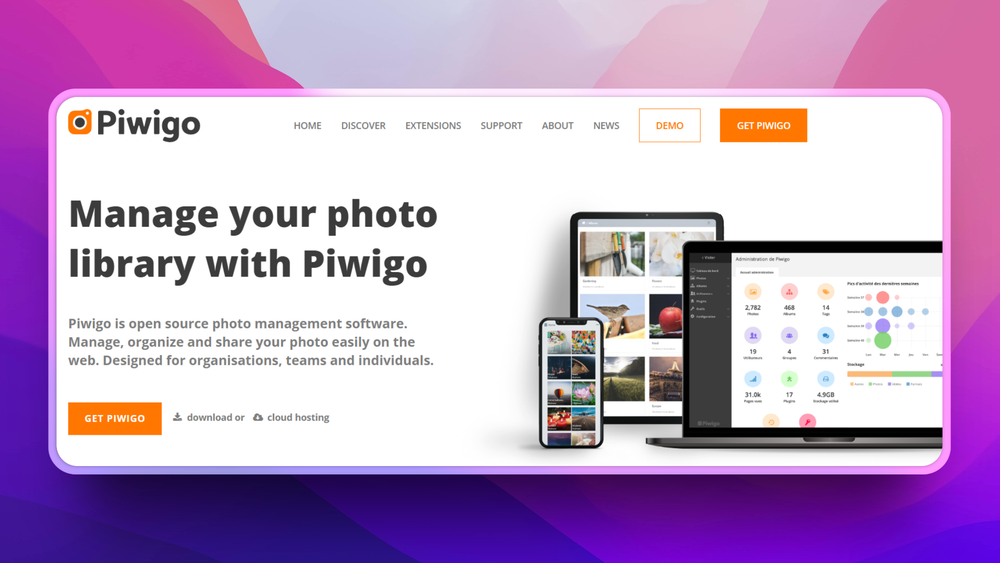
Use Piwigo to run a branded gallery for events, collections, or internal photo libraries.
You only need cloud backup for personal camera rolls.
Use Piwigo when photos should live on controlled infrastructure with web-based browsing.
You need a managed consumer app with automatic phone sync.
Use Piwigo to host albums under a community domain with long-term access.
A temporary shared album link is enough.
Photo libraries become hard to control when albums, permissions, and archives live inside a hosted consumer service. Organizations need galleries that can sit on their own domain, use their own storage, and match internal privacy expectations. They also need predictable access to media collections that may outlive a vendor plan or consumer account policy.
Piwigo is open source photo gallery software for managing photo libraries on the web.
Piwigo runs on a web server with PHP, MySQL or MariaDB, and ImageMagick or PHP GD for image handling.
A NetInstall script and manual upload workflow give administrators two practical paths for installing Piwigo on web hosting.
Piwigo is released under GPL v2, giving organizations source access under copyleft terms.
Piwigo is open source web photo gallery software for managing and publishing photo libraries.
Yes. Piwigo can run on a web server with PHP, a database, and image processing support.
No. Piwigo manages and publishes photo galleries. Use a RAW or image editor for detailed photo editing.

Alternative to Flickr
Fediverse photo sharing: no central platform, fully user-owned

Alternative to WHMCS
WHMCS
Self-hosted billing for hosting providers, MIT licensed

Alternative to OpenVPN Access Server
Web panel for Xray-core with per-client and multi-node controls

Alternative to Google Maps
OpenStreetMap and Google data, no account, no Play Services

Android app updates direct from GitHub and F-Droid

Alternative to Dust
Dust
Open source AI workspace with sandboxed apps and Gatekeeper security
Run Piwigo on your own server
Hostinger sets Piwigo up as a one-click app on a VPS.
Deploy on HostingerFeatured

Alternative to Superhuman
AI email assistant that drafts replies and clears your inbox

Alternative to Grok Bot
AI teammates you own: your keys, your model, your machine.

Alternative toClaude Managed Agents
Open-source agent deployment API. Self-host or use Omnara Cloud.
The projects we add and every new guide. Free, unsubscribe any time.
 Claude Code to
  OpenCode
 Jira to
  Windshift
 Notion to
  AppFlowy
 Slack to
  Mattermost
 Linear to
  GitLab
 Wispr Flow to
  Handy
Handy CapCut to
  Concat
 Grok Bot to
  rakazo
 Superhuman to
  Inbox Zero
 Airtable to
  AITable
 Muse to
  OpenClaw
 GitHub Copilot to
  Cline
Cline Datadog to
  Netdata
 Microsoft Teams to
  Rocket.ChatConfluence to
  Docmost
 Pinecone to
  Qdrant
 Zapier to
  n8n
n8n Devin AI to
  OpenHands
 Firebase to
  Supabase
 1Password to
  KeePassXC
 Contentful to
  Strapi
 Adobe Premiere Pro to
  Shotcut
 ChatGPT to
  AnythingLLM
 LangSmith to
  Langfuse


