

Who Sylius is for#
Engineering teams building custom commerce
Use Sylius when checkout, catalog, or integration requirements are too specific for Shopify-style platforms.
Skip if:
Skip if you need a simple hosted storefront with minimal development.
Agencies building Symfony commerce projects
Sylius fits PHP agencies that want a structured ecommerce framework and plugin ecosystem.
Skip if:
Skip if your team is not comfortable maintaining Symfony applications.
The problem it solves#
Standard ecommerce platforms work until checkout, catalog, inventory, fulfillment, or integration rules become specific to the business. At that point, teams either fight platform constraints or build custom commerce logic around a system that was not designed for deep modification.
How it solves it#
Symfony-based ecommerce framework
Built on Symfony, which gives PHP teams a familiar foundation for domain-specific commerce applications.
REST API for integrations
The README states that Sylius uses a REST API for integrations and customer experiences across devices, which helps developers connect commerce flows to custom frontends and services.
BDD-oriented development culture
Sylius uses phpspec and Behat for behavior-driven development, reflecting a codebase aimed at serious custom projects.
Strengths and trade-offs#
Strengths
- Framework, not just a store appSylius is strongest when ecommerce needs custom domain modeling and integration work rather than a generic storefront.
- MIT licenseThe MIT license gives teams permissive commercial use for custom commerce builds.
Trade-offs
- -Requires engineering ownershipSylius is a framework for developers. A hosted store builder is faster for merchants who do not need custom commerce logic.
Sylius vs alternatives#
What it's built on#
- Languages
- PHP
- Tooling
- Webpack
FAQ#
What is Sylius?
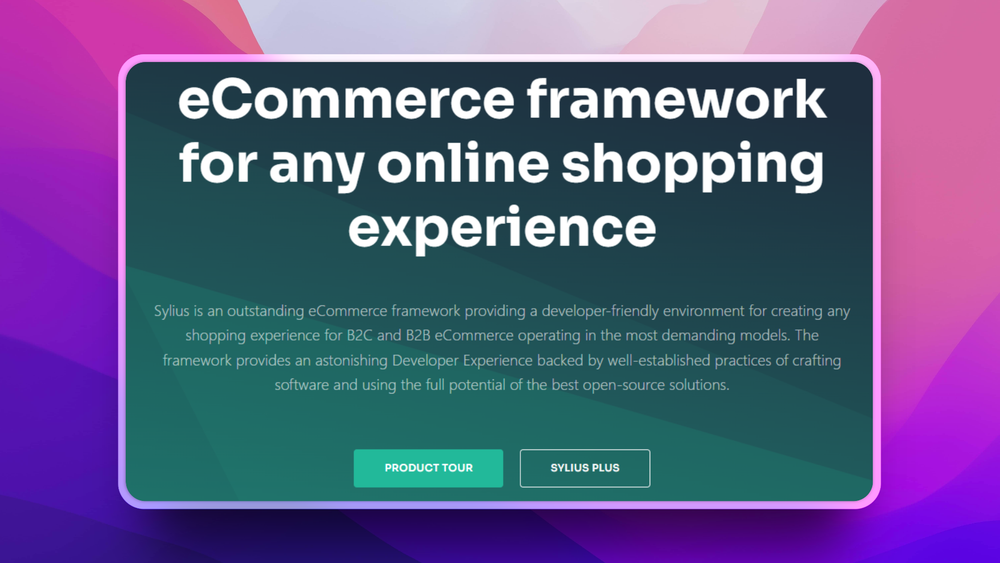
Sylius is an open source ecommerce framework built on Symfony.
Is Sylius open source?
Yes. Sylius is MIT licensed.
Is Sylius a Shopify alternative?
Sylius can replace Shopify for custom, engineering-led commerce builds. Shopify remains better for merchants who want a managed storefront platform.
Similar open-source tools#

PrestaShop
Open source eCommerce platform for online stores

WooCommerce
Open source WordPress eCommerce with full customization

Bagisto
Laravel eCommerce with headless API and no transaction fees

Saleor
Open source headless e-commerce platform with GraphQL API

WordPress

Gumroad
Open source platform for selling digital products directly