
Developers testing webhooks locally
Use Tunnelmole when Stripe, GitHub, Slack, or another external service needs to call your local endpoint.
Skip if:
The endpoint is production-facing or needs long-term uptime guarantees.

Open source alternative to ngrok, LocalXpose and Cloudflare Tunnel
Last verified
Connect local HTTP or HTTPS servers to a public URL for webhook testing, client demos, and cross-device debugging.
Use Tunnelmole when Stripe, GitHub, Slack, or another external service needs to call your local endpoint.
The endpoint is production-facing or needs long-term uptime guarantees.
Use Tunnelmole to give a teammate or client a temporary URL for a local app without deploying a preview environment.
Your team already has secure preview deployments attached to every branch.
Local development breaks down when an external service needs to reach your machine. Webhook providers, mobile devices, teammates, and clients cannot access localhost, so developers either deploy unfinished work or fight with network configuration.
Hosted tunnel tools solve the access problem, but they add account, pricing, and vendor dependency concerns. Some teams want a simpler open source path for temporary public URLs.
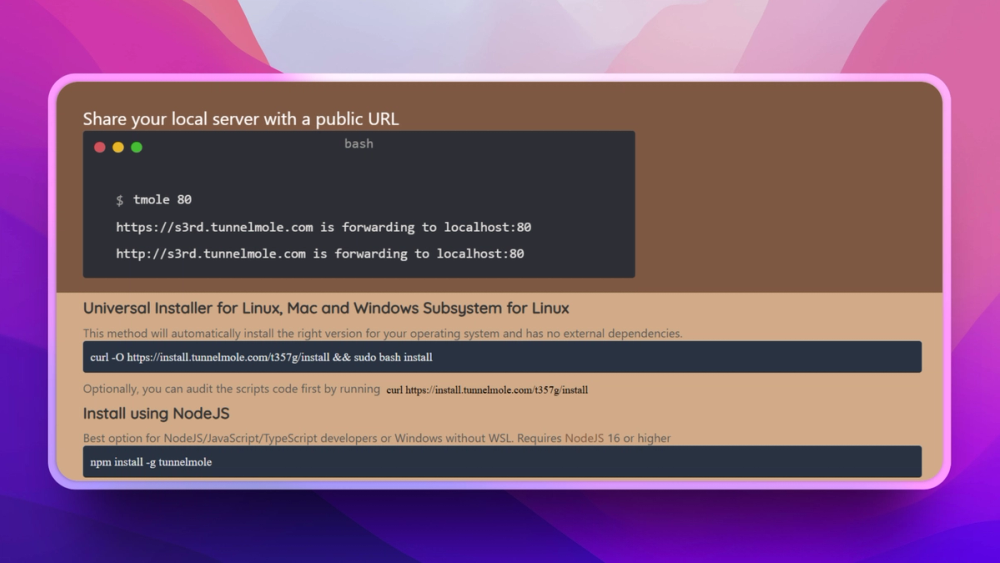
Creates a public URL for locally running HTTP or HTTPS servers, including web servers, APIs, Docker containers, and React or Node apps.
Lets services such as payment providers or automation tools call a local endpoint during development without deploying the app.
Provides a client-side tunnel workflow with source access, giving developers more inspection and self-hosting options than a closed tunnel service.
Tunnelmole is used to expose local HTTP or HTTPS servers through a public URL for development, demos, and webhook testing.
Yes. Tunnelmole can replace ngrok for common local tunneling jobs, especially when developers want an open source client.
No. Tunnelmole is best for temporary development tunnels. Production services need stable ingress and security controls.

Alternative to Tailscale
Connect devices seamlessly without relying on the cloud.

Alternative to Vercel
Full-stack Vite toolkit with one-command Cloudflare deployment

Alternative to CodeDashboard
Review code changes as architecture maps, not line diffs

Open-source tools that work instantly, no signup required

Alternative to Helius
Drop-in local Solana test validator with forking support

Alternative to GitHub
Self-hosted Git forge for teams that want platform independence
Run Tunnelmole on your own server
Self-host Tunnelmole on a Hostinger VPS.
Deploy on HostingerFeatured

Alternative to Grok Bot
AI teammates you own: your keys, your model, your machine.

Alternative toClaude Managed Agents
Open-source agent deployment API. Self-host or use Omnara Cloud.

Alternative to Superhuman
AI email assistant that drafts replies and clears your inbox
The projects we add and every new guide. Free, unsubscribe any time.
 Claude Code to
  OpenCode
 Jira to
  Windshift
 Notion to
  AppFlowy
 Slack to
  Mattermost
 Linear to
  GitLab
 Wispr Flow to
  Handy
Handy CapCut to
  Concat
 Grok Bot to
  rakazo
 Superhuman to
  Inbox Zero
 Airtable to
  AITable
 Muse to
  OpenClaw
 GitHub Copilot to
  Cline
Cline Datadog to
  Netdata
 Microsoft Teams to
  Rocket.Chat
 Pinecone to
  Qdrant
 Zapier to
  n8n
n8n Devin AI to
  OpenHands
 Firebase to
  Supabase
 1Password to
  KeePassXCConfluence to
  Docmost
 Contentful to
  Strapi
 Adobe Premiere Pro to
  Shotcut
 ChatGPT to
  AnythingLLM
 LangSmith to
  Langfuse


