

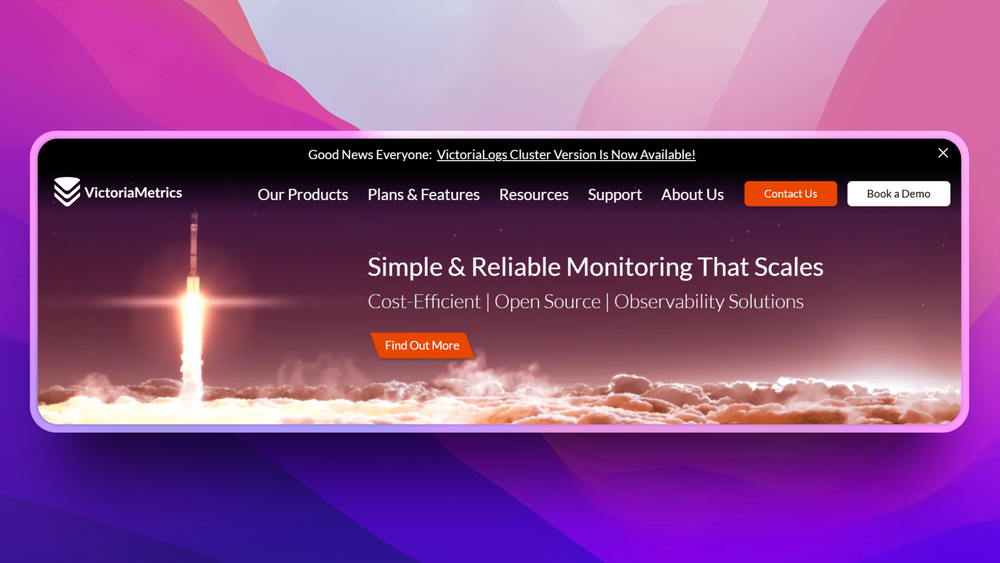
Who VictoriaMetrics is for#
SRE teams extending Prometheus retention
Use VictoriaMetrics when Prometheus data needs longer retention and faster queries without sending all metrics to a SaaS vendor.
Skip if:
Skip if your current Prometheus server is small, simple, and already meets retention needs.
Platform teams monitoring Kubernetes fleets
VictoriaMetrics can handle high-cardinality metrics from many services while staying compatible with Grafana-style workflows.
Skip if:
Skip if your organization wants a fully managed observability suite with no database operations.
The problem it solves#
Prometheus is excellent for scraping and short-term monitoring, but production metrics can become expensive and slow as retention windows, label cardinality, and Kubernetes fleets grow. Teams add Thanos, Cortex, or managed services, then inherit more moving parts or vendor pricing.
The pain is storing enough telemetry to debug incidents later without turning metrics infrastructure into its own large operations project.
How it solves it#
Prometheus-compatible ingestion
Accepts Prometheus remote write and supports PromQL-compatible query workflows, reducing migration work for existing monitoring stacks.
Single-node and cluster modes
Runs as a simpler single binary for smaller deployments or as clustered components for larger metrics volumes.
Storage-efficient time series engine
Focuses on high ingestion performance and compression so teams can retain more metrics at lower infrastructure cost.
Strengths and trade-offs#
Strengths
- Practical Prometheus scaling pathVictoriaMetrics gives teams a way to keep Prometheus-style metrics while improving retention and storage economics.
- Apache-2.0 licensingThe core project is permissively licensed, which helps teams standardize on it without network-copyleft concerns.
Trade-offs
- -Enterprise features may sit outside the coreSome advanced needs, such as certain enterprise controls, may require the commercial edition or additional components.
VictoriaMetrics vs alternatives#
VictoriaMetrics vs Datadog
VictoriaMetrics and Datadog both help teams work with operational metrics, but they sit at different layers. VictoriaMetrics is a self-hosted time series database and metrics backend; Datadog is a managed observability suite.
VictoriaMetrics is better when high-volume metrics storage cost and Prometheus compatibility are the main issues. Datadog is still better when a team wants managed dashboards, integrations, incident workflows, and vendor support in one platform.
What it's built on#
- Languages
- GoTypeScript
- Infrastructure
- Kubernetes
FAQ#
Is VictoriaMetrics open source?
Yes. VictoriaMetrics is open source under the Apache-2.0 license.
Can VictoriaMetrics replace Prometheus?
VictoriaMetrics can replace parts of a Prometheus metrics storage stack and can ingest Prometheus remote write data. Many teams still keep Prometheus for scraping.
How does VictoriaMetrics compare to Datadog?
VictoriaMetrics is a self-hosted time series database and monitoring backend. Datadog is a proprietary managed observability platform with broader hosted features.
Similar open-source tools#

Prometheus
66,601 GitHub starsTime series monitoring with a dimensional model and PromQL query language.
Alternative to Datadog

InfluxDB
31,767 GitHub starsHigh-performance time series database with SQL-based querying
Alternative to Amazon Timestream

ClawTrace
47 GitHub starsVisualize agent execution trees and track token costs per step
Alternative to LangSmith

Stakpak
1,813 GitHub starsOpen source agent that automates app deployment and monitoring
Alternative toDatadog

OpenObserve
22,406 GitHub starsSelf-hosted observability for logs, metrics, and traces
Alternative toDatadog

Coroot
7,974 GitHub starsInstant observability with no-code setup.
Alternative toDatadog