

Who Azimutt is for#
Developers onboarding to a large schema
Use Azimutt to map the tables and relationships behind a feature without needing to understand the whole database at once.
Skip if:
Your database has only a few tables and a simple static ERD already answers the question.
DBAs documenting production data models
Use Azimutt to attach schema notes and explain relationships where engineers regularly need shared context.
Skip if:
Your primary need is operational database administration rather than schema exploration.
The problem it solves#
Large production databases are hard to understand through a full-schema diagram. Once a schema has dozens or hundreds of tables, the usual ERD becomes a wall of boxes and lines that hides the relationship a developer actually needs.
The pain is worse during onboarding and incident response. Engineers need to answer narrow questions quickly: which tables connect, where a field comes from, and which relationship explains a query or data bug.
How it solves it#
Progressive schema exploration
Lets users reveal the part of a schema they need instead of rendering every table at once. This keeps large database maps readable.
Relationship path finding
Traces how tables connect through foreign keys, helping engineers navigate unfamiliar schemas without manually following every join.
Documentation and analysis
Combines diagrams with schema notes and database analysis so teams can turn investigation work into reusable database knowledge.
Strengths and trade-offs#
Strengths
- Built for existing databasesAzimutt is strongest when the database already exists and the team needs to explore it. That is different from lightweight diagram tools aimed at designing a schema from scratch.
- Works across common database typesThe project targets relational and document databases, including PostgreSQL, MySQL, MariaDB, SQL Server, Oracle, MongoDB, and Couchbase topics in its official repository.
Trade-offs
- -Not a full database clientAzimutt helps teams explore and document schemas, but it does not replace every query, migration, backup, or administration feature in a database IDE.
What it's built on#
- Languages
- ElixirTypeScript
- Databases
- MariaDBMongoDBMySQLPostgreSQL
- Tooling
- esbuild
FAQ#
What is Azimutt used for?
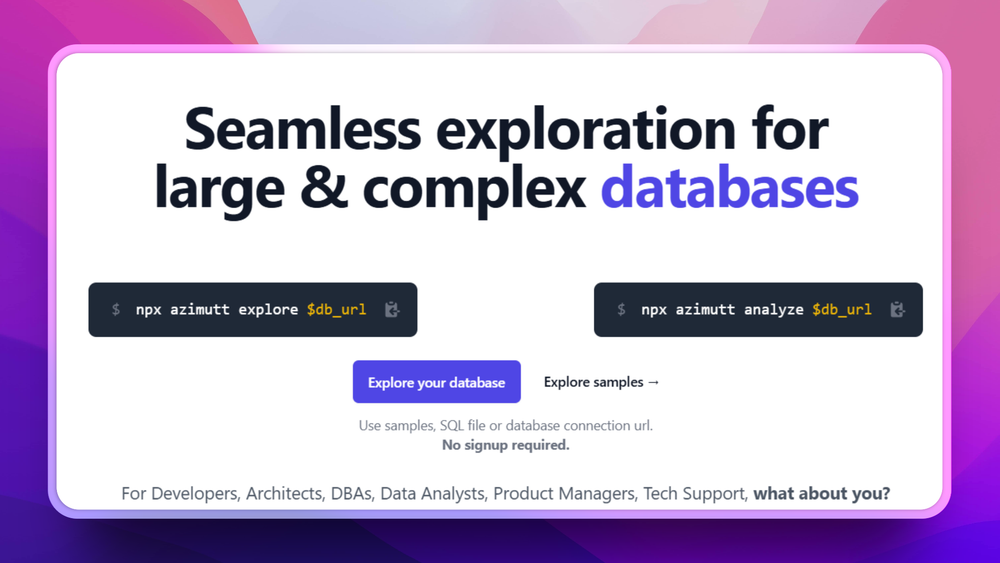
Azimutt is used to explore, document, and analyze database schemas. It is especially useful for large existing databases where a full ERD is hard to read.
Is Azimutt only for SQL databases?
No. Azimutt supports relational database workflows and also lists document database support such as MongoDB and Couchbase in its project metadata.
How is Azimutt different from a diagram tool?
Azimutt focuses on exploring real databases with progressive reveal, path finding, and schema analysis. Basic diagram tools are often better for small designs created from scratch.
Similar open-source tools#

ChartDB
Free open source database diagram editor and visualizer

Duckle
Self-hosted ETL on DuckDB with 385 connectors and no per-row billing.

libredb-studio
One browser tab for 18 database engines, deployed beside your data

DBeaver
Free open-source database management tool for SQL databases.

TiKV
Distributed key-value store with ACID transactions at scale

DuckDB
Fast in-process SQL analytics database, no server needed