

Who ChartDB is for#
Backend teams documenting relational schemas
ChartDB helps developers understand table relationships during onboarding, refactors, and migration planning.
Skip if:
Skip if your database is tiny or your ORM already generates enough diagrams.
Data teams explaining warehouse models
Visual schema maps help analysts discuss tables and joins without direct admin access.
Skip if:
Skip if you need BI dashboards rather than schema documentation.
The problem it solves#
Database diagrams go stale quickly when teams maintain them by hand in generic drawing tools. Schema changes land in migrations, but documentation lives elsewhere, so onboarding developers and analysts see diagrams that no longer match production.
The problem is not drawing shapes; it is keeping schema understanding close to the actual database. Developers need diagrams that understand tables, columns, relationships, and exports without forcing every change through a manual design canvas.
How it solves it#
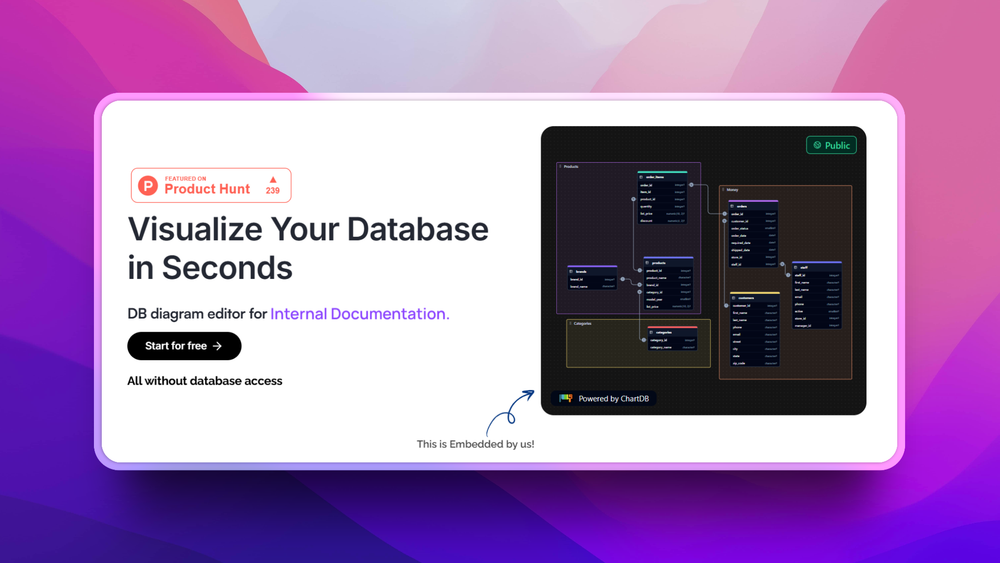
Database schema visualization
ChartDB focuses on diagrams derived from database structure, making ERDs easier to keep aligned with real schemas.
Editable diagram workspace
Teams can inspect and arrange schema relationships visually instead of reading only migration files or SQL dumps.
Export and sharing workflows
ChartDB supports sharing schema diagrams with teammates who need to review data models without connecting directly to production.
Strengths and trade-offs#
Strengths
- Database-aware alternative to generic diagrammingChartDB is stronger than Lucidchart for ERDs because the workflow centers on schema structure instead of freeform drawing.
- Open source control for schema docsThe AGPL-3.0 codebase gives teams a self-hostable path for sensitive database structure documentation.
Trade-offs
- -Not a full database IDEChartDB helps visualize and document schema, but it does not replace query workbenches, migration tools, or production database administration.
- -Sensitive metadata needs careful handlingSchema names can reveal product and customer concepts, so teams should treat hosted or shared diagrams as sensitive assets.
ChartDB vs alternatives#
ChartDB vs Lucidchart
ChartDB and Lucidchart can both produce diagrams, but ChartDB is database-aware while Lucidchart is a general diagramming product.
| Criteria | ChartDB | Lucidchart |
|---|---|---|
| License | AGPL-3.0 | Proprietary |
| Primary fit | Database schema diagrams | General business diagrams |
| Self-hosting | Yes | No |
ChartDB is better when the diagram should reflect real database structure. Lucidchart is still better when the team needs broad diagramming templates, non-technical collaboration, and enterprise workspace features.
What it's built on#
- Languages
- TypeScript
- Frameworks
- ReactReact Flow
- Databases
- MariaDBMySQLPostgreSQLSQLite
FAQ#
Is ChartDB open source?
Yes. ChartDB is open source under the AGPL-3.0 license.
Can ChartDB replace Lucidchart?
ChartDB can replace Lucidchart for database schema diagrams, but Lucidchart remains broader for general business diagrams.
Does ChartDB replace a database client?
No. ChartDB is for schema visualization and documentation, not full query editing or database administration.
Similar open-source tools#

Azimutt
Explore and document complex database schemas visually

diagram-design
Editorial diagrams for Claude Code, no Figma or Mermaid required
diagrams.net
Create portable diagrams without vendor lock-in

OpenFlowKit
Local-first AI diagramming tool for developers and builders

Excalidraw
Open source whiteboard for hand-drawn style diagrams

Duckle
Self-hosted ETL on DuckDB with 385 connectors and no per-row billing.