

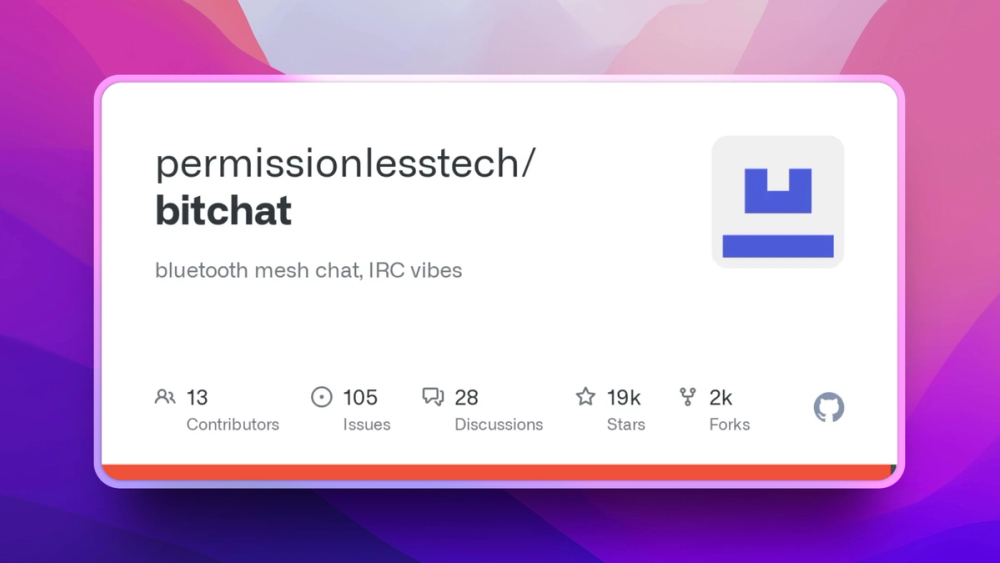
Who bitchat is for#
Offline local communication
Use Bitchat when nearby people need accountless messaging during events, outages, remote travel, or other low-connectivity situations.
Skip if:
Skip it if the group needs reliable enterprise chat, compliance controls, or centralized user management.
Privacy and protocol experiments
Use Bitchat when developers want to study Bluetooth mesh, Nostr routing, and decentralized messaging UX in a real app.
Skip if:
Skip it if the project requires mature moderation, retention, or enterprise deployment controls.
The problem it solves#
Mainstream messaging apps assume internet access, user accounts, phone numbers, and centralized routing. That is a poor fit for outages, crowded events, remote areas, protests, or groups that do not want membership tied to a phone number. Bluetooth-only chat apps solve local connectivity but lose reach once peers move out of range.
Bitchat takes a hybrid approach: Bluetooth mesh for nearby offline communication and Nostr relays for internet-based reach. It is not a Slack replacement; it is a communication tool for situations where accountless, decentralized, and local-first messaging matters.
How it solves it#
Bluetooth mesh communication
Nearby devices can discover peers and relay messages over Bluetooth Low Energy, including multi-hop routing. This supports local chat without internet access.
Nostr fallback for internet reach
When internet connectivity exists, Bitchat can use Nostr relays for location channels and direct message fallback. That extends the model beyond a short-range Bluetooth-only app.
No accounts or phone numbers
Users do not need a phone number, email address, or central account to participate. That reduces identity coupling compared with mainstream messaging apps.
Privacy-focused message routing
The project describes end-to-end encryption paths using Noise Protocol for mesh and NIP-17 for Nostr private messages, plus features such as emergency wipe and ephemeral identities.
Strengths and trade-offs#
Strengths
- Works when internet access is unreliableBitchat is useful for local groups that need communication during outages, events, travel, or remote work where ordinary messaging apps may fail.
- Decentralized design is the product valueUnlike WhatsApp or Signal, Bitchat is not centered on a managed identity service. Its value is accountless messaging across local mesh and distributed relay paths.
Trade-offs
- -Not a general team collaboration platformBitchat does not provide managed workspaces, admin controls, searchable history, compliance exports, or guaranteed delivery. It should be evaluated as decentralized local messaging, not enterprise chat.
bitchat vs alternatives#
Bitchat vs Signal
Bitchat is the better fit when users need accountless local messaging over Bluetooth mesh with optional Nostr reach. Signal is stronger for everyday secure messaging with phone-based identity, mature clients, reliable delivery, and a managed service. Choose Bitchat for off-grid and decentralized communication experiments; choose Signal for general private messaging.
What it's built on#
- Languages
- Swift
FAQ#
What does Bitchat replace?
Bitchat can replace ad hoc local group chats when internet access, phone numbers, or central accounts are not desirable. It does not replace Slack, Discord, or Signal for general team communication.
Is Bitchat self-hosted?
Bitchat is an app and protocol-style project rather than a server you host. It uses local Bluetooth mesh and can use Nostr relays for internet-based communication.
What license does Bitchat use?
The OSA item record lists Unlicense, and the repository says the project is released into the public domain. Review the license file before redistribution.
Similar open-source tools#

Cinny
Elegant open source Matrix client for self-hosted chat

Tox
Free encrypted P2P messaging and voice calls, no servers

REA
AI-powered reverse engineering for binaries, apps, and assemblies.

Markdown Preview Editor
Browser-only Markdown editor with live preview and strict privacy.

Pulse
Read-only Windows diagnostics with a local AI assistant.
Xray-core
Open source proxy core with XTLS, VLESS, and REALITY protocols