

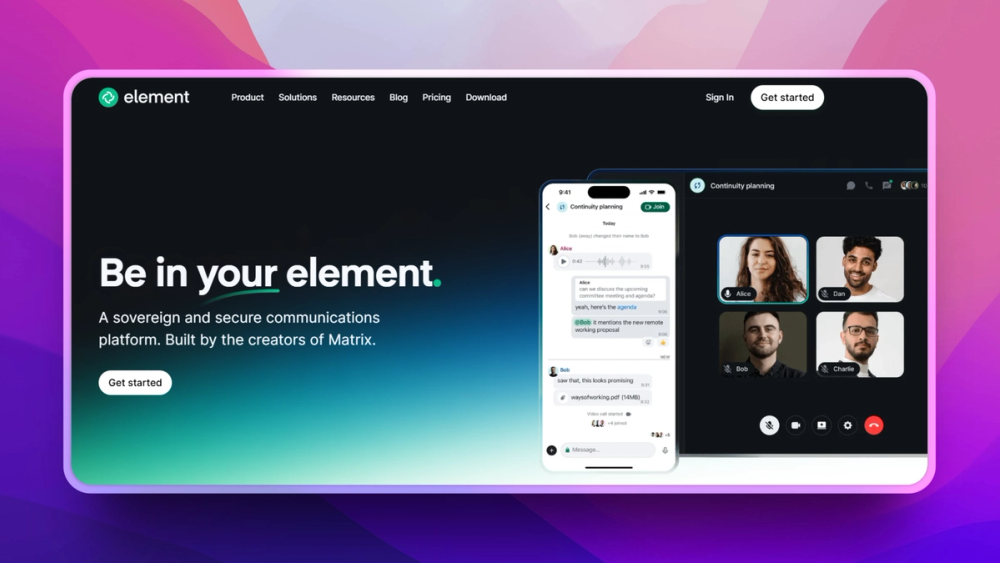
Who Element is for#
Communities spanning organizations
Element fits communities that need rooms across different homeservers and identities while keeping a familiar chat client.
Skip if:
Skip it if every participant must use a single corporate identity provider and admin plane.
Security-conscious teams using Matrix
Element gives teams an established Matrix client with encrypted-room support and public source code.
Skip if:
Use a hosted collaboration suite if federation and protocol control are not real requirements.
The problem it solves#
Team chat becomes infrastructure once decisions, incident response, and customer-sensitive conversations live there. A closed workspace can limit federation, archive control, and the ability to choose where accounts and rooms are hosted.
Organizations with cross-company collaboration or sovereignty requirements need messaging that can span servers without handing the whole network to one vendor.
How it solves it#
Matrix protocol federation
Element works with Matrix homeservers, so rooms can span organizations and servers instead of living inside one vendor workspace.
End-to-end encrypted rooms
Element supports encrypted Matrix conversations for private team and community communication. That makes it useful when chat content is sensitive by default.
Web, desktop, and mobile clients
Element ships client experiences across major platforms, which matters for teams that need a Slack-like daily client rather than a protocol demo.
Strengths and trade-offs#
Strengths
- Protocol-first collaborationElement benefits from the Matrix model: the client can connect to federated homeservers rather than forcing every collaborator into one company's tenant.
- Inspectable client codeThe Element Web repository is AGPL-3.0 licensed, giving security-sensitive teams a public client codebase to inspect and adapt.
Trade-offs
- -Matrix administration has overheadRunning a Matrix homeserver requires operational knowledge, moderation practices, and federation decisions. This is heavier than creating a channel in a hosted chat app.
- -Not every team needs federationIf all collaborators already live in one company tenant and need bundled docs, meetings, and admin controls, a mainstream workspace may be simpler.
What it's built on#
- Languages
- JavaScriptTypeScript
- Frameworks
- ExpressReact
- Tooling
- Webpack
FAQ#
Is Element the same as Matrix?
No. Matrix is the open protocol and network model; Element is a client and product built for Matrix communication.
Can Element be self-hosted?
Element can be paired with self-hosted Matrix infrastructure, commonly through a Matrix homeserver such as Synapse.
What license does Element Web use?
Element Web is published under AGPL-3.0.
Similar open-source tools#

Quiet
Peer-to-peer serverless chat app with no central server

Tox
Free encrypted P2P messaging and voice calls, no servers

Vela
OpenStreetMap and Google data, no account, no Play Services

Prose
Decentralized open source workplace with chat and docs

Passbolt
Open source team password manager with sharing and audit

MiroTalk
Free browser-based video calls with no sign-up required