

Who Quiet is for#
Small privacy-sensitive groups
Use Quiet when a group needs private chat without depending on a central workspace provider.
Skip if:
You need enterprise administration, app integrations, and formal compliance reporting.
Communities avoiding central servers
Use Quiet for community spaces where server ownership and metadata exposure are major concerns.
Skip if:
Your members need the simplest possible mainstream onboarding experience.
The problem it solves#
Private groups often use hosted team chat even when they do not want a central provider controlling servers, metadata, or access. That creates a trust gap for activist groups, sensitive communities, and teams working under privacy constraints.
Serverless messaging can reduce provider dependence, but it changes expectations around availability, moderation, and administration. Teams need to choose it for the right reason: privacy and ownership, not maximum workplace features.
How it solves it#
Peer-to-peer team chat
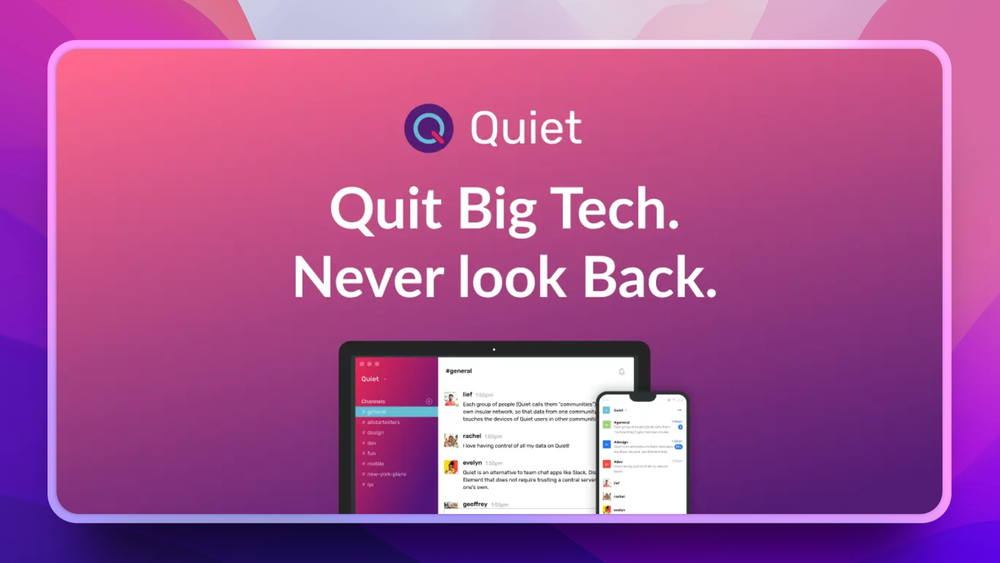
Quiet is built around group messaging without a traditional central workspace server.
Tor-based privacy layer
The project uses Tor as part of its privacy model, reducing exposure of network metadata compared with ordinary hosted chat.
Local-first community data
Quiet emphasizes local-first communication patterns, which helps groups retain more control over their messages and spaces.
Strengths and trade-offs#
Strengths
- No central chat providerQuiet is useful for groups that do not want their communication tied to a company-owned workspace server.
- Designed for sensitive communitiesThe Tor and peer-to-peer architecture makes privacy a core product decision rather than an add-on setting.
Trade-offs
- -Not a Slack cloneQuiet should not be evaluated as a feature-for-feature Slack replacement. It prioritizes privacy architecture over broad workplace integrations.
What it's built on#
- Languages
- CC++JavaScriptKotlinPythonSwiftTypeScript
- Frameworks
- ExpressNestJS
- Tooling
- Webpack
FAQ#
Is Quiet self-hosted?
Quiet is better described as peer-to-peer and serverless rather than a traditional self-hosted chat server.
Does Quiet use Tor?
Yes. Quiet uses Tor as part of its privacy-focused communication model.
Can Quiet replace Slack?
Quiet can replace Slack for small groups prioritizing privacy, but it is not meant to match Slack's full business workspace ecosystem.
Similar open-source tools#

Element
Secure team chat built on the Matrix open protocol

Tox
Free encrypted P2P messaging and voice calls, no servers

Vela
OpenStreetMap and Google data, no account, no Play Services

meetily
Privacy-first AI meeting notes that run entirely on your device

simplex-chat
Private messaging without user IDs or servers.

bitchat
Peer-to-peer encrypted chat over Bluetooth mesh network