

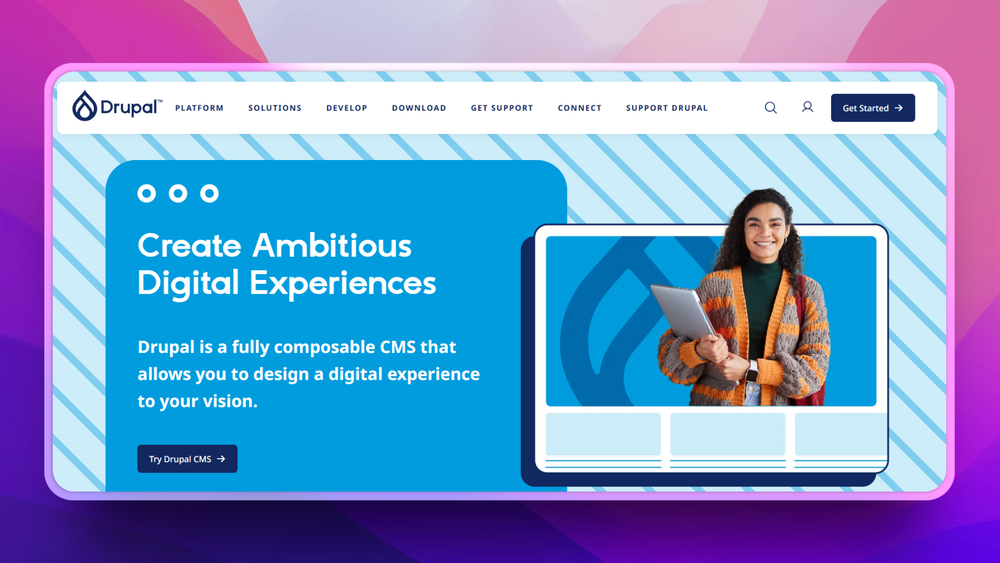
Who Drupal is for#
Public sector and university websites
Use Drupal when content governance, accessibility, permissions, and long-term self-hosting matter.
Skip if:
Your team needs a no-code marketing site with minimal technical ownership.
Enterprise content portals
Use Drupal for structured content, workflows, and integrations that go beyond a basic CMS.
Skip if:
Your organization wants a fully managed proprietary CMS and vendor-led implementation.
Communities with custom publishing needs
Use Drupal when a community site needs custom roles, modules, and long-term extensibility.
Skip if:
A simple forum or hosted knowledge base covers the whole use case.
The problem it solves#
Enterprise websites often need more than page publishing: structured content, permissions, localization, workflow, integrations, and custom business logic. Proprietary CMS platforms can solve that, but they bring high licensing cost and vendor dependence. Teams that need long-lived public infrastructure also need access to code, modules, security advisories, and migration paths they can control.
How it solves it#
Open source CMS platform
Drupal supports websites ranging from personal blogs to large community-driven sites, with code and project infrastructure maintained in public.
Large module ecosystem
Thousands of free and open source modules extend Drupal core before teams write custom code.
Public security process
Drupal maintains security advisories, an RSS feed, and a documented security team process for reporting vulnerabilities.
Deep documentation and change records
Drupal keeps documentation, API references, and detailed change records, which helps long-term site owners plan upgrades and migrations.
Strengths and trade-offs#
Strengths
- Strong fit for complex content modelsDrupal is well suited to sites where content types, permissions, workflow, and integrations matter more than a simple page builder.
- Mature public ecosystemModules, providers, security advisories, and documentation reduce dependence on one vendor for the full CMS lifecycle.
- Self-hosting and code controlOrganizations can run Drupal on their own infrastructure and customize core behavior through modules and code.
Trade-offs
- -Higher implementation complexityDrupal is more demanding than simpler CMS tools. Teams need experienced developers or an agency for complex builds and upgrades.
- -Not ideal for simple brochure sitesIf a site only needs a few static pages, Webflow, WordPress, or a static site generator may ship faster with less maintenance.
What it's built on#
- Languages
- JavaScriptPHP
- Tooling
- Webpack
FAQ#
What is Drupal?
Drupal is an open source content management platform used for websites, portals, and community-driven digital experiences.
Does Drupal have extensions?
Yes. Drupal has thousands of free and open source modules for extending core.
Who should choose Drupal?
Drupal fits teams that need complex content models, permissions, workflow, and hosting control rather than a simple visual website builder.
Similar open-source tools#

Sulu
Enterprise-ready open source CMS built on Symfony

Strapi

Payload CMS
Build code-first CMS backends with TypeScript schemas

Grav
Flat-file CMS for fast, self-hosted websites.

Craft CMS
Flexible developer-friendly CMS for content teams

Decap CMS
Git-based content management for static site generators