

Who Grav is for#
Developers shipping small content sites
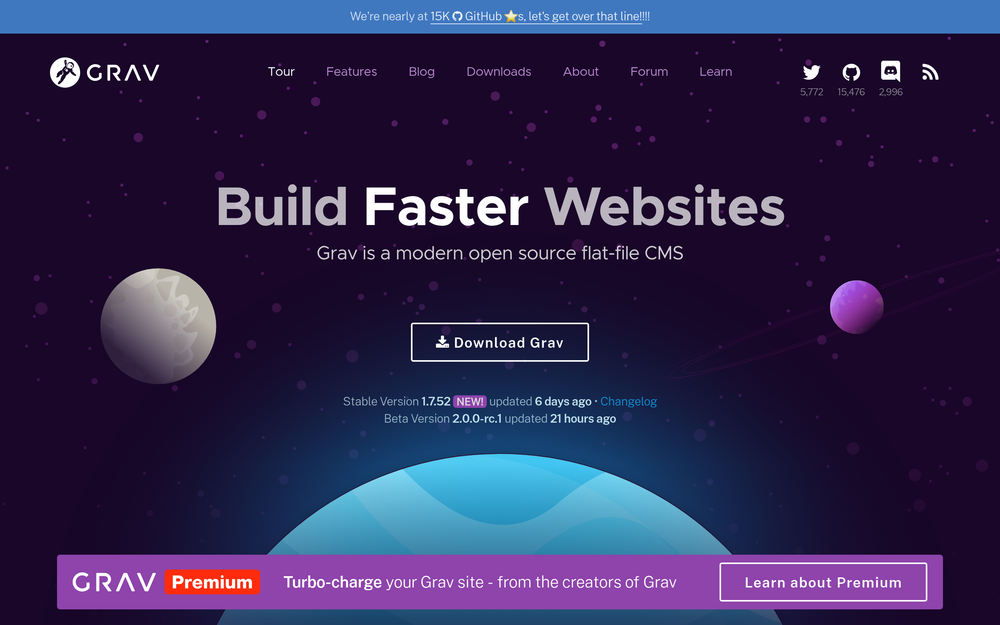
Grav fits documentation, marketing sites, portfolios, and local business pages where content can live as Markdown files. Developers can keep themes and content in the same deployment flow.
Skip if:
Use WordPress or a headless CMS if non-technical editors need complex workflows, user roles, and a large plugin marketplace.
Teams replacing hosted site builders
Grav gives teams ownership of templates, content files, and hosting. It is useful when Webflow or Squarespace feels restrictive for developer-controlled sites.
Skip if:
Skip it if visual drag-and-drop editing is more important than source control and hosting portability.
The problem it solves#
Many websites do not need a database, hosted page builder, or complex CMS operations. Small business sites, documentation hubs, campaign pages, and personal sites often need fast editing, simple deployment, and content that can be versioned with the code.\u000A\u000ADatabase-backed CMS stacks add upgrade, plugin, backup, and security work. Hosted builders reduce maintenance but lock content, templates, and publishing workflows into the vendor's system.
How it solves it#
Flat-file content storage
Grav stores content in files instead of a database. Markdown, YAML, and templates can live in version control, which simplifies backups, review, and deployment for small sites.
Twig theme system
Themes use Twig templates, giving developers direct control over page layouts. This is useful when a site needs custom presentation without a hosted visual builder.
Plugin and admin ecosystem
Grav supports plugins and an optional admin panel, so teams can add forms, search, media handling, and editing workflows without turning the project into a full database CMS.
Strengths and trade-offs#
Strengths
- No database to operateFlat-file storage removes database backups, migrations, and query tuning from routine site maintenance. For static-ish content sites, that is a meaningful operations reduction.
- Permissive license and portable contentMIT licensing and file-based content make Grav easy to move between hosts. Teams are not locked into a proprietary builder or a hosted content API.
Trade-offs
- -Not ideal for complex editorial workflowsGrav can support admin editing and plugins, but it is not a full enterprise CMS with large editorial teams, granular workflow states, or heavy content modeling.
- -PHP hosting knowledge helpsGrav is simpler than many CMS stacks, but teams still need PHP hosting, updates, file permissions, and deployment discipline.
Grav vs alternatives#
Grav vs WordPress.com\u000A\u000AGrav and WordPress both manage website content, but Grav is a self-hosted flat-file CMS while WordPress.com is a hosted database-backed publishing product.\u000A\u000A| Criterion | Grav | WordPress.com |\u000A| --- | --- | --- |\u000A| License | MIT | Hosted proprietary service around WordPress |\u000A| Storage | Markdown and files | Database-backed service |\u000A| Hosting | Self-hosted PHP | Managed SaaS |\u000A| Best fit | Developer-controlled small sites | Editor-heavy sites and hosted publishing |\u000A\u000AGrav is the better choice when file portability, source control, and minimal infrastructure matter. WordPress.com is still better when editors need hosted convenience, a mature block editor, and a broad plugin ecosystem.
What it's built on#
- Languages
- PHP
FAQ#
Does Grav need a database?
No. Grav is a flat-file CMS, so it stores content in files rather than a database. That makes backups and version control simpler for many small sites.
Is Grav open source?
Yes. Grav is MIT licensed. Teams can use, modify, and host it commercially under permissive license terms.
How does Grav compare to WordPress?
Grav is lighter and file-based, while WordPress is database-backed with a much larger plugin and editor ecosystem. Grav is better for developer-controlled small sites; WordPress is better for large editor teams and plugin-heavy sites.
Similar open-source tools#

WordPress

GrapesJS
Build drag-and-drop page editors inside your own stack.

Ycode
Open source visual website builder with no-code CMS

Webstudio
Open source website builder with visual design and CMS

Strapi
