Agencies building bespoke marketing sites
Use Craft CMS when clients need custom content types, editorial control, and designed templates rather than a generic builder.
Skip if:
The client wants a fully hosted no-code site with minimal development.

Open source alternative to Contentful, Sanity and Storyblok
Last verified
Build custom websites and headless content platforms with a self-hosted CMS that gives developers flexible content modeling, Twig templates, and GraphQL APIs.
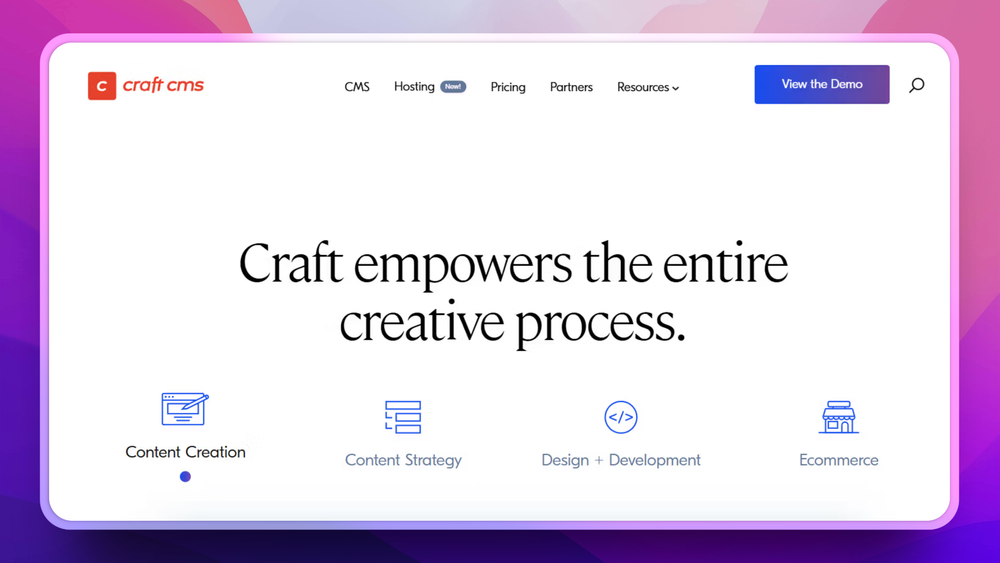
Use Craft CMS when clients need custom content types, editorial control, and designed templates rather than a generic builder.
The client wants a fully hosted no-code site with minimal development.
Use Craft when a project needs both Twig-rendered pages and GraphQL access for decoupled front ends.
Your team wants a pure hosted content API with no server maintenance.
Use Craft when editorial content and bespoke commerce need to live in one PHP CMS ecosystem.
A standard Shopify storefront covers the whole business.
Many CMS tools force teams into either rigid templates or hosted content APIs. Custom sites need content models that match the business, editorial controls that non-developers can use, and front-end flexibility for bespoke designs. Proprietary headless CMS products solve some of this, but they add vendor pricing and data dependency to a core publishing workflow.
Craft uses a clean-slate content modeling approach that does not assume the content structure a project needs.
Twig templates support front-end development, while an auto-generated GraphQL API supports headless applications.
Craft is a self-hosted PHP app that can connect to MySQL or PostgreSQL for content storage.
Craft includes a Plugin Store and a commerce platform for bespoke ecommerce experiences.
Craft CMS is a flexible self-hosted PHP content management system for custom digital experiences.
Yes. Craft CMS includes an auto-generated GraphQL API for building headless applications.
Craft CMS can connect to MySQL and PostgreSQL for content storage.

Alternative to Contentful
Headless CMS with auto-generated REST and GraphQL for any content model.

Alternative toContentful
Build code-first CMS backends with TypeScript schemas

Alternative to CloudCannon
Open source headless CMS with inline editing and Git backend

Alternative toContentful
Enterprise-ready open source CMS built on Symfony

Alternative toCloudCannon
Git-based content management for static site generators

Alternative to WordPress.com
Flat-file CMS for fast, self-hosted websites.
Run Craft CMS on your own server
Self-host Craft CMS on a Hostinger VPS.
Deploy on HostingerFeatured

Alternative toClaude Managed Agents
Open-source agent deployment API. Self-host or use Omnara Cloud.

Alternative to Grok Bot
AI teammates you own: your keys, your model, your machine.

Alternative to Superhuman
AI email assistant that drafts replies and clears your inbox
The projects we add and every new guide. Free, unsubscribe any time.
 Claude Code to
  OpenCode
 Jira to
  Windshift
 Notion to
  AppFlowy
 Slack to
  Mattermost
 Linear to
  GitLab
 Wispr Flow to
  Handy
Handy CapCut to
  Concat
 Grok Bot to
  rakazo
 Superhuman to
  Inbox Zero
 Airtable to
  AITable
 Muse to
  OpenClaw
 GitHub Copilot to
  Cline
Cline Datadog to
  Netdata
 Microsoft Teams to
  Rocket.Chat
 Pinecone to
  Qdrant
 Zapier to
  n8n
n8n Devin AI to
  OpenHands
 Firebase to
  Supabase
 1Password to
  KeePassXCConfluence to
  Docmost
 Contentful to
  Strapi
 Adobe Premiere Pro to
  Shotcut
 ChatGPT to
  AnythingLLM
 LangSmith to
  Langfuse


