
Who FerretDB is for#
Teams reducing MongoDB lock-in
FerretDB fits teams that want to keep a MongoDB-like API while moving toward open-source database foundations.
Skip if:
Skip it if your app depends on advanced MongoDB features that FerretDB does not support.
PostgreSQL-first teams needing document APIs
Teams already strong in PostgreSQL operations can evaluate FerretDB for document-style workloads.
Skip if:
Use MongoDB Atlas if full compatibility and managed operations matter more.
The problem it solves#
MongoDB compatibility is attractive because many apps and developers know the document model. The problem is that managed MongoDB-compatible services can create licensing, cost, and portability concerns once the database becomes central to the product.
Teams need a migration path that preserves common MongoDB application patterns while moving storage onto open-source foundations they can operate and inspect.
How it solves it#
MongoDB wire-protocol goal
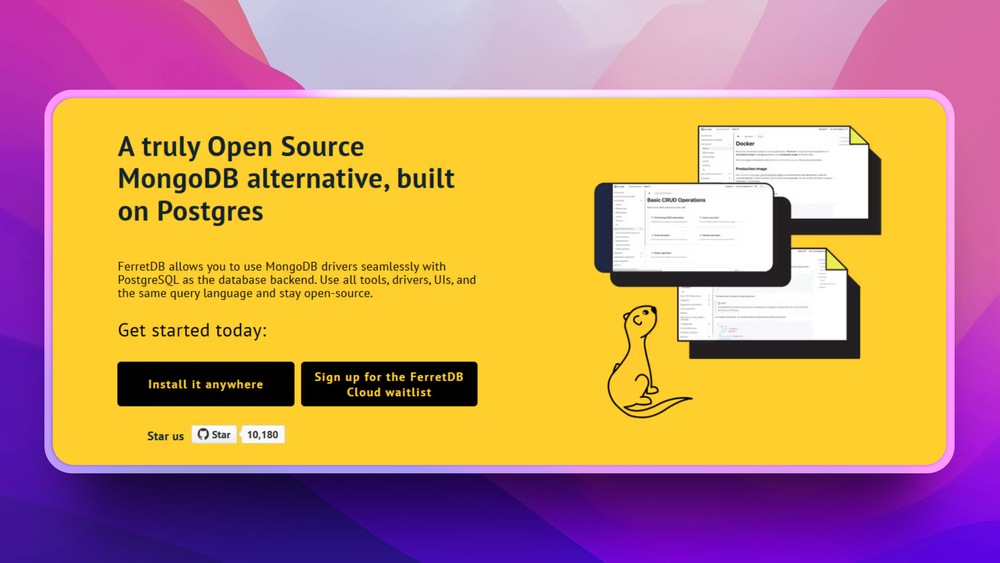
FerretDB aims to provide MongoDB-compatible behavior for applications and drivers, reducing the need to rewrite every data access path at once.
PostgreSQL-backed deployment
FerretDB uses PostgreSQL as a backend, letting teams build on a widely understood open-source database foundation.
Document database API
Applications can keep document-style data access patterns while teams evaluate what compatibility gaps matter for their workload.
Strengths and trade-offs#
Strengths
- Open-source compatibility pathFerretDB gives teams a way to reduce MongoDB dependency without abandoning document-oriented application design immediately.
- Apache-2.0 licenseApache-2.0 licensing makes FerretDB easier to evaluate for commercial use than restrictive or source-available database licenses.
Trade-offs
- -Not full MongoDB parityCompatibility depends on the commands, indexes, aggregation behavior, and workload you use. Production migrations need careful testing.
- -PostgreSQL behavior still mattersBecause PostgreSQL is the backend, performance and operations depend on PostgreSQL sizing, backups, and query behavior.
What it's built on#
- Languages
- GoJavaScript
- Databases
- MongoDBPostgreSQL
FAQ#
Is FerretDB a MongoDB replacement?
FerretDB can replace MongoDB for compatible workloads, but teams must test feature and command compatibility.
What database does FerretDB use underneath?
FerretDB commonly uses PostgreSQL as its backend.
What license does FerretDB use?
FerretDB is Apache-2.0 licensed.
Similar open-source tools#

Apache CouchDB
NoSQL database with multi-primary sync and HTTP API

OrientDB
Multi-model NoSQL database: graphs, docs, and key-value

RethinkDB
Open source distributed document database with real-time feeds

code-graph-rag
AI-powered codebase analysis with knowledge graphs

Duckle
Self-hosted ETL on DuckDB with 385 connectors and no per-row billing.

Parson
Self-hosted music server. Folder in, music everywhere.