

Who Trench is for#
Product teams owning analytics data
Use Trench when product events need to stay in infrastructure you control while still supporting Segment-style tracking calls.
Skip if:
You need a fully managed analytics suite with polished non-technical reporting out of the box.
Engineers building custom analytics products
Use Trench as a base event pipeline for dashboards, observability, RAG, or internal analytics systems.
Skip if:
Your workload is a small marketing site where a hosted analytics snippet is enough.
The problem it solves#
Product analytics can become expensive and opaque as event volume grows. Hosted tools make tracking easy, but teams often lose control over raw events, retention, data deletion, and how analytics data feeds internal systems.
Building an event pipeline from scratch is also hard. Kafka, ClickHouse, ingestion APIs, privacy controls, and dashboards all need to work together before product teams can ask useful questions.
How it solves it#
Kafka and ClickHouse event pipeline
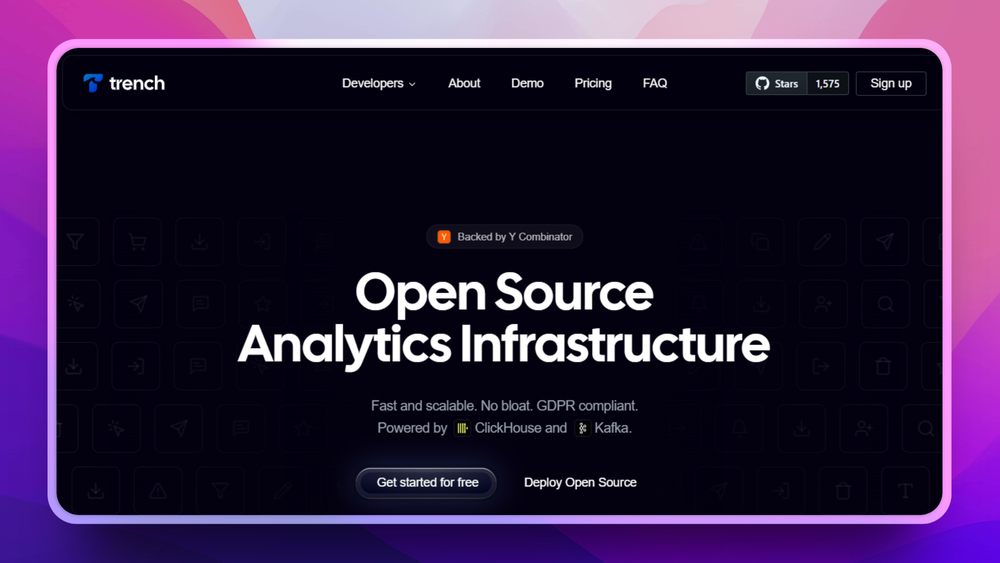
Processes event data through Kafka and stores analytics in ClickHouse, giving teams a high-volume architecture for real-time event workloads.
Segment-compatible tracking
Supports Segment-style Track, Identify, and Group calls, which lowers migration work for teams already using familiar analytics event patterns.
Single Docker image deployment
The official README describes a production-ready Docker image, making the first deployment simpler than assembling every analytics component by hand.
Strengths and trade-offs#
Strengths
- Raw analytics infrastructure ownershipTrench gives teams more control over event ingestion, storage, and deletion than closed hosted analytics dashboards.
- Built for high event volumeThe project describes processing thousands of events per second on a single node, which matters for teams outgrowing basic product analytics tools.
Trade-offs
- -Infrastructure skills requiredTrench simplifies the stack, but Kafka and ClickHouse still need operational understanding, backup planning, upgrades, and capacity management.
What it's built on#
- Languages
- JavaScriptTypeScript
- Frameworks
- NestJS
- Databases
- ClickHouse
- Runtimes
- Node.js
- Messaging
- Kafka
- Cache
- Redis
- Tooling
- esbuild
FAQ#
What is Trench used for?
Trench is used for self-hosted event tracking and real-time analytics infrastructure built on Kafka and ClickHouse.
Is Trench Segment-compatible?
Yes. Trench supports Segment-style Track, Identify, and Group events according to the official README.
Who should use Trench?
Trench fits engineering teams that want to own analytics event infrastructure instead of sending all raw product events to a hosted analytics vendor.
Similar open-source tools#

openpanel
Open-source analytics with funnels, replay, and self-hosting

Umami
Self-hosted analytics for product and marketing teams

PostHog
Track events, replay sessions, and run A/B tests, self-hostable

Plausible
Cookie-free web analytics for privacy-focused teams

ClickHouse
Fast open source column-oriented database for analytics

Traffic Source
Open source self-hosted analytics for total data ownership