

Who Automatisch is for#
Operations teams self-hosting automations
Automatisch fits teams routing leads, syncing support data, and sending notifications where workflow data should stay under their own infrastructure controls.
Skip if:
Use Zapier if connector breadth and hosted convenience are more important than self-hosting.
Small teams reducing integration scripts
Teams can move simple recurring integration tasks out of custom scripts and into a workflow UI. This helps non-developers maintain routine automations safely.
Skip if:
Skip it if your workflows require complex code, long-running jobs, or enterprise integration patterns better served by a workflow orchestrator.
The problem it solves#
Zapier-style automations become part of business operations quickly: lead routing, support triage, billing updates, notifications, and data sync. When those workflows live in a proprietary service, teams depend on external pricing, connector limits, and vendor availability for routine operations.\u000A\u000ASome organizations also cannot send operational data through a third-party automation vendor. They need a workflow tool they can host close to the systems being connected.
How it solves it#
No-code workflow builder
Automatisch lets users define triggers and actions between connected apps through a workflow UI. That supports routine business automation without building every integration from scratch.
Self-hosted automation runtime
Teams can run Automatisch on their own infrastructure, keeping workflow execution and connected-account data under their chosen controls.
App integration model
Automatisch is designed around connecting common SaaS and internal tools. It fits lead handoffs, notifications, CRM updates, and lightweight data movement.
Strengths and trade-offs#
Strengths
- Zapier-like workflow ownershipAutomatisch gives teams a familiar automation pattern without making every workflow depend on a hosted automation vendor. That matters for privacy-sensitive operations.
- Useful bridge between no-code and engineeringNon-developers can create routine workflows, while technical teams can host and govern the runtime. This reduces pressure to build small integration services for every process.
Trade-offs
- -Connector coverage may trail ZapierZapier and Make have much larger connector ecosystems. Automatisch is better for control, but teams should verify every required app integration before migration.
- -AGPL core with enterprise filesAutomatisch applies AGPL-3.0 to repository files except .ee. files, which are covered by an enterprise license. Teams modifying and offering it over a network should review AGPL obligations and enterprise feature boundaries.
Automatisch vs alternatives#
Automatisch vs Zapier
Automatisch and Zapier both connect apps through trigger-action workflows, but Automatisch is self-hosted while Zapier is a hosted proprietary automation service.
| Criterion | Automatisch | Zapier |
|---|---|---|
| License | AGPL-3.0 core with enterprise-licensed .ee. files | Proprietary SaaS |
| Hosting | Self-hosted | Managed SaaS |
| Connector ecosystem | Smaller, verify required apps | Very large |
| Best fit | Workflow ownership and privacy | Fast hosted automation with broad connectors |
Automatisch is the better choice when workflow data should stay under team control. Zapier is still better when teams need the largest connector catalog and do not want to operate automation infrastructure.
What it's built on#
- Languages
- JavaScript
- Frameworks
- ExpressReactVue
- Databases
- PostgreSQL
FAQ#
Is Automatisch a Zapier alternative?
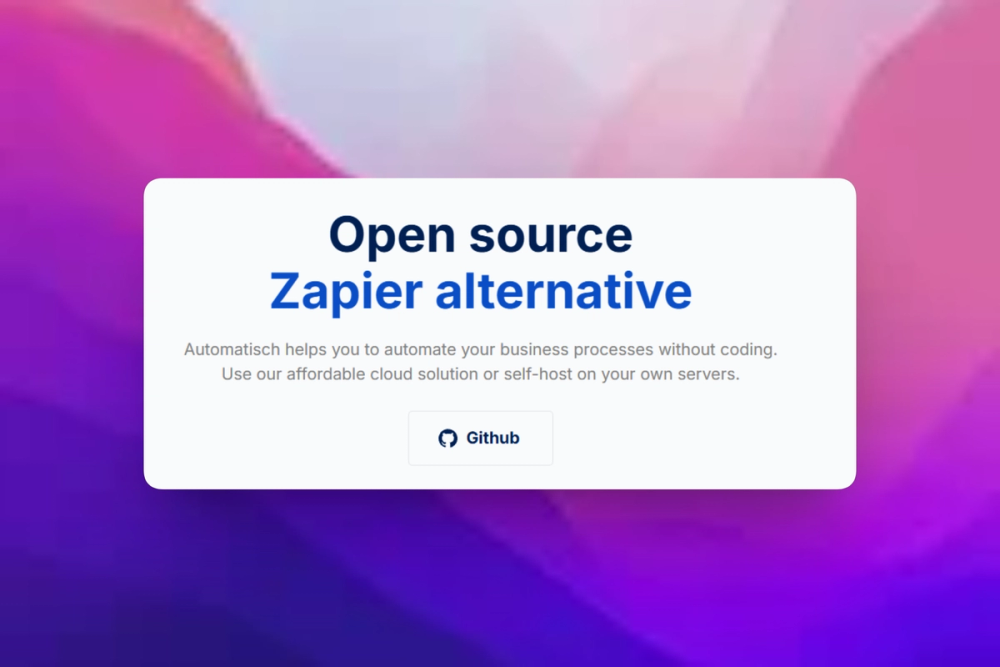
Yes. Automatisch is positioned as an open source Zapier alternative for building workflow automations. Its main advantage is the self-hosted deployment model.
Can Automatisch be self-hosted?
Yes. Automatisch is designed to run on your own infrastructure. Self-hosting gives more control over workflow data and connected accounts.
Is Automatisch open source?
Automatisch Community Edition code is AGPL-3.0 except .ee. files, which use an enterprise license. Review the AGPL and enterprise boundaries before commercial modification or hosted use.
Similar open-source tools#

Node-RED
Low-code event-driven programming with a browser-based editor

n8n
Self-hosted workflow automation with 400+ node connectors

Huginn
Self-hosted agents that watch the web and trigger automations

Activepieces
Build AI-powered automations and agents without vendor lock-in

AI-Flow
Visually chain AI models and APIs into automated pipelines

rakazo
AI teammates you own: your keys, your model, your machine.