

Who Manifest is for#
AI products reducing model spend
Manifest helps teams route simple requests to cheaper models while preserving access to stronger models for complex work.
Skip if:
Use one provider directly if your app has low model volume and does not need routing, fallback, or cost controls.
Agent teams standardizing provider access
Teams can put multiple model backends behind one gateway instead of wiring every agent to every provider separately.
Skip if:
Skip it if vendor-managed observability, enterprise SLAs, and a hosted AI gateway are required.
The problem it solves#
AI apps often start with one model API, then grow into a mix of premium models, cheaper fallbacks, local models, and subscription-backed providers. Without a routing layer, developers scatter provider logic across application code and lose visibility into cost, fallback behavior, and model selection.
Managed AI gateways can solve routing, but they add another vendor to a sensitive part of the stack. Teams that already manage model keys and local inference may want a self-hosted control point instead.
How it solves it#
Smart model routing
Manifest routes each query to a model based on complexity, specificity, and custom HTTP headers, helping teams reserve expensive models for requests that need them.
Provider mix in one gateway
The README documents API keys, paid subscriptions, local models, and custom OpenAI-compatible providers behind the same routing layer.
Cost tracking and controls
Manifest tracks spend and supports notifications and limits, giving teams a clearer view of LLM usage before bills grow.
Self-hosted Docker deployment
The project ships as a Docker image with a one-command self-hosted installer and a local admin account created on first sign-up.
MIT license
The GitHub repository reports MIT licensing, which is permissive for commercial and internal use.
Strengths and trade-offs#
Strengths
- Fast model-gateway setupManifest gives teams a routing layer without building provider selection, fallback behavior, and spend tracking from scratch.
- Useful for AI-assisted productsAgents and AI apps can route routine calls to cheaper models while keeping stronger models available for harder prompts.
- Keeps routing under team controlSelf-hosting lets teams manage keys, provider choices, and model policy closer to their own infrastructure.
Trade-offs
- -Routing quality needs tuningA model router only helps if its policies match the product's quality bar. Teams should test routing decisions against real prompts before trusting cost savings.
- -Provider limits still applyManifest can route across providers, but each upstream model API, subscription, or local runtime still has its own reliability, latency, and terms.
Manifest vs alternatives#
Manifest vs Portkey
Manifest and Portkey both sit between AI applications and model providers, but Manifest emphasizes a self-hosted smart router with local models, paid subscriptions, API keys, and custom providers behind one gateway. Portkey is a managed AI gateway with hosted observability, policy, and enterprise workflow features.
Manifest is the better fit when a team wants a lightweight self-hosted router and direct control over model provider choices. Portkey is still better when the organization wants a managed AI gateway with vendor-operated dashboards, enterprise controls, and less infrastructure ownership.
Quick start#
bash <(curl -sSL https://raw.githubusercontent.com/mnfst/manifest/main/docker/install.sh)What it's built on#
- Languages
- JavaScriptTypeScript
- Frameworks
- NestJSReact
- Databases
- PostgreSQL
- Infrastructure
- AWS
FAQ#
What does Manifest do?
Manifest routes AI requests across model providers, local models, and subscription-backed providers while tracking cost and fallback behavior.
Is Manifest self-hosted?
Yes. Manifest ships as a Docker image and includes a self-hosted install script in the official README.
Is Manifest still a backend generator?
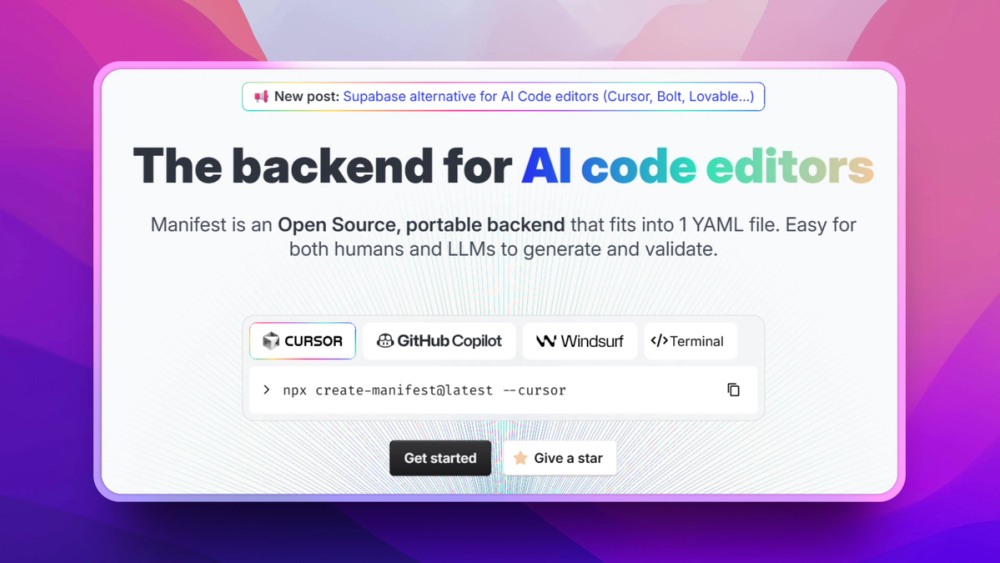
No. The current README says the legacy manifest npm package is deprecated and no longer published. The project now focuses on model routing for agents and AI applications.
Similar open-source tools#

InsForge
Backend-as-a-service platform built for AI coding agents

Modelence
Full-stack framework for building production-ready web apps

Supabase
Open source Firebase: Postgres database, auth, and file storage

Appwrite
Self-hosted backend: auth, databases, storage, and functions

Directus
Wrap any SQL database with REST and GraphQL APIs and an admin UI

Nhost
Firebase alternative: GraphQL, Postgres auth, and file storage