

Who RethinkDB is for#
Collaborative realtime products
Use RethinkDB when the application needs database-backed live updates for boards, feeds, dashboards, presence-like state, or collaborative content.
Skip if:
Skip it if relational integrity, SQL ecosystem depth, or managed database support matters more than native changefeeds.
Teams reducing polling code
Use RethinkDB when polling loops and ad hoc websocket synchronization are becoming a maintenance burden.
Skip if:
Skip it if your realtime layer is already well served by Postgres logical replication, Supabase Realtime, or a hosted pub/sub service.
The problem it solves#
Realtime applications often start by polling a database or layering custom pub/sub code over a conventional data store. That approach adds latency, duplicated state, and operational complexity as more clients need live updates. Teams building collaborative products need a data layer that treats changing query results as part of the core model.
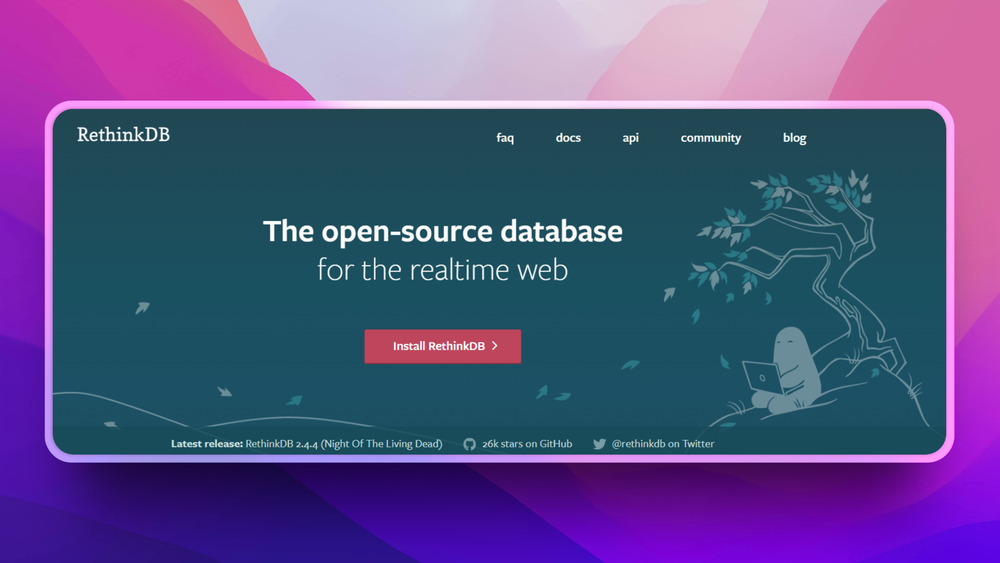
RethinkDB was designed around that realtime use case. It stores schemaless JSON documents like a NoSQL database, but its distinguishing feature is changefeeds: applications can subscribe to query changes instead of repeatedly asking whether data has changed.
How it solves it#
Realtime changefeeds
Subscribe to updated query results and push changes to applications without polling. This fits live dashboards, collaborative interfaces, feeds, and notification-driven products.
JSON document model
Store schemaless JSON documents for application data that does not fit rigid relational tables. Developers can iterate on product data models while still querying through ReQL.
Distributed database design
RethinkDB supports clustering, scaling, and automatic failover. That matters for realtime apps where the database becomes both storage and update-delivery infrastructure.
Official and community drivers
The project documents official JavaScript, Python, Ruby, and Java drivers plus community drivers for other languages. That gives teams several integration paths for application stacks.
Strengths and trade-offs#
Strengths
- Realtime behavior is nativeUnlike PostgreSQL plus a custom notification layer, RethinkDB makes live query updates a core database capability. That can simplify products where users expect the UI to update immediately.
- Apache-2.0 upstream license signalThe upstream README says RethinkDB is licensed under Apache-2.0 by the Linux Foundation. ContentOps should update the OSA license record, which currently says NOASSERTION, after verification.
Trade-offs
- -Maturity and ecosystem differ from mainstream databasesRethinkDB is a specialized choice. PostgreSQL, MongoDB, and hosted realtime platforms have larger hiring pools, managed offerings, and broader ecosystem support for many production teams.
RethinkDB vs alternatives#
RethinkDB vs Firebase Realtime Database
RethinkDB is the better fit when a team wants a self-hosted realtime database with JSON documents and changefeeds. Firebase Realtime Database is stronger when a team wants a managed backend, mobile SDKs, authentication tie-ins, and Google-operated infrastructure. Choose RethinkDB for database-level control; choose Firebase when managed platform speed matters more.
What it's built on#
- Languages
- C++JavaScriptPython
FAQ#
What does RethinkDB replace?
RethinkDB can replace a conventional document database plus custom polling or websocket update logic for realtime applications. It is not a general replacement for every PostgreSQL or MongoDB workload.
Is RethinkDB self-hosted?
Yes. RethinkDB is database software you run on your own servers or infrastructure, with install and quickstart guides in the official docs.
What license does RethinkDB use?
The upstream README states Apache-2.0 licensing through the Linux Foundation. The OSA item record lists NOASSERTION, so verify and update the stored license before applying.
Similar open-source tools#

Apache CouchDB
NoSQL database with multi-primary sync and HTTP API

MongoDB
Popular open source NoSQL document database for modern apps

FerretDB
Run MongoDB apps on PostgreSQL with no code changes needed

PouchDB
JavaScript database that syncs with CouchDB, works offline

OrientDB
Multi-model NoSQL database: graphs, docs, and key-value

TiKV
Distributed key-value store with ACID transactions at scale