
Who Soketi is for#
SaaS teams replacing Pusher Channels
Use Soketi when an app already uses Pusher-compatible clients and message volume makes hosted pricing unattractive.
Skip if:
You want a globally managed real-time network with vendor SLAs and no infrastructure ownership.
Developers adding real-time pub/sub
Use Soketi when private channels, presence, and WebSocket events are needed without inventing a custom protocol.
Skip if:
Your app only needs occasional server-sent updates that could be handled by polling or server-sent events.
The problem it solves#
Real-time app features can become expensive when every message and connection passes through a hosted WebSocket vendor. Live dashboards, notifications, chat, collaboration, and presence features all create steady traffic that grows with product usage.
Building custom WebSocket infrastructure from scratch is also risky. Teams need authentication, channels, horizontal scaling, and client SDK compatibility without spending months maintaining a bespoke messaging layer.
How it solves it#
Pusher protocol compatibility
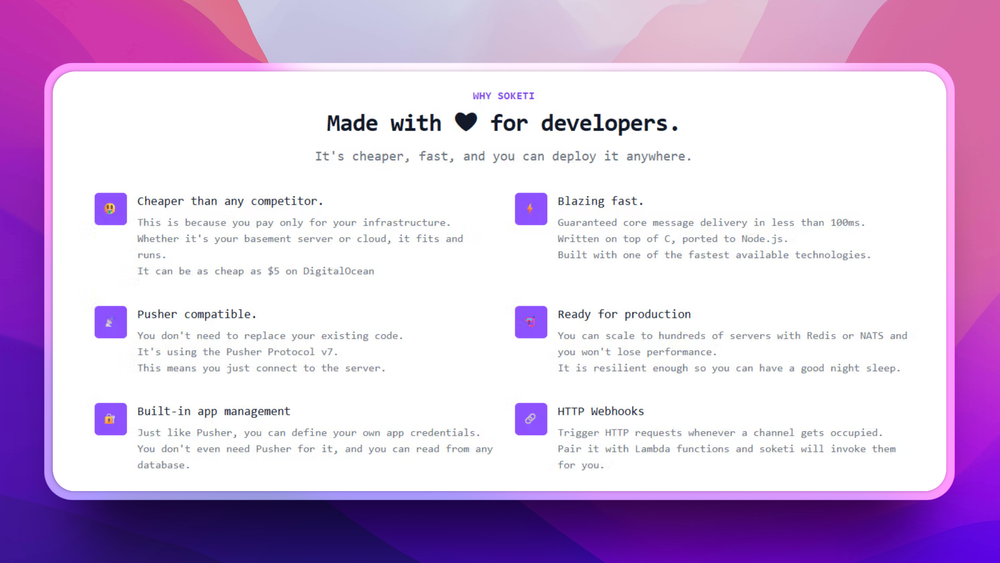
Soketi implements the Pusher Channels protocol, so existing Pusher-compatible clients can connect by changing configuration rather than rewriting the application messaging layer.
Private and presence channels
Support for authenticated private channels and presence channels lets teams build real-time collaboration and user-status features with familiar Pusher-style semantics.
Redis-backed horizontal scaling
Soketi can scale across instances with Redis, giving production teams a path beyond a single WebSocket process.
Strengths and trade-offs#
Strengths
- Lower migration friction from PusherProtocol compatibility makes Soketi practical for teams already using Pusher clients and server APIs who want to move traffic onto their own infrastructure.
- Real-time control without vendor message pricingSelf-hosting removes third-party per-message limits and gives teams direct control over capacity, networking, and data flow.
Trade-offs
- -Infrastructure ownership is requiredSoketi replaces a managed service with software your team must operate. Scaling, Redis, TLS, deployment, monitoring, and incident response become internal responsibilities.
What it's built on#
- Languages
- JavaScriptTypeScript
- Frameworks
- Express
- Databases
- MySQLPostgreSQL
- Runtimes
- Node.js
- Infrastructure
- AWSDocker
- Messaging
- NATS
- Cache
- Redis
FAQ#
What is Soketi?
Soketi is a self-hosted WebSocket server that implements the Pusher Channels protocol for real-time pub/sub messaging.
Can Soketi replace Pusher?
Yes. Soketi can replace Pusher Channels for teams that want compatible real-time messaging on their own infrastructure.
Does Soketi scale horizontally?
Soketi documents Redis-backed scaling for multi-instance deployments, but teams must operate that infrastructure themselves.
Similar open-source tools#
Centrifugo
Scalable real-time messaging server with WebSocket support
Sylius
Headless Symfony commerce for complex B2B and B2C stores
Saleor
Open source headless e-commerce platform with GraphQL API
iptv
A collaborative database for TV channels
Neovim
Hyperextensible Vim-based editor with Lua plugin support
Traefik
Auto-routing reverse proxy for Docker and Kubernetes from labels

