
Engineering-led commerce teams
Saleor fits teams building custom storefronts, marketplaces, or multi-channel commerce experiences.
Skip if:
Skip if you need a store online this week with minimal development work.

Open source alternative to commercetools, Shopify and BigCommerce
Last verified
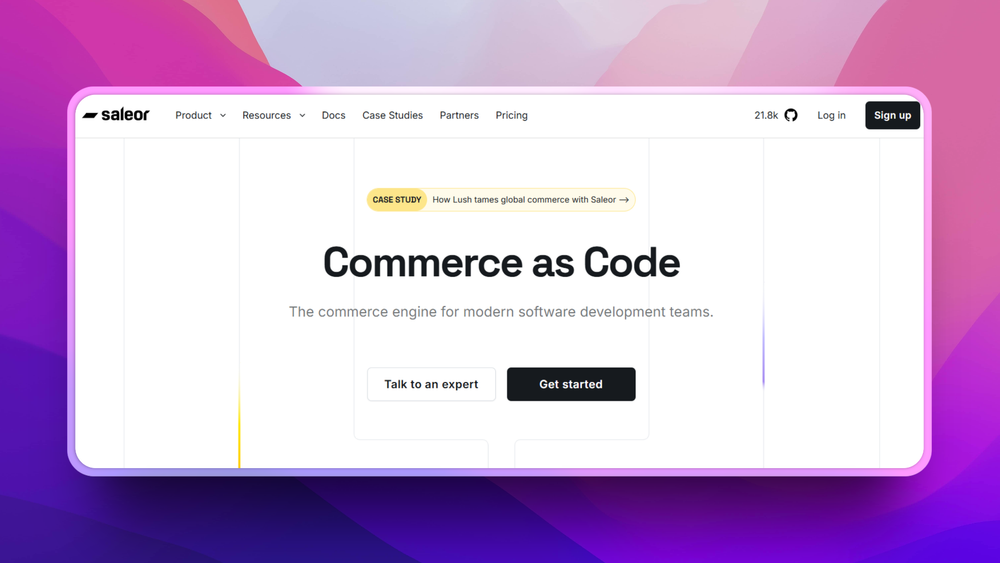
A composable, open-source e-commerce platform using GraphQL-first API for building dynamic shopping experiences.
Saleor fits teams building custom storefronts, marketplaces, or multi-channel commerce experiences.
Skip if you need a store online this week with minimal development work.
Saleor gives teams more backend control when Shopify apps and theme hacks become hard to maintain.
Skip if your current Shopify workflow is standard and the app ecosystem covers your needs.
Hosted commerce platforms are fast to start, but they become restrictive when a team needs custom checkout flows, multi-channel catalogs, unusual pricing, or deep backend integration. Workarounds pile up in apps, scripts, and theme code while the core commerce logic stays locked behind a vendor model.
Engineering-led retailers and marketplaces need commerce primitives they can extend cleanly. They want APIs, webhooks, and deployment control without building every order, payment, and catalog concept from scratch.
Saleor exposes commerce operations through GraphQL, which fits custom storefronts, mobile apps, and internal tools.
Teams can build frontend experiences separately from backend commerce logic instead of being tied to a hosted theme system.
Saleor covers core commerce concepts so teams do not have to implement carts, orders, discounts, and channels from nothing.
Teams can evaluate Saleor Cloud or operate the open source platform depending on control, staffing, and compliance needs.
Saleor and Shopify both support online commerce, but they optimize for different teams. Saleor is API-first and developer-led; Shopify is managed and merchant-led.
| Criteria | Saleor | Shopify |
|---|---|---|
| License | BSD-3-Clause | Proprietary |
| Self-hosting | Yes | No |
| Architecture | Headless GraphQL commerce | Hosted commerce SaaS |
| Best fit | Custom commerce builds | Fast store launch and managed operations |
Saleor is better when commerce logic needs to fit a custom product, marketplace, or multi-channel architecture. Shopify is better when speed, managed hosting, and a large app ecosystem matter more than backend control.
Yes. Saleor is open source under the BSD-3-Clause license.
Saleor can replace Shopify for teams that want API-first headless commerce and have developers to build and operate the stack. Shopify remains easier for no-code store setup.
Yes. Saleor is designed as a headless commerce platform with a GraphQL API for custom storefronts and integrations.


Alternative to Shopify
Open source WordPress eCommerce with full customization

Alternative toShopify
Headless Symfony commerce for complex B2B and B2C stores

Alternative toShopify
Laravel eCommerce with headless API and no transaction fees

Alternative to Wix
Wix
Open source CMS with a block editor, 60,000+ plugins, and 40% market share.

Alternative to Payhip
Open source platform for selling digital products directly
Run Saleor on your own server
Self-host Saleor on a Hostinger VPS.
Deploy on HostingerFeatured

Alternative to Superhuman
AI email assistant that drafts replies and clears your inbox

Alternative toClaude Managed Agents
Open-source agent deployment API. Self-host or use Omnara Cloud.

Alternative to Grok Bot
AI teammates you own: your keys, your model, your machine.
The projects we add and every new guide. Free, unsubscribe any time.
 Claude Code to
  OpenCode
 Jira to
  Windshift
 Notion to
  AppFlowy
 Slack to
  Mattermost
 Linear to
  GitLab
 Wispr Flow to
  Handy
Handy CapCut to
  Concat
 Grok Bot to
  rakazo
 Superhuman to
  Inbox Zero
 Airtable to
  AITable
 Muse to
  OpenClaw
 GitHub Copilot to
  Cline
Cline Datadog to
  Netdata
 Microsoft Teams to
  Rocket.ChatConfluence to
  Docmost
 Pinecone to
  Qdrant
 Zapier to
  n8n
n8n Devin AI to
  OpenHands
 Firebase to
  Supabase
 1Password to
  KeePassXC
 Contentful to
  Strapi
 Adobe Premiere Pro to
  Shotcut
 ChatGPT to
  AnythingLLM
 LangSmith to
  Langfuse


