

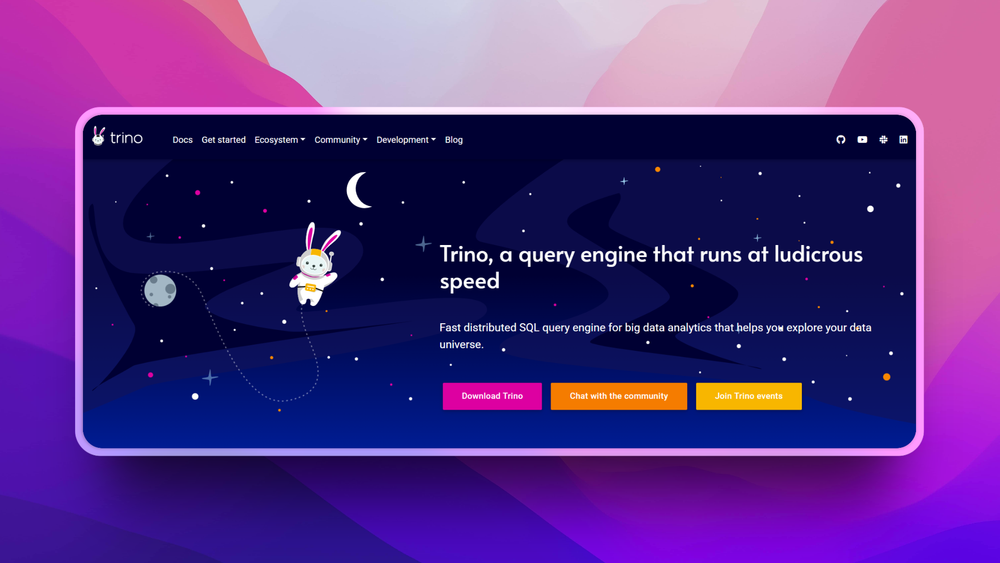
Who Trino is for#
Data platform teams unifying SQL access
Trino fits teams that need one SQL entry point across several storage systems without standardizing on one warehouse.
Skip if:
Skip it if all data already lives in one managed warehouse and query cost is acceptable.
Analytics teams querying data lakes
Teams can use Trino to query object-store-backed datasets alongside other sources through SQL connectors.
Skip if:
Use a managed service if your team cannot operate query clusters.
The problem it solves#
Data teams often end up with useful data spread across object storage, warehouses, relational databases, and specialized engines. Copying everything into one platform adds latency, cost, and governance work.
The pain is not just query speed. Analysts want familiar SQL, platform teams want to avoid another storage migration, and engineers need connectors that let compute move to the data without committing the whole company to one vendor.
How it solves it#
Federated SQL connectors
Trino can query many data systems through connectors, including lakehouse, warehouse, and operational sources. Teams can join data without first moving every dataset.
Distributed query execution
Trino separates query compute from storage and runs distributed SQL workloads across a cluster. That fits interactive analytics over large datasets.
ANSI SQL focus
Users query through SQL rather than a vendor-specific notebook interface. That keeps BI tools and analyst workflows closer to standard database access.
Strengths and trade-offs#
Strengths
- Storage-neutral architectureTrino does not require teams to move all data into a Trino-owned storage layer. That helps organizations with mixed data platforms and existing governance boundaries.
- Apache-2.0 foundationThe Apache-2.0 license supports broad internal and commercial use. Teams can run Trino without tying the query layer to a proprietary cloud contract.
Trade-offs
- -Cluster operations are real workTrino performance depends on connector behavior, cluster sizing, catalog configuration, and workload management. It is not a managed warehouse by itself.
- -Not every workload fits federationHeavy transformations or repeated high-concurrency dashboards may be better served by materialized data in a warehouse or lakehouse table format.
What it's built on#
- Languages
- Java
- Frameworks
- React
- Tooling
- Webpack
FAQ#
Is Trino a database?
Trino is a distributed SQL query engine, not a storage database. It queries data where it lives through connectors.
What license does Trino use?
Trino is Apache-2.0 licensed.
What is Trino best for?
Trino is best for federated analytics where teams need SQL across multiple storage systems.
Similar open-source tools#

timesfm
Foundation model for time-series forecasting

ClickHouse
Fast open source column-oriented database for analytics

DuckDB
Fast in-process SQL analytics database, no server needed

Apache AsterixDB
Scalable Big Data management with high-performance analytics

TiDB
MySQL-compatible distributed SQL database for elastic scale

YugabyteDB
Open source distributed SQL database for cloud-native apps