

Who Budibase is for#
Operations teams replacing Retool screens
Use Budibase when teams need internal tools for approvals, portals, inventory, CRM back offices, or support workflows that connect to existing data sources.
Skip if:
Skip it if the team only needs a single static form or already has engineering capacity for custom internal apps.
Companies standardizing low-code work
Use Budibase when many small operational requests need one governed place for apps, automations, users, and connectors.
Skip if:
Skip it if procurement, vendor-managed uptime, and enterprise support matter more than self-hosting control.
The problem it solves#
Internal operations usually start with spreadsheets, admin scripts, shared inboxes, and one-off dashboards. That works until every approval, record update, and customer portal request needs an engineer to wire another CRUD screen or automation. Hosted low-code tools reduce that backlog, but they can place internal data, user management, and pricing inside a vendor account.
Budibase addresses that operational gap by combining app building, agents, automations, and connectors in a tool teams can host themselves. It is useful when the goal is not just a nicer form builder, but a controlled way to turn internal processes into maintainable apps and workflows.
How it solves it#
Internal app builder
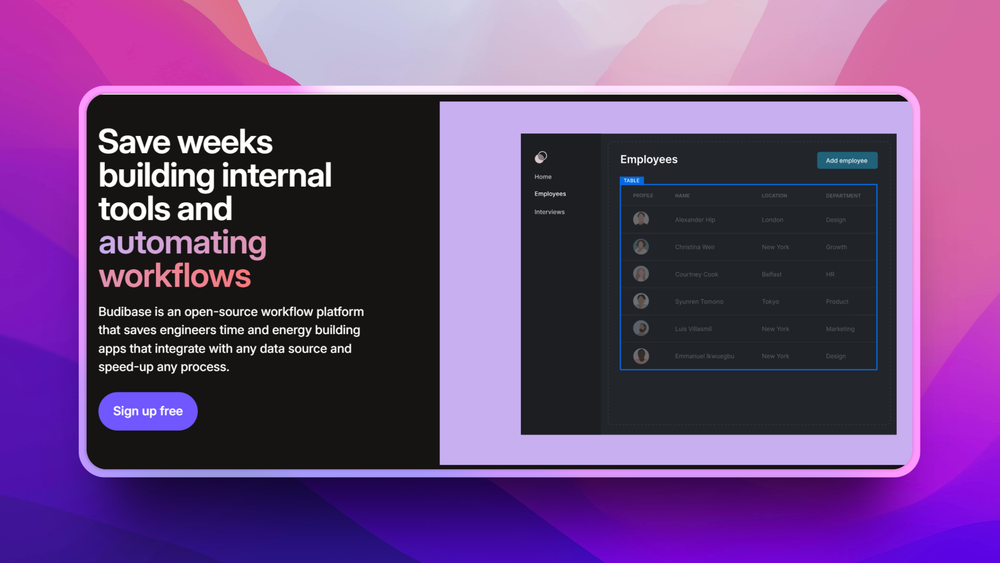
Build admin panels, forms, portals, and data GUIs around existing databases and APIs. Teams can replace one-off internal screens with reusable interfaces that non-engineers can operate.
Agents and automations
Route approvals, update records, notify teams, and connect business systems from the same operations workspace. That reduces the handoff between an app builder and a separate workflow automation tool.
Self-hosting paths
Budibase documents hosting through Docker, Docker Compose, Kubernetes, DigitalOcean, and Portainer. Teams with internal-data requirements can place the runtime closer to their own infrastructure.
Connector-oriented workflow
Connect databases, REST APIs, AI models, and business tools so internal apps can act on live operational data instead of duplicated spreadsheet exports.
Strengths and trade-offs#
Strengths
- Covers apps and automation togetherBudibase is stronger than a narrow CRUD builder when a process needs both a user-facing internal app and backend actions. That matters for approvals, service requests, onboarding flows, and support operations.
- Practical self-hosting choicesThe official docs describe multiple self-hosted deployment methods, which gives teams a cleaner adoption path than tools that only run as hosted SaaS.
Trade-offs
- -License and edition boundaries need reviewThe current OSA record does not expose a clean SPDX license. Teams should review Budibase license terms and edition limits before using it for redistributed products or competitive hosted services.
Budibase vs alternatives#
Budibase vs Retool
Budibase is the better fit when internal tools need app screens, automations, agents, database connectors, and self-hosted deployment in one operations platform. Retool remains stronger when a team wants a mature hosted internal-tool vendor, a larger enterprise feature set, and less infrastructure ownership. Choose Budibase when control over internal data and deployment matters; choose Retool when managed depth matters more.
What it's built on#
- Languages
- JavaScriptTypeScript
- Frameworks
- ExpressReactSvelte
- Infrastructure
- AWS
- Cache
- Redis
- Tooling
- esbuild
FAQ#
What does Budibase replace?
Budibase can replace parts of Retool, Microsoft Power Apps, Airtable Interfaces, and Zapier-style internal automations. It is best viewed as an operations app platform, not as a full CRM or ERP by itself.
Is Budibase self-hosted?
Yes. Budibase documents self-hosted deployment options including Docker, Docker Compose, Kubernetes, DigitalOcean, and Portainer, alongside Budibase Cloud.
What license does Budibase use?
This draft keeps license language conservative because the OSA item record lists NOASSERTION. Confirm the current upstream license and self-hosted terms before commercial redistribution or modified hosted use.
Similar open-source tools#

Appsmith
Build internal tools with a low-code drag-and-drop UI

ToolJet
Build internal tools with a drag-and-drop UI and 50+ connectors

NocoDB
Turn any database into a no-code spreadsheet. Self-hostable.

Totum
Self-hosted low-code platform for internal business tools

Cloudflare Os
Open source AI workspace with sandboxed apps and Gatekeeper security

Anytype
Local-first knowledge OS with E2E encryption and P2P sync