
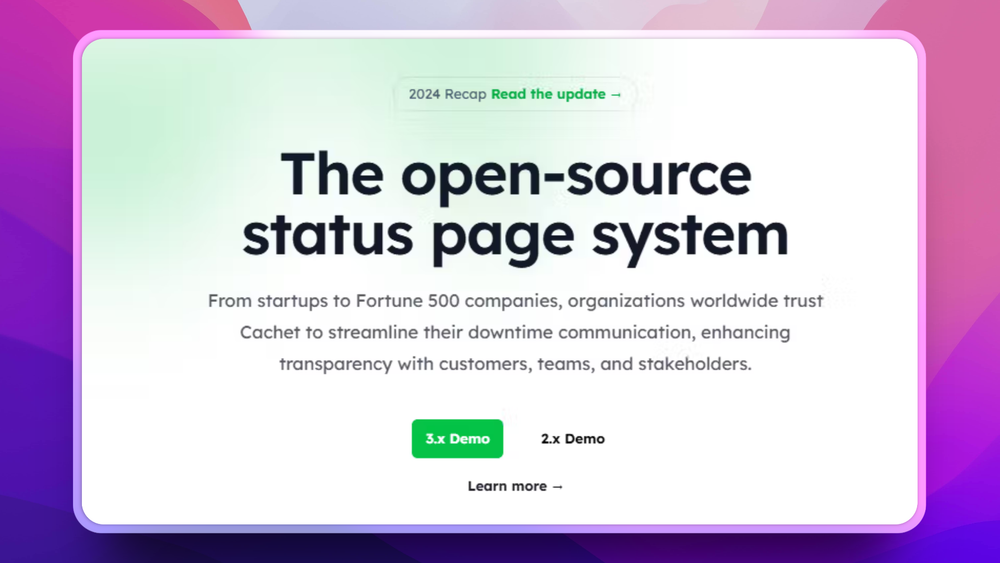
Cachet is an open source self-hosted status page system that lets engineering teams communicate service incidents, scheduled maintenance, and component health to customers in real time.
The Problem
When a service goes down, customers immediately look for a status page. Without one, they flood support channels, post on social media, and lose confidence in the product. Hosted status page services like Atlassian Statuspage charge per subscriber and process your incident data on their servers, adding cost and data privacy concerns for every notification sent.
How Cachet Solves It
Cachet provides a complete status page hosted on your own server. Define components (API, web app, CDN), create incidents with time-stamped updates, and schedule maintenance windows in advance. Customers can subscribe to email notifications and receive updates directly from your infrastructure. MIT licensed; deploy via Docker or any PHP/MySQL environment.
Key Features
- Component status tracking: define each service and set its status (operational, degraded, partial outage, major outage)
- Incident timeline with time-stamped updates for transparent outage communication
- Scheduled maintenance windows with advance subscriber notifications
- Email and webhook subscriber notifications for incident updates
- Customizable public status page on your own domain and branding
- MIT licensed; deploy via Docker or standard PHP/Laravel hosting
Who It's For
Cachet is best for SaaS companies and engineering teams that want to communicate incidents professionally without paying Atlassian Statuspage's per-subscriber fees or routing customer notification data through a third-party service.
Compared to Atlassian Statuspage
Unlike Atlassian Statuspage, Cachet runs on your own server with no per-subscriber fees and no third-party data processing. Statuspage offers better integrations with PagerDuty, Datadog, and monitoring tools; Cachet gives full control over the status page, subscriber data, and incident history with no ongoing cost.

